Most travelers reach Nepal in one of three ways: flying into Tribhuvan International Airport (KTM) in Kathmandu, crossing overland from India at one of several open border posts, or entering from Tibet through the Rasuwagadhi–Kerung crossing on an organized tour. There’s no direct flight from North America, Europe (apart from Turkish Airlines’ Istanbul route), or Australia, so nearly every long-haul visitor connects through a hub like Doha, Dubai, Delhi, Bangkok, Kuala Lumpur, Hong Kong, or Singapore before touching down in Kathmandu. Visa on arrival is available to most nationalities at the airport and at major land borders, and Indian citizens can enter with just a passport or voter ID — no visa needed at all. Since January 2026, all foreign visitors must also complete FNMIS digital registration, a step many older guides haven’t caught up with yet.
This guide walks through every realistic entry option — air, road, and the Himalayan overland route through China — with current visa fees, honest travel-time estimates, and the kind of practical detail that only comes from actually standing in these immigration queues. Whether you’re a first-time trekker booking a flight from London, a family driving up from Delhi for a week in Chitwan, a pilgrim heading to Kailash via Kerung, or a digital nomad weighing budget versus comfort, you’ll find a route and a cost estimate that matches your situation. We’ll also cover what to do the moment you land or cross the border, so the logistics stop being a source of anxiety and start being part of the adventure.
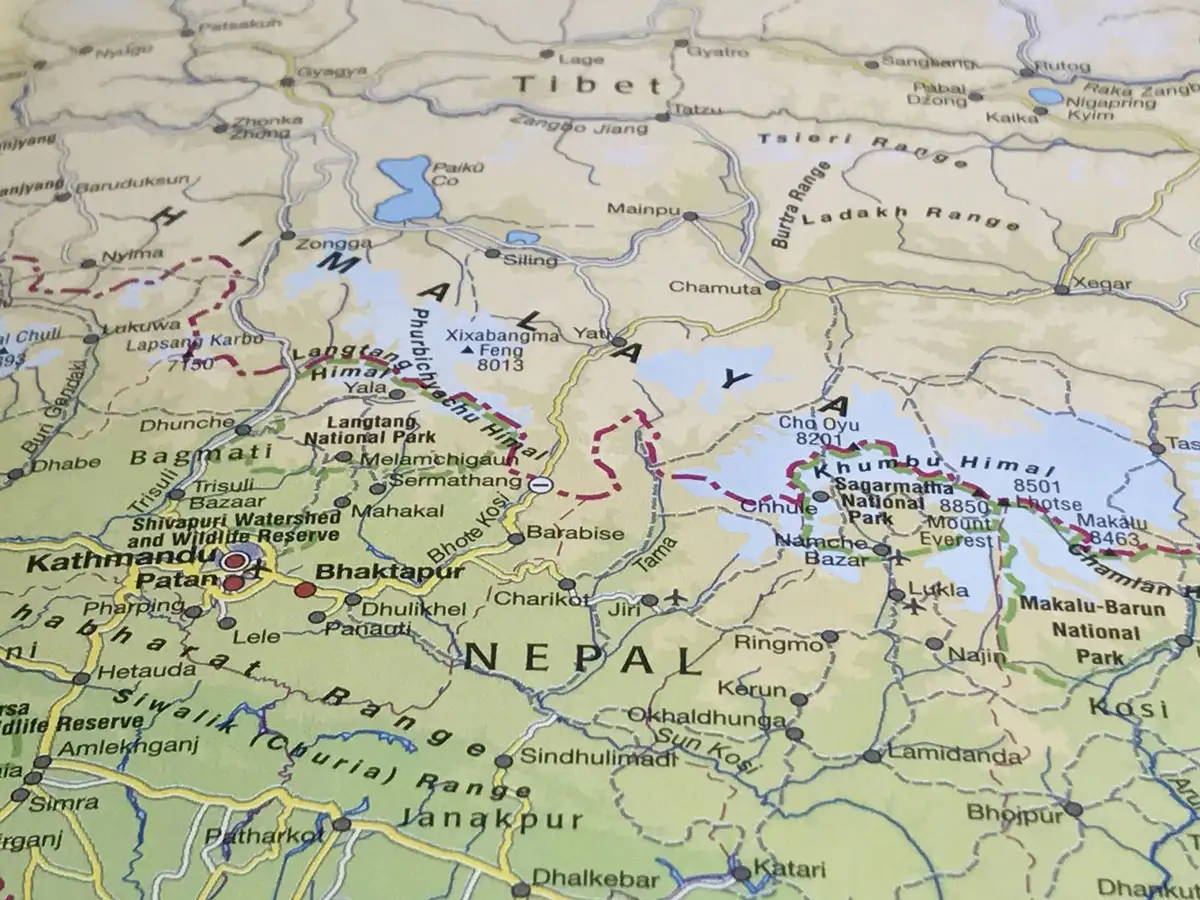
Nepal is reached by air through Tribhuvan International Airport (KTM) in Kathmandu, Nepal’s only major international gateway, or overland from India via land border crossings such as Sunauli, Raxaul–Birgunj, or Kakarbhitta. Travelers from China/Tibet can enter through the Rasuwagadhi–Kerung border, though this route is normally used only as part of an organized Tibet tour. Most nationalities receive a visa on arrival (USD 30–125, depending on duration), while Indian citizens need no visa at all.
Nepal doesn’t have a single simple “front door.” Depending on where you’re flying from, whether you’re coming from India, and what kind of trip you’re planning — trekking, pilgrimage, safari, or luxury culture tour — your ideal entry point changes. Booking a flight without understanding the visa rules, or planning an overland trip from India without knowing which border matches your route, is one of the most common (and avoidable) mistakes first-time visitors make. Getting this right saves you a day of your itinerary and, at busier border posts, a genuinely stressful few hours.
| Entry Point | Best For | Typical Travelers | Visa on Arrival? |
|---|---|---|---|
| Tribhuvan International Airport (Kathmandu) | Long-haul international travelers | Trekkers, families, luxury travelers, solo travelers | Yes |
| Sunauli–Bhairahawa (India border) | Budget overlanders from UP/Delhi, Lumbini-bound pilgrims | Backpackers, spiritual travelers | Yes |
| Raxaul–Birgunj (India border) | Travelers from Bihar/Patna | Overlanders, traders, budget travelers | Yes |
| Kakarbhitta–Panitanki (India border) | Travelers from Darjeeling/Siliguri/Northeast India | Overlanders heading to eastern Nepal | Yes |
| Banbasa–Mahendranagar (India border) | Travelers from Uttarakhand/Delhi via the west | Wildlife travelers (Bardiya National Park) | Yes |
| Rasuwagadhi–Kerung (China/Tibet border) | Kailash Mansarovar pilgrims, Tibet overland tours | Organized pilgrimage and overland groups | No (China group visa required) |
Short answer: Fly into Tribhuvan International Airport (KTM) in Kathmandu — Nepal’s only international airport capable of handling wide-body long-haul aircraft. There are no scheduled nonstop flights from the United States, Canada, mainland Western Europe, or Australia; nearly everyone connects through a hub city.
Tribhuvan International Airport sits in the Kathmandu Valley and functions as Nepal’s primary gateway, connecting the country to roughly 40 international destinations across the Middle East, South Asia, East Asia, and Southeast Asia. It’s home base for Nepal Airlines and Himalaya Airlines, and it’s also the jumping-off point most travelers use before flying onward to Lukla for Everest region treks.
The airport has two separate terminals:
Pro tip: If you’re connecting straight from an international flight to a domestic one (for example, flying onward to Lukla for Everest Base Camp), build in at least a half-day buffer. TIA’s congestion, especially in peak trekking season (October–November and March–May), regularly causes delays, and domestic flights to mountain airstrips are also weather-dependent.
There’s no single carrier that connects Kathmandu directly to North America or most of Europe. Instead, the route network is built around regional and Middle Eastern hubs:
| Region | Hub City | Airline(s) | Notes |
|---|---|---|---|
| Middle East | Doha | Qatar Airways | Best onward connectivity to Europe/North America |
| Middle East | Dubai | flydubai, Himalaya Airlines, Air Arabia | Multiple daily options, budget-friendly via flydubai |
| Middle East | Abu Dhabi | Air Arabia Abu Dhabi | Good value connections |
| Middle East | Kuwait | Kuwait Airways, Jazeera Airways | |
| Europe (direct) | Istanbul | Turkish Airlines | The only true long-haul nonstop into Kathmandu, roughly 8 hours from Istanbul |
| South Asia | Delhi, Mumbai, Bengaluru, Kolkata | Air India, Air India Express, IndiGo | Fastest, cheapest route for travelers already in India |
| Southeast Asia | Bangkok | Thai Airways, Thai AirAsia, Thai Lion Air | Popular Southeast Asia stopover |
| Southeast Asia | Kuala Lumpur | Malaysia Airlines, Batik Air, Himalaya Airlines | |
| Southeast Asia | Singapore | Singapore Airlines | Premium long-haul connection |
| East Asia | Hong Kong | Cathay Pacific, Nepal Airlines | |
| East Asia | Seoul | Korean Air | 4x weekly, popular with Korean trekkers |
| China | Chengdu, Kunming, Guangzhou, Lhasa, Shenzhen | Air China, China Eastern, China Southern, Sichuan Airlines, Himalaya Airlines | Lhasa route relevant for onward Tibet travel |
| South Asia (regional) | Dhaka, Colombo | Biman, Himalaya Airlines, SriLankan Airlines | |
| Himalaya | Paro (Bhutan) | Bhutan Airlines, Druk Air | Only route connecting Nepal and Bhutan directly |
What this means practically:
Short answer: Most nationalities can get a visa on arrival at Kathmandu airport or major land borders for USD 30 (15 days), USD 50 (30 days), or USD 125 (90 days). Indian citizens don’t need a visa at all. A short list of countries must apply through a Nepalese embassy in advance.
| Duration | Fee (USD) | Best For |
|---|---|---|
| 15 days | $30 | Short cultural trips, quick Everest/Annapurna viewpoint treks |
| 30 days | $50 | Standard treks (EBC, Annapurna Circuit), most first-time visitors |
| 90 days | $125 | Long treks, volunteering, extended cultural travel, digital nomads |
Children under 10 receive a free visa regardless of nationality. SAARC nationals (Bangladesh, Bhutan, Maldives, Pakistan, Sri Lanka) get a free 30-day visa once per calendar year. Chinese nationals currently receive a fee-free tourist visa. Indian citizens are exempt entirely under the 1950 Indo-Nepal Treaty, though air travel still requires a valid passport or Election Commission voter ID — an Aadhaar card alone is not accepted for flights.
Nationalities that cannot get a visa on arrival and must apply through a Nepalese embassy before travel include Nigeria, Ghana, Zimbabwe, Cameroon, Ethiopia, Liberia, Somalia, Eswatini (Swaziland), Afghanistan, Iraq, Syria, and Palestine. This list is set by Nepal’s Department of Immigration and can change, so confirm directly with your nearest Nepalese diplomatic mission if you hold one of these passports.
Important note: Passports must have at least 6 months of validity remaining from your date of entry, and you’ll need a passport-sized photo (carry a physical copy as backup even if you upload one digitally).
Tourist visas can be extended up to a combined maximum of 150 days per calendar year. Extensions cost $45 for a minimum 15 days, plus $3 per additional day, and must be arranged at the Department of Immigration office in Kathmandu or the immigration office in Pokhara before your current visa expires. Overstaying carries a fine of roughly $5 per day on top of the extension fee, and repeated or serious overstays can result in detention or a re-entry ban — so treat your expiry date as a hard deadline, not a suggestion.
Short answer: Indian nationals can cross into Nepal at any open land border with just a passport or voter ID — no visa required. Foreign nationals of other countries can also get a visa on arrival at the same crossings, though queues and facilities vary considerably by border post.
Nepal and India share an open border with several official crossing points. Four are commonly used by tourists:
The most popular tourist crossing, reached via Gorakhpur in Uttar Pradesh. It’s the fastest route from Delhi, Varanasi, or Lucknow, and it sits close to Lumbini, the birthplace of the Buddha — a natural first stop for pilgrims and cultural travelers. Expect a chaotic scene of touts and money changers right at the crossing; walk directly to the immigration building and ignore unsolicited “help.” Direct tourist buses to Kathmandu and Pokhara depart from Bhairahawa in the early morning (roughly 7–8 AM); missing this window often means a longer wait or a less comfortable local bus.
Known as the “Gateway of Nepal” because of the volume of freight traffic, this crossing works best for travelers coming from Patna, Bodh Gaya, or elsewhere in Bihar. It’s generally considered the easiest and least touristy of the major crossings, with straightforward immigration formalities on both sides.
Immigration hours for foreign nationals at Raxaul–Birgunj typically run 6:00 AM–7:00 PM; Indian citizens can generally cross outside these hours, but with more limited services.
This eastern crossing connects Siliguri and Darjeeling in West Bengal with eastern Nepal. It’s the natural choice for travelers combining a Darjeeling/Sikkim trip with Nepal, or heading toward Ilam’s tea gardens and eastern hill stations.
Note for foreign (non-Indian) travelers: This crossing has had periods of restricted access for non-Indian, non-Nepali nationals in the recent past due to local administrative issues. It’s currently reported open, but if you’re not an Indian or Nepali citizen, confirm the crossing’s current status with a local operator or the nearest Nepalese consulate before building your itinerary around it.
The westernmost crossing, best reached from Bareilly, Rudrapur, or Haldwani in Uttarakhand. It’s the quietest of the four main crossings and the natural route if you’re planning to visit Bardiya National Park, one of Nepal’s best (and least crowded) wildlife destinations, on the way to Kathmandu or Pokhara.
Short answer: The only currently open international crossing between Nepal and China for foreign travelers is Rasuwagadhi (Nepal) – Kerung/Gyirong (Tibet). This route is used almost exclusively by organized Kailash Mansarovar pilgrimage groups and Tibet overland tours — it is not a casual walk-in border crossing like the India posts.
The older Kodari–Zhangmu crossing on the Araniko Highway has remained closed to foreign travelers since it was badly damaged in the 2015 earthquake. Rasuwagadhi–Kerung became the primary route instead, opening to international travelers in 2017, and briefly closed again in mid-2025 after a glacial flood damaged the Friendship Bridge — a temporary Bailey bridge restored full operations in January 2026.
What makes this route different:
If your goal is Kailash Mansarovar or an overland Tibet extension after your Nepal trip, plan this as a distinct, professionally guided leg of your journey rather than a casual border hop — and book your Nepal-side visa and Tibet group visa paperwork through the same operator to avoid mismatched documentation.
Short answer: From Kathmandu, most tourists use prepaid airport taxis, hire a private car with driver, or book a domestic flight onward to Pokhara, Lukla, or Chitwan. From land borders, tourist buses and shared jeeps connect directly to Kathmandu and Pokhara.
Short answer: October–November (autumn) and March–May (spring) are Nepal’s best seasons — clear skies, comfortable temperatures, and the most reliable trekking and flight conditions. Monsoon (June–September) and winter (December–February) each have narrower use cases.
| Season | Months | Good For | Watch Out For |
|---|---|---|---|
| Autumn (peak) | Oct–Nov | Trekking (EBC, Annapurna), mountain flights, festivals (Dashain, Tihar) | Highest prices, crowded trails and flights |
| Spring | Mar–May | Trekking, rhododendron blooms, Lhotse/Everest views | Occasional haze in lower valleys |
| Winter | Dec–Feb | Kathmandu Valley sightseeing, Chitwan safaris, Lumbini, budget travel | High passes and remote treks may close; cold at altitude |
| Monsoon | Jun–Sep | Upper Mustang, Dolpo (rain-shadow regions), lush landscapes, fewer crowds | Landslides on mountain roads, leeches on lower trails, flight delays |
| Route/Item | Approx. Cost | Approx. Time |
|---|---|---|
| Long-haul flight (US/Europe → Kathmandu, via hub) | $700–$1,600 round trip (economy) | 18–26 hours total |
| Flight from Delhi/Mumbai → Kathmandu | $80–$200 one way | 1.5–2 hours |
| 30-day visa on arrival | $50 | 15–30 minutes at counter (faster with online pre-registration) |
| Sunauli to Kathmandu (tourist bus) | ₹800–1,200 (~$10–15) | 8–10 hours |
| Raxaul to Kathmandu (bus) | Similar range | 6–8 hours |
| Kakarbhitta to Kathmandu (bus) | Similar range | 12–16 hours |
| Kathmandu–Pokhara domestic flight | $90–$130 one way | 25 minutes |
| Kathmandu–Pokhara tourist bus | $8–$15 | 6–7 hours |
| Prepaid airport taxi (Kathmandu) | NPR 700–1,000 (~$5–8) | 20–40 minutes to Thamel |
Flying in from abroad: Day 1 — Land at TIA, clear visa/immigration (allow 45–90 minutes in peak season), prepaid taxi to Thamel, rest and acclimatize, evening walk through Thamel’s markets and a first dal bhat dinner.
Overlanding from India via Sunauli: Day 1 — Cross the border early morning, catch the direct 7–8 AM tourist bus, arrive Kathmandu by early evening; alternatively, break the journey with a night in Lumbini before continuing.
Overlanding from India via Raxaul: Day 1 — Cross at Birgunj, take a shared jeep or tourist bus, arrive Kathmandu or Pokhara same evening given the shorter road time.
Whether you’re flying in for a two-week trek, driving up from India for a family holiday, or arranging a Kailash Mansarovar pilgrimage through Tibet, getting the entry logistics right from day one sets the tone for the whole trip. A local Nepal-based travel operator can confirm current visa rules for your specific nationality, book your domestic connections, and build an itinerary around the entry route that actually fits your plans — worth a quick conversation before you book that first flight.