If you’ve heard whispers about a temple in a dark southern gorge where goats and roosters are offered to a fierce black goddess, you’ve heard about Dakshinkali. This Dakshinkali temple travel guide covers everything a first-time visitor actually needs: exact location and history, the best day to witness rituals, dress code and etiquette, whether non-Hindus can enter the inner sanctum, and every practical transport option from Thamel, Balkhu, or Ratna Park, right down to fares and road conditions.
Dakshinkali is not a polished tourist attraction. It is a living shrine where ancient Shakti worship happens exactly as it has for centuries, in the open air, in front of anyone who cares to watch respectfully. That rawness is precisely why it belongs on any serious Kathmandu itinerary, alongside Pharping’s Buddhist caves, Chobhar Gorge, Taudaha Lake, and Shesh Narayan Temple, all reachable on the same southern valley road.
Quick Facts: Dakshinkali Temple
| Detail | Information |
|---|---|
| Deity | Goddess Kali (Dakshina Kali, the “southern” form of Kali/Parvati) |
| Location | Southern edge of Kathmandu Valley, near Pharping village |
| Distance from Kathmandu | Approximately 20 to 22 km from Ratna Park / Thamel |
| Drive time | 45 minutes to 1.5 hours depending on traffic and season |
| Built | Popularly dated to the reign of Malla-era King Pratap Malla (17th century), though some local accounts place the shrine’s founding earlier |
| Best worship days | Tuesday and Saturday |
| Biggest festival | Dashain (especially the eighth and ninth days, Maha Ashtami and Nawami) |
| Entry fee | Free for the outer temple grounds (small parking/camera charges may apply) |
| Non-Hindu access | Allowed in the outer courtyard and lower “daughter” shrine; the innermost sanctum and sacrificial area are reserved for Hindu worshippers |
| Ideal duration | 1.5 to 2 hours at the temple, or a full day combined with Pharping and Chobhar |
| Nearby highlights | Pharping’s Asura and Yangleshö caves, Shesh Narayan Temple, Taudaha Lake, Chobhar Gorge |
Dakshinkali answers a question most travel guides gloss over: what does living Tantric-Shakti worship actually look like in the twenty-first century? Nowhere else in the Kathmandu Valley will you see the ritual of animal sacrifice performed so openly, with such quiet devotion, and with so little theatre for tourists. For travelers interested in comparative religion, anthropology, or simply the raw emotional pulse of Hindu Nepal, a morning here is unlike anything else on a typical Kathmandu sightseeing route.
It also happens to sit at the mouth of one of the valley’s richest micro-regions for day-tripping. Within a 20-minute radius you can walk through a Vajrayana Buddhist pilgrimage town founded on a cave where Guru Rinpoche is said to have reached enlightenment, stand at the gorge that Nepali legend credits with draining the ancient Kathmandu lake, and feed carp at a lake believed to be the home of a serpent king. Few single half-day trips from Kathmandu pack in this much genuine cultural range.
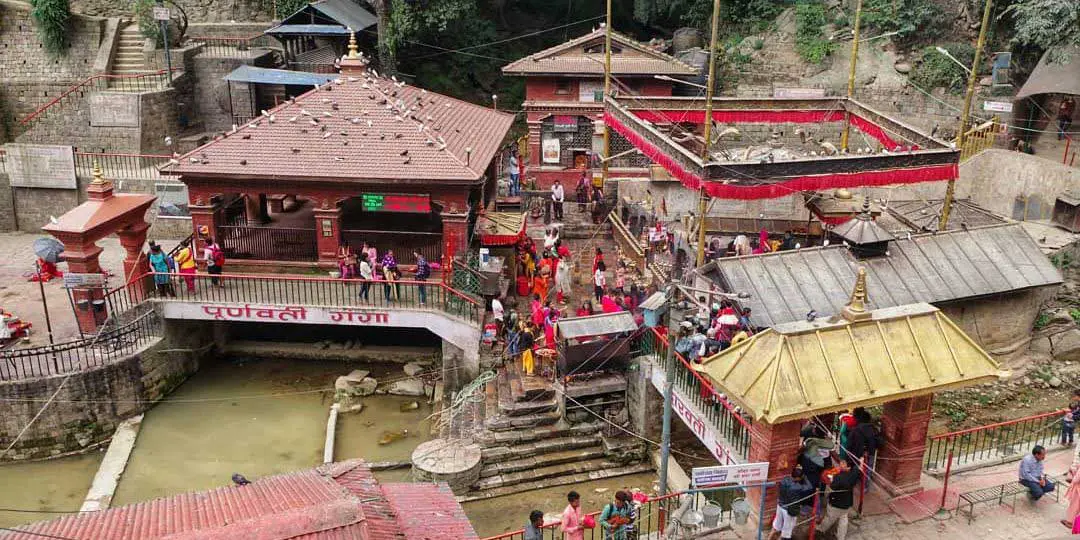
Dakshinkali temple sits at the meeting point of two small streams in a narrow, forested gorge on the southern rim of the Kathmandu Valley, roughly 20 to 22 kilometres from central Kathmandu near the Newar town of Pharping. The name itself explains the site: “Dakshin” means south, and “Kali” is the goddess enshrined here, so Dakshinkali translates simply to “Kali of the South,” one of several protective Kali shrines that traditionally ring the valley at its cardinal points.
The most widely repeated origin story credits the 17th-century Malla ruler King Pratap Malla. According to local tradition, the goddess appeared to the king in a dream and instructed him to build a shrine at the confluence of two sacred streams in the southern valley. Some regional sources instead trace the shrine’s founding to the 14th century, and a few local legends describe Kali appearing to villagers as a young girl who chose the gorge herself as her dwelling place. Both traditions agree on the essential symbolism: the goddess selected a wild, water-fed ravine, not a city square, as her home, and that choice of setting still defines the experience of visiting today.
The temple’s stone image shows Kali standing on a prone figure, a common Shakta iconographic motif representing the goddess’s triumph of consciousness over ignorance rather than literal violence. The idol carries four arms and is depicted with her right foot resting on Shiva’s chest, a form distinguished from the more fearsome Vamakali images that show the left foot forward. This detail matters to devotees and is worth knowing before you arrive, since it explains why the murti looks the way it does.
Dakshinkali is one of the last major Kathmandu Valley shrines where blood sacrifice remains a core, unhidden part of worship. Cockerels and uncastrated male goats are the traditional offerings, and sacrifice intensifies sharply during the Dashain festival. Devotees believe the offering, whether an animal or a symbolic substitute like a coconut or pumpkin for those who prefer not to sacrifice a living creature, appeases the goddess’s fierce nature and secures protection, prosperity, or the fulfilment of a specific wish (a new business, a difficult pregnancy, recovery from illness).
It is worth being honest with yourself before visiting: the sight and smell of the sacrificial courtyard on a busy Saturday is intense, and can be genuinely difficult for sensitive travelers, children, or anyone uncomfortable around blood. This is not something to hide from visitors, and a good local guide will always ask about your comfort level beforehand and can plan your visit around quieter hours or a symbolic-offering-only day.
Dashain is Nepal’s largest festival, and Dakshinkali becomes one of the busiest pilgrimage sites in the country during it. Thousands of devotees line up to make offerings and receive blessings during Dashain, bringing red hibiscus flowers, vermillion, and rice as part of their puja. The temple’s association with Kali makes it especially significant during the festival’s climactic days, when families across Nepal traditionally sacrifice animals at home or at a Shakti shrine to mark the goddess’s mythic victory over the buffalo demon Mahishasura. If you are in Nepal during Dashain (usually late September to early October) and want to witness Hindu festival culture at its most intense and authentic, Dakshinkali during this week is unmatched, but also extremely crowded, so plan for long queues and arrive at dawn.
Tuesday and Saturday are the two designated worship days at Dakshinkali, when priests are present and sacrificial rituals take place continuously through the morning. Hundreds of devotees, especially on these two days, come to make animal sacrifices to the goddess, so if witnessing an authentic ritual is your goal, plan your visit around one of these mornings rather than a quiet weekday.
Pro Tip: If you want the cultural experience without the more intense sacrificial scenes, visit on a Sunday, Monday, Wednesday, Thursday, or Friday morning. You’ll still see devotees, incense, bells, and the striking gorge setting, just without the queue of animals waiting their turn.
Non-Hindu visitors are welcome at Dakshinkali and can freely access the outer courtyard, viewing platforms, and the lower shrine area, but entry into the innermost sanctum where the sacred image sits and where the actual sacrifice is performed is generally reserved for Hindu devotees. This is standard practice at several of the valley’s most sacred Shakti and Vishnu shrines (Pashupatinath’s inner sanctum follows the same rule), and it is enforced respectfully rather than aggressively.
A useful local distinction, confirmed by Tibetan Buddhist pilgrimage sources familiar with the Pharping area, separates the site into two parts: a lower complex known locally as the “Dakshinkali Chorri,” where the wrathful blood-sacrifice worship happens and non-Hindu entry beyond the immediate perimeter is restricted, and an upper temple known as “Dakshinkali Mata,” where no blood sacrifice takes place and access is considerably more open. If your goal is simply to observe the atmosphere, take photographs (where permitted), and understand the ritual from a respectful distance, you will have no trouble as a non-Hindu visitor. If restricted, a guide can clarify exactly where the line is on the day you visit, since practice can vary slightly with festival crowding.
Note: Photography of the sacrifice itself is a sensitive subject. Always ask a local priest or your guide before photographing rituals up close, and never photograph grieving or praying devotees without permission.
Dressing and behaving appropriately at Dakshinkali matters more than at many tourist-oriented heritage sites, because this is an active place of worship for Hindu Nepalis, not a museum.
Dress Code Checklist
Etiquette Do’s and Don’ts
| Do | Don’t |
|---|---|
| Walk clockwise around shrines when circling them (pradakshina) | Point your feet toward the deity or another person while seated |
| Speak quietly and move calmly near the ritual area | Touch the sacred idol, offerings, or sacrificial implements |
| Ask before photographing priests, devotees, or the sacrifice | Photograph the sacrifice up close without asking first |
| Offer a small donation if you wish to support the temple’s upkeep | Wear leather belts or bags into the innermost courtyard |
| Follow your guide’s instructions on where non-Hindus may stand | Argue with temple staff about access restrictions |
| Wash hands/feet at the designated area if invited to do so | Bring outside meat, alcohol, or tobacco into the complex |
Pro Tip: Nepali Hindu families often travel in large multi-generational groups on ritual days. Give priority space to devotees actively performing puja rather than positioning yourself in their path for a photo.
Dakshinkali sits only about a kilometre from Pharping, a Newar hill town that is, in its own right, one of the most important Vajrayana Buddhist pilgrimage destinations in Nepal. Most well-planned itineraries treat Dakshinkali and Pharping as a single half-day or full-day circuit rather than two separate trips.
Two major meditation caves associated with Guru Rinpoche (Padmasambhava) sit on the hillside directly above Pharping: the upper Asura Cave and the lower Yangleshö Cave. Tibetan Buddhist tradition holds this pair of caves in the same regard that Indian Buddhists hold Bodhgaya. Guru Rinpoche is said to have practiced intensive meditation on the wrathful deity Yangdak Heruka here, and both he and his consort Shakyadevi are believed to have reached an advanced level of tantric realisation, known as mahamudra vidyadhara, at this site.
Practical tip: Remove your shoes before entering any cave shrine, and expect steep stone steps; wear proper walking shoes rather than sandals.
Shesh Narayan is a revered Vishnu shrine visible directly from the Dakshinkali highway, close to the lower Yangleshö cave, and it is commonly bundled into the same Pharping stop by day-tour operators. It is a good example of how closely Hindu and Buddhist sacred geography overlap in this part of the valley, both traditions revere sites within a few hundred metres of each other.
| Time | Stop | What to Expect |
|---|---|---|
| 8:30 AM | Depart Kathmandu (Thamel/Ratna Park) | Private car or taxi, roughly 45 minutes to Pharping |
| 9:30 AM | Kirtipur old town (optional add-on) | Newar architecture, Bagh Bhairab temple, hilltop valley views |
| 10:15 AM | Pharping: Asura & Yangleshö caves | Guided walk, prayer flags, monastery visit |
| 11:15 AM | Shesh Narayan Temple | Short stop, Vishnu shrine and pond |
| 11:45 AM | Drive to Dakshinkali (about 2 km) | Short scenic descent into the gorge |
| 12:00 PM | Dakshinkali Temple | 1 to 1.5 hours for temple, market stalls, and photography |
| 1:15 PM | Lunch | Local Newari or Nepali thali restaurant near Pharping/Dakshinkali |
| 2:00 PM | Taudaha Lake | Birdwatching, lakeside walk, 30-minute stop |
| 2:45 PM | Chobhar Gorge and Manjushree Park | Gorge viewpoint, Adinath temple, valley panorama |
| 4:00 PM | Return to Kathmandu | Roughly 30 to 45 minutes back to Thamel |
This pacing works well for most travelers, but slow it down if you have a spiritual guide leading meditation stops, or speed it up if you are combining it with an afternoon Kathmandu Durbar Square visit.
Chobhar sits between Kathmandu and Pharping and makes a natural final stop on the return leg from Dakshinkali. Local tradition holds that the Kathmandu Valley was once entirely a lake, and that the bodhisattva Manjushree cut a gorge through the surrounding hills at Chobhar to drain the water and make the land habitable. The legend describes Manjushree traveling from Wu-tai Shan in China after seeing a radiant lotus at the centre of the lake, and cutting the gorge with a sword of wisdom to reach it. Geologists note that the valley genuinely was a lake in the distant past, giving the myth an unusual grounding in real topography.
Today, Chobhar Gorge is the single point where the Bagmati River exits the Kathmandu Valley, and Manjushree Park, a small landscaped area beside the gorge, offers walking paths and viewpoints over the ravine, plus the nearby Adinath and Jal Binayak temples.
Taudaha, the largest natural lake remaining in the Kathmandu Valley, sits about 1.5 kilometres from Chobhar and roughly 12 kilometres from Dakshinkali. Local belief holds that the lake is home to Karkotak Nag, a serpent king appeased by Manjushree after the great drainage, and boating is prohibited out of respect for this belief. The lake attracts migratory birds in winter, making it a pleasant, easy stop for casual birdwatching, and there are lakeside restaurants for a relaxed break before heading back into the city.
Comparison: Which Nearby Sites Suit Which Traveler
| Site | Best For | Time Needed | Physical Effort |
|---|---|---|---|
| Dakshinkali Temple | Cultural/religious immersion, photography | 1 to 2 hours | Low (some stairs) |
| Asura & Yangleshö Caves | Buddhist pilgrims, meditation-curious travelers | 1 to 1.5 hours | Moderate (steep steps) |
| Shesh Narayan Temple | Quick cultural stop, Hindu-Buddhist overlap | 20 to 30 minutes | Low |
| Chobhar Gorge / Manjushree Park | Legend/mythology fans, valley views | 45 minutes to 1 hour | Low to moderate |
| Taudaha Lake | Birdwatchers, families, relaxation | 30 to 45 minutes | Very low |
Dakshinkali is about 20 to 22 kilometres south of central Kathmandu. A private taxi from Thamel takes roughly 45 minutes to just over an hour and typically costs between NPR 2,500 and NPR 4,000 one-way (more for a return trip with waiting time), while a local bus from Ratna Park or Balkhu costs a fraction of that but takes considerably longer.
This is the most comfortable and time-efficient option, especially if you’re combining Dakshinkali with Pharping, Chobhar, and Taudaha in a single day.
The Kathmandu-Pharping-Dakshinkali road is paved for its full length and passes through the southern Ring Road, Balkhu, Chalnakhel, and Pharping before descending into the temple’s gorge. Road conditions are generally good by Nepali standards, but expect:
Yes, both Pathao and InDrive operate car and bike bookings to Dakshinkali from within Kathmandu, and they’re a practical middle-ground option between a hotel-arranged taxi and a local bus.
Transport Comparison Table
| Option | Approx. Cost (one-way) | Duration | Comfort | Best For |
|---|---|---|---|---|
| Private taxi from Thamel | NPR 2,500 to 4,000 | 45 to 70 minutes | High | Multi-stop day trips, families, comfort-focused travelers |
| Local bus (Ratna Park/Balkhu) | Under NPR 150 | 1.5 to 2+ hours | Basic | Budget travelers, solo backpackers |
| Pathao/InDrive | Similar to taxi, sometimes lower | 45 to 70 minutes | Moderate to high | Solo/couple travelers wanting app-based convenience |
| Organized day tour (guide + vehicle) | Bundled into package price | Full day (6 to 8 hrs) | High | First-time visitors, non-Hindi/Nepali speakers, those wanting full context and access guidance |
The best overall time to visit Dakshinkali is during Nepal’s dry seasons, autumn (late September to November) and spring (March to May), when skies are clear and the gorge’s forest is at its most pleasant. For witnessing active rituals specifically, Tuesday and Saturday mornings are best, and Dashain (usually late September/early October) is the most culturally significant, if most crowded, time of year.
| Season | Months | Conditions | Recommendation |
|---|---|---|---|
| Autumn | September to November | Clear skies, comfortable temperatures, festival season | Best overall time; book ahead around Dashain |
| Winter | December to February | Cool mornings, mist in the gorge, generally dry | Good for quieter visits, dress warmly |
| Spring | March to May | Warm, occasionally hazy, good for photography | Excellent, especially for combining with Pharping hikes |
| Monsoon | June to September | Heavy rain, humid, slippery stone steps | Visit is still possible but requires caution (see safety notes below) |
Visiting Dakshinkali during monsoon season is entirely possible, plenty of devotees still make the trip, but it requires some extra care given the gorge’s stream-fed terrain.
Most international travelers base themselves in Kathmandu (Thamel, Boudha, or Patan) and visit Dakshinkali as a day trip, since the drive is short. However, Pharping itself has a small but genuine range of accommodation for travelers who want to stay overnight, particularly those attending a Buddhist retreat or wanting an early start for temple rituals.
Some Pharping monasteries themselves, such as the one at Asura Cave, offer basic retreat accommodation, though rooms are limited and advance booking is genuinely necessary. Additional retreat-style rooms are available at guesthouses associated with nearby monasteries, and several standard hotels along Pharping’s main road accept short-notice bookings for travelers who prefer simplicity over spiritual retreat.
Given the short 45-to-70-minute drive, most travelers, especially families, luxury travelers, and anyone on a broader multi-day Kathmandu itinerary, simply base themselves in Thamel, Patan, or Boudha and treat Dakshinkali as a half-day excursion. This keeps you close to the city’s restaurants, shopping, and other heritage sites for the remainder of the day.
Pro Tip: If you want to witness the pre-dawn preparation and early rituals on a Tuesday or Saturday, an overnight stay in Pharping (rather than a same-morning drive from Kathmandu) is the only way to be there before the first devotees arrive.
Don’t expect banking infrastructure at the temple itself. Basic traveler facilities exist, but you should plan ahead:
The Pharping-Chobhar corridor is genuine Newar farming country, and several unpretentious local restaurants along the route serve authentic regional food, a nice contrast to Thamel’s more international menus.
| Expense | Estimated Cost (per person, USD equivalent) |
|---|---|
| Private taxi (round trip, Thamel to Dakshinkali) | $18 to $35 (shared among group) |
| Local bus (one-way) | Under $1.50 |
| Guided day tour (Dakshinkali + Pharping + Chobhar + Taudaha) | $35 to $70, depending on group size and inclusions |
| Lunch (local restaurant) | $3 to $8 |
| Temple donation / offering flowers, incense | $1 to $5 |
| Parking fee (if self-driving) | Under $1 |
| Overnight retreat/guesthouse stay in Pharping | $10 to $30 |
Realistic total for a well-organized half-day guided visit: roughly $40 to $80 per person, all-inclusive, when booked through a local operator with a private vehicle, guide, and lunch stop, less if traveling independently by local bus and self-guiding.
| Traveler Type | Suitability | Notes |
|---|---|---|
| Cultural/spiritual travelers | Excellent | Among the most authentic living-ritual experiences near Kathmandu |
| Photographers | Excellent | Striking gorge setting, but plan around light and etiquette |
| Families with young children | Good, with preparation | Explain the ritual context beforehand; consider a non-ritual weekday visit |
| Solo travelers | Excellent | Straightforward to combine with Pharping via bus or shared taxi |
| Luxury travelers | Good | Best experienced via a private guided vehicle combined with Pharping/Chobhar |
| Sensitive to graphic content | Visit with caution | Consider a weekday visit and skip the inner sacrificial courtyard |
| Trekkers/adventure travelers | Good add-on | Pairs naturally with a short Pharping hillside hike |
| Senior travelers | Good, moderate effort | Stone steps present; a slower pace and walking stick help |
Nepal Tour Package Pvt. Ltd. designs Dakshinkali visits as part of flexible, fully customized Kathmandu Valley itineraries, ideal whether you want a focused half-day cultural excursion or a full immersion into the valley’s southern sacred sites.
If you’d like a private guide, a comfortable vehicle, and an itinerary paced around your interests, whether that’s photography, Buddhist pilgrimage, or simply witnessing an authentic Nepali ritual, our Kathmandu-based travel planning team can put together a custom day plan built around Dakshinkali, Pharping, Chobhar, and Taudaha. Reach out and we’ll tailor the timing, transport, and pace to exactly what you’re looking for.
Dakshinkali temple rewards travelers willing to step slightly outside Kathmandu’s standard heritage circuit. In a single gorge, you get centuries-old Shakti worship still practiced exactly as tradition dictates, a genuinely dramatic natural setting, and an easy gateway into Pharping’s Buddhist caves, Chobhar’s mythic gorge, and Taudaha’s quiet lake, all within an hour of Thamel. Whether you come on a ritual Tuesday morning to witness the full intensity of Kali worship, or on a calmer weekday to simply absorb the atmosphere and continue on to Pharping’s monasteries, this Dakshinkali temple travel guide should give you everything you need: the history, the etiquette, the transport options, and the honest heads-up about what to expect.
If you’d rather not plan the logistics yourself, from taxi fares to festival-day crowd timing, our Kathmandu-based team at Nepal Tour Package can build a private, guided day trip around Dakshinkali, Pharping, and the surrounding valley sites, paced to exactly what you want to see. Get in touch, and we’ll help you plan a visit that respects the temple’s living traditions while giving you the cultural depth this remarkable place deserves.
📞 +977 9841620757 (Available on WhatsApp, Viber, WeChat, RedNote)
✉️ info@nepaltourpackage.com / nepaltourpackage@outlook.com
📍 Kathmandu, Nepal