If you have an afternoon, a day, or even just a strong pair of legs and a curious mind, Namo Buddha deserves a place on your Nepal itinerary. Perched on a forested ridge in Kavrepalanchok district, about 40 kilometers southeast of Kathmandu, this hilltop is one of the most sacred Buddhist pilgrimage sites in the country, and one of the most rewarding half day trips from the capital. This namo buddha monastery travel guide walks you through the legend that gives the place its name, the working monastery of Thrangu Tashi Yangtse that now crowns the hill, and every practical detail you need: how to get there, where to stay, what it costs, when to go, and how to behave once you arrive.
Unlike Boudhanath or Swayambhunath, Namo Buddha is not a crowded tourist checkpoint. It is a living monastic community of over 250 monks, a school for young novices, a medical clinic, and a meditation retreat, all built around a story of extraordinary compassion that Buddhists have been walking uphill to honor for centuries.
Namo Buddha (Thrangu Tashi Yangtse Monastery) is a Tibetan Buddhist pilgrimage site in Kavrepalanchok district, about 40 to 45 km and a 1.5 to 2 hour drive southeast of Kathmandu. It marks the legendary spot where Prince Mahasattva sacrificed his body to feed a starving tigress and her cubs. Entry to the monastery grounds is free, and the site is best combined with a hike from Dhulikhel or Panauti.
| Intent Type | What Travelers Want |
|---|---|
| Informational | The history of Prince Mahasattva and the tigress, the meaning of Namo Buddha, monastery background |
| Travel Planning | How to reach the site, hiking routes, best season, entry rules |
| Commercial | Day tours, guided hikes, package pricing, guesthouse and resort bookings |
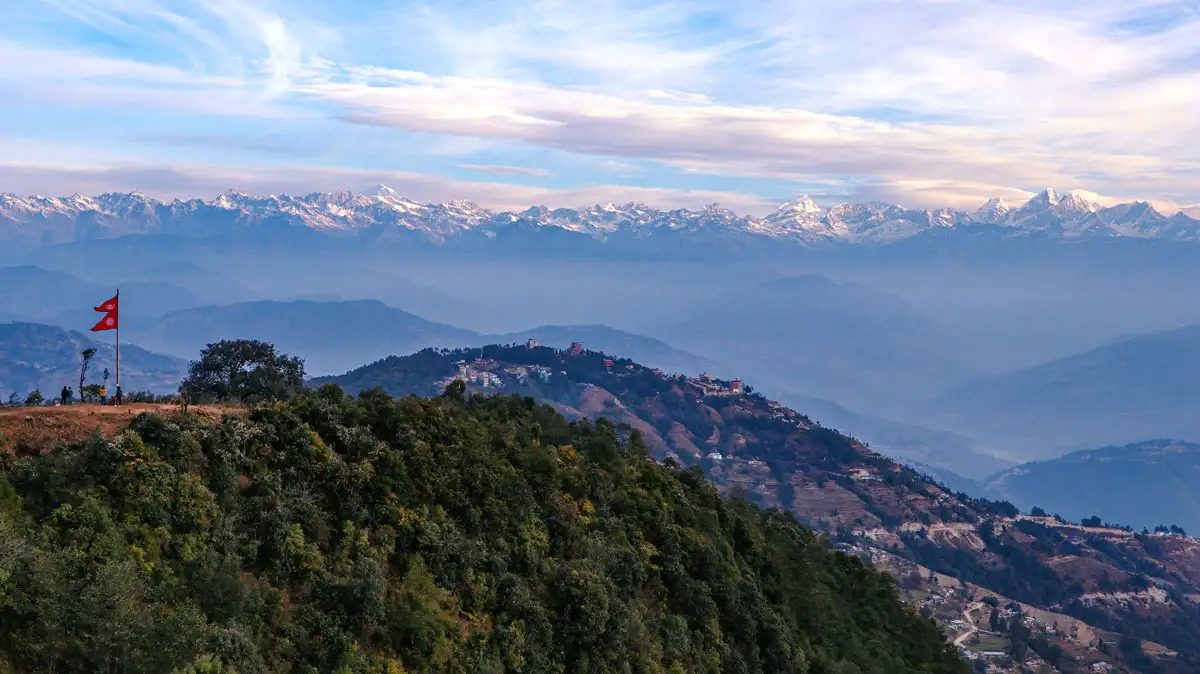
Namo Buddha rewards visitors on three levels at once. Spiritually, it is one of the holiest Jataka sites in the Himalayan Buddhist world, a place where devotees perform kora (ritual circumambulation) and light butter lamps in memory of an act of total selflessness. Scenically, the ridge delivers one of the finest low altitude Himalayan panoramas near Kathmandu, with Langtang, Ganesh Himal, and on the clearest days a distant sliver of Everest visible from the viewpoint above the monastery. Culturally, Thrangu Tashi Yangtse is a functioning monastic college where you can sit quietly at the back of the hall and listen to young monks chant their morning prayers, an experience that feels far more intimate than the busier stupas of the Kathmandu Valley.
It is also refreshingly uncrowded. Most day trippers from Kathmandu visit Boudhanath, Pashupatinath, and Swayambhunath, then head home. Namo Buddha requires a bit more effort, which is exactly why it still feels genuine.
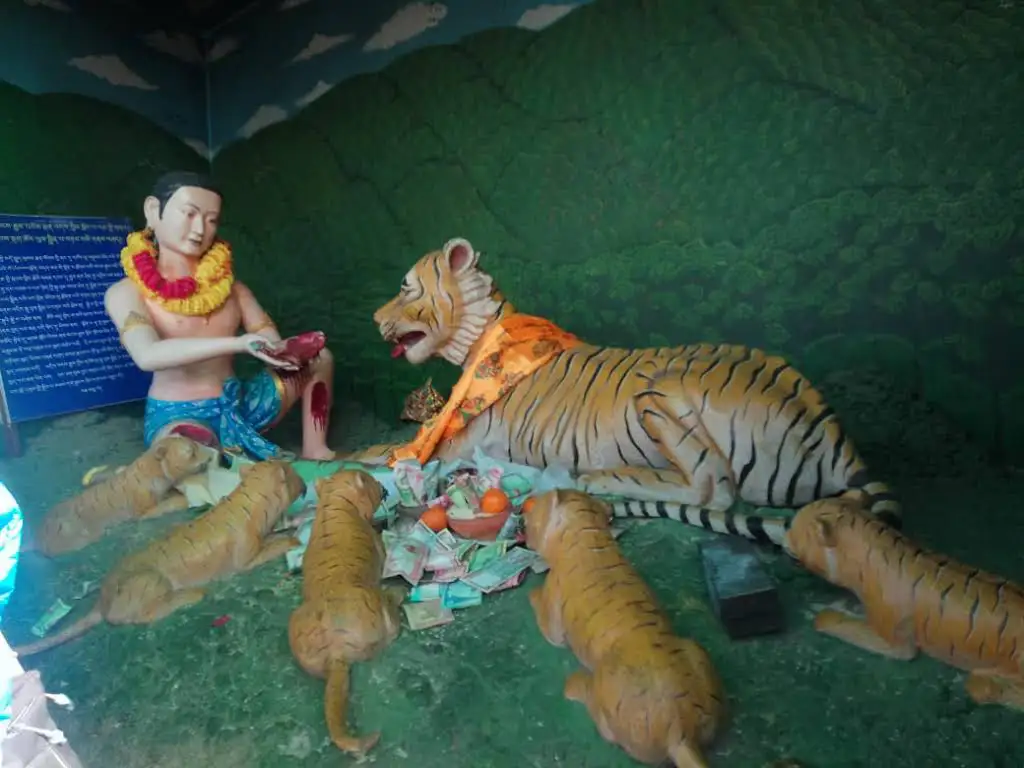
According to the Jataka tales, Prince Mahasattva, the youngest of three royal brothers, encountered a starving tigress in the forest who was too weak to hunt and was about to eat her own newborn cubs. Moved by compassion, the prince offered his own body so the tigress could survive and feed her cubs. Buddhists regard this as one of the Buddha’s previous lives, and the hill where it happened became known as Namo Buddha, meaning “homage to the Buddha.”
The full story, as it has been retold across Tibetan and Newar Buddhist tradition, goes roughly like this. Three princes, sons of a king, were walking through a forest near present day Kavre when they came upon a tigress lying exhausted beside her cubs. She had recently given birth and had gone days without food, and was on the verge of turning on her own young out of desperation. The two older brothers walked on, but the youngest, Mahasattva, was overwhelmed with compassion. Unable to find another way to help her in time, he offered his own body as food, allowing the starving tigress and her cubs to survive.
Buddhist tradition identifies this act of extreme generosity, known as dana paramita, as one of the Buddha’s own past lives, a demonstration of the boundless compassion that would eventually lead to enlightenment. The site of the sacrifice became a place of pilgrimage, and the name Namo Buddha (sometimes written Namobuddha) roughly translates as “hail to the Buddha” or “homage to the Buddha,” a tribute to the prince’s selfless deed.
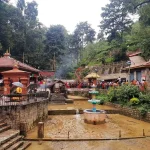
A small stone stupa and shrine mark the traditional location of the sacrifice on the lower part of the hill, separate from the main Thrangu Tashi Yangtse complex above it. Pilgrims circle this stupa clockwise, spin the prayer wheels set into its base, and leave offerings of butter lamps, khata scarves, and coins.
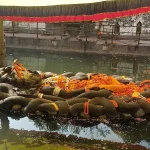
A short walk below the main monastery, at the older Namo Buddha stupa site, you will find a carved stone relief depicting the tigress with her cubs, along with the prince’s act of sacrifice. This is generally regarded as the more historic and atmospheric of the two Namo Buddha sites, since it marks the original pilgrimage spot rather than the newer monastic complex above. Look for strings of prayer flags, a cluster of smaller chortens, and elderly pilgrims doing rounds of prostration here, particularly in the early morning. It is a quieter, more contemplative stop than the busier main temple above, and most guided itineraries include both.
While the pilgrimage legend is ancient, the monastery that now dominates the ridge is a modern construction with deep roots in the Karma Kagyu lineage of Tibetan Buddhism. The Very Venerable 9th Khenchen Thrangu Rinpoche began building here in 1978, when the hill had no road access and no water supply. Over four decades, the complex grew into one of the most significant Tibetan Buddhist institutions in Nepal, and the main temple was officially inaugurated on December 5, 2008.
Today, Thrangu Tashi Yangtse Monastery is home to more than 250 monks and includes a monastic college (shedra), a retreat center, the Shree Mangal Dvip Branch School for young monks, a Tibetan medical clinic offering free consultations to local communities, a large kitchen and dining hall, several dormitory buildings, a library and text depository, and multiple guesthouses for visiting pilgrims and travelers.
The main prayer hall at Thrangu Tashi Yangtse features 36 ornate pillars, each topped with a gilded bronze Buddha statue, and richly painted murals depicting Buddhist deities and teachings. Visitors are welcome to sit quietly at the back during prayer sessions, and the golden stupa outside the hall is a popular spot for photos of the surrounding Himalayan ridgeline.
Climbing the stairs from the parking and cafe area, you reach a series of courtyards before arriving at the main temple, a large, colorfully decorated hall with gleaming golden roof arches. Inside, thirty six pillars line the space, each crowned with a small gilded Buddha, and the walls are covered in detailed thangka style murals. Compared to the older stupa lower down the hill, this is a grander, more architecturally polished space, reflecting decades of ongoing construction and donor funding.
Outside the hall, a large white stupa and several smaller chortens sit within the monastery courtyard, often decorated with fresh prayer flags. This is the classic photo spot, with the monastery’s golden roofline in the foreground and layers of green hills and, on clear days, snow peaks in the distance.
Namo Buddha’s morning puja typically begins early, usually before 7 AM, and the monastery also holds an evening prayer session. Visitors can sit quietly at the back of the main hall to listen to the young monks chant. Sessions can be intense and loud with horns, drums, and cymbals, which some visitors find deeply moving and others find overwhelming.
If your schedule allows an overnight stay, witnessing the puja is the single most memorable part of a Namo Buddha visit. Long horns, hand drums, and cymbals accompany the chanting, and the energy inside the hall builds steadily as the ritual progresses. Because timings can shift around festivals, private pujas, or the monks’ academic schedule, it is worth checking with the monastery office or your guide the evening before to confirm the next morning’s start time.
Pro Tip: Arrive ten to fifteen minutes early, sit toward the back or side of the hall so you do not block monks moving through the space, and keep phones silent. Photography during active prayer sessions is generally discouraged out of respect; ask a monk or your guide before taking any photos inside.
| Attraction | What to Expect | Time Needed |
|---|---|---|
| Thrangu Tashi Yangtse Main Temple | 36 pillar prayer hall, gilded Buddhas, murals | 30 to 45 minutes |
| Old Namo Buddha Stupa and Stone Carving | Original pilgrimage site, tigress relief carving | 20 to 30 minutes |
| Namo Buddha Viewpoint / Ridge | Himalayan panorama, sunrise and sunset views | 30 to 60 minutes |
| Monastic School and Medical Clinic | Glimpse of young monks’ daily education (exterior view only) | 10 to 15 minutes |
| Monastery Cafe | Vegetarian meals, butter tea, momos with a view | 30 to 60 minutes |
The best mountain views from Namo Buddha are from the ridge just above and behind the main monastery, ideally at sunrise or in the clear light of late autumn and winter (October to February). On a good day you can see Langtang, Ganesh Himal, Gaurishankar, and other peaks along the northern skyline.
Because Namo Buddha sits at roughly 1,750 meters, well above the Kathmandu Valley floor, the ridge offers an unusually open, uninterrupted view of the Himalayan range for a site so close to the capital. Photographers should aim for early morning, before the valley haze builds up later in the day, and the post monsoon and winter months generally offer the clearest skies. Bring a zoom lens if you have one, since the peaks sit at a distance, and a wide angle lens works well for the monastery’s golden roofline against the hills.
Namo Buddha is roughly 40 to 45 km from Kathmandu and takes about 1.5 to 2 hours by private car via Banepa and Dhulikhel. Travelers can also take a public bus to Dhulikhel or Banepa and continue by local transport or on foot, or hike in from Dhulikhel or Panauti as part of a scenic day trip.
A private taxi or car from Kathmandu to Namo Buddha typically travels via the Araniko Highway through Banepa and Dhulikhel before turning off onto the Kavre Bhanjyang access road. Fares vary depending on the vehicle type, season, and whether it is a one way transfer or a return trip with waiting time, so it is best to confirm the current rate with your hotel, a licensed taxi counter, or your tour operator before departure. As a general guide, a private one way transfer runs a moderate fixed fare, while a return trip with several hours of waiting time at the monastery costs more. Booking through a registered Nepal-based operator, such as Nepal Tour Package, is generally more reliable than street hailed taxis for this route, since drivers familiar with the area know the correct turn off points and parking areas.
Budget travelers can take a local bus from Ratna Park or the Bagh Bazaar bus park in Kathmandu toward Banepa or Dhulikhel, then switch to a local minivan, shared jeep, or short taxi ride for the final stretch up to Namo Buddha, since public transport does not run all the way to the monastery gate.
Buses heading along the Araniko Highway toward Bhaktapur, Banepa, and Dhulikhel depart regularly from the Ratna Park area and from Bhaktapur’s bus stands. From Banepa or Dhulikhel, look for local minivans or shared jeeps heading toward Namo Buddha or Kavre Bhanjyang; frequency drops in the afternoon, so it is safer to start this route early in the day. This option takes considerably longer than a private vehicle and requires some flexibility, but it is significantly cheaper and gives a more authentic look at the small towns along the way.
The final approach road climbs steadily through terraced farmland and pine forest before reaching the parking area near Kavre Bhanjyang, just below the monastery. The road is paved for most of the route but narrows and has some rougher patches closer to the top, particularly after heavy monsoon rain, so a sturdy car or a driver experienced with hill roads is recommended during July and August. Parking near the monastery entrance is informal but generally sufficient outside of major festival days, when it can fill up quickly.
Namo Buddha is one of the most popular short hikes near Kathmandu, largely because it can be combined into a single satisfying day with two other worthwhile stops: Dhulikhel and Panauti.
The hike from Dhulikhel to Namo Buddha covers roughly 8 to 10 km through farmland, pine forest, and small Tamang villages, and takes about 2.5 to 3 hours at a relaxed pace. The trail is considered easy to moderate and suitable for most fitness levels, including families with older children.
Starting from Dhulikhel (around 1,550 m), the trail descends briefly before climbing gradually toward Namo Buddha (1,750 m), passing terraced fields, scattered farmhouses, and forested ridgelines with regular Himalayan views opening up behind you. Trail markers exist in places but are not always reliable, so hiking with a local guide or a downloaded offline map (Maps.me or a GPX file from a trekking agency) is strongly recommended for first time visitors.
From Namo Buddha, hikers typically continue downhill to the historic Newar town of Panauti, a walk of around 2 to 2.5 hours covering roughly 8 to 10 km, passing through the villages of Sankhu or Balthali depending on the route chosen.
There are two commonly used descent routes from Namo Buddha to Panauti. The route via Sankhu is gentler and more direct, popular with first time hikers and families. The route via Balthali is longer, hillier, and passes through more remote terrain with deeper valley views, better suited to travelers who already have some hiking experience. Both trails eventually reach Panauti, a beautifully preserved Newar town at the confluence of the Roshi and Punyamati rivers, known for its cluster of centuries old temples.
Combined one day itinerary: Kathmandu to Dhulikhel (drive, about 1 hour) to Namo Buddha (hike, about 3 hours) to Panauti (hike, about 2 to 2.5 hours) to Kathmandu (drive, about 1.5 hours). Total distance covered on foot is roughly 18 to 20 km, and the full day, including sightseeing stops, generally takes 8 to 10 hours door to door.
| Route Segment | Distance | Walking Time | Difficulty |
|---|---|---|---|
| Dhulikhel to Namo Buddha | 8 to 10 km | 2.5 to 3 hours | Easy to Moderate |
| Namo Buddha to Panauti (via Sankhu) | 8 to 10 km | 2 to 2.5 hours | Easy |
| Namo Buddha to Panauti (via Balthali) | 10 to 12 km | 3 to 3.5 hours | Moderate |
| Panauti to Namo Buddha (reverse direction) | 8 to 10 km | 2 to 3 hours | Easy to Moderate |
Thrangu Tashi Yangtse Monastery operates its own guesthouses on the monastery grounds, offering simple, budget friendly rooms for pilgrims and travelers who want to experience monastic life, including access to morning and evening prayer sessions. Bookings can generally be arranged directly through the monastery office or via a local tour operator, and it is wise to reserve ahead during festival periods.
Staying inside the monastery compound is a rare opportunity to live briefly alongside a working Buddhist community. Rooms are simple, often shared or twin bedded, with basic bedding and shared bathroom facilities in some buildings. This is not a luxury experience, and travelers should set expectations accordingly, but the trade off is proximity: you can wake to the sound of the morning puja and walk downstairs to attend it without any transport at all.
Cost and Inclusions: Guesthouse rates at the monastery are modest compared to hotels in Kathmandu, generally covering a bed and access to the shared cafeteria for simple vegetarian meals, though exact current rates and availability are best confirmed directly with the monastery office or through your tour operator before arrival, since they can change seasonally.
For travelers who want mountain views with more comfort, Namo Buddha Resort, located near the ridge but independent of the monastery, is the best known upscale option in the area, offering private cottages and locally sourced vegetarian and non vegetarian dining with panoramic Himalayan views. Namo Buddha New Guesthouse offers a step up from the basic monastic dormitories while still keeping you close to the monastery routine. Dhulikhel, about an hour’s drive or a half day hike away, has a wider range of resorts and boutique hotels if you prefer to base yourself there and visit Namo Buddha on a day trip.
| Accommodation Type | Example | Best For | Price Level |
|---|---|---|---|
| Monastery Guesthouse | Thrangu Tashi Yangtse Guesthouse | Spiritual travelers, budget stays, attending puja | Budget |
| Mid Range Guesthouse | Namo Buddha New Guesthouse | Travelers wanting privacy near the monastery | Mid Range |
| Luxury Eco Resort | Namo Buddha Resort | Couples, luxury travelers, honeymooners | Premium |
| Hill Station Hotels | Dhulikhel resorts and boutique hotels | Families, travelers basing in Dhulikhel | Mid Range to Premium |
The monastery’s own cafeteria and a nearby cafe serve simple vegetarian Nepali and Tibetan style meals, including dal bhat, noodle soups, momos, and butter tea, generally through daytime hours to serve pilgrims and day visitors. Meat is typically not served within the monastery cafeteria out of respect for Buddhist dietary customs, though nearby independent eateries may offer a wider menu.
Meals here are simple, wholesome, and unhurried. Butter tea (a salty, buttery Tibetan style tea) and momos are the local specialties travelers rave about most, often enjoyed on an outdoor terrace with a view toward the stupa and hills beyond. If you have dietary restrictions, vegetarian and vegan travelers will find this one of the easiest stops in Nepal, while those craving meat dishes should plan to eat in Dhulikhel or carry snacks.
No, there are no reliable ATMs or currency exchange counters directly at Namo Buddha. Travelers should withdraw or exchange cash in Kathmandu, Banepa, or Dhulikhel before heading up to the monastery, since small vendors and guesthouses in the area often prefer cash and may not accept cards.
| Item | Approximate Cost Guidance |
|---|---|
| Monastery grounds entry | Free (donations welcome) |
| Private taxi from Kathmandu (one way) | Moderate fixed fare, confirm with operator |
| Local bus (Kathmandu to Banepa/Dhulikhel) | Low cost, budget friendly |
| Guided day hike or tour package | Mid range, varies by group size and inclusions |
| Monastery guesthouse stay | Budget, confirm current rate directly |
| Luxury resort stay near Namo Buddha | Premium, varies by season and room category |
| Meals at monastery cafe | Low to moderate |
Trust Note: Exact prices for transport, guesthouse stays, and entry donations can shift with fuel costs, season, and monastery policy. This guide gives realistic ranges based on current travel patterns; always confirm final pricing directly with your operator or the monastery office before booking.
The best months to visit Namo Buddha for clear Himalayan views are October to December and February to April, when skies are generally clear and temperatures are comfortable for hiking. The monsoon season (June to September) brings lush green scenery but frequent rain, mist, and leeches on the trail, while January can be very cold at this elevation.
| Season | Months | Conditions | Best For |
|---|---|---|---|
| Autumn | October to November | Clear skies, best mountain visibility, comfortable temperatures | Photography, hiking, first time visitors |
| Winter | December to February | Cold mornings, generally clear afternoons, occasional fog | Quiet visits, fewer crowds |
| Spring | March to April | Warm days, rhododendrons in bloom, good visibility | Hiking, nature lovers |
| Monsoon | June to September | Frequent rain, mist, slippery trails, lush greenery | Not ideal for hiking, better for short drives |
Entry to the Namo Buddha and Thrangu Tashi Yangtse Monastery grounds is generally free for all visitors, including foreign tourists and SAARC citizens, since it functions as an active religious site rather than a ticketed monument. A voluntary donation toward the monastery’s upkeep, school, or medical clinic is welcomed and appreciated.
Visitors should dress modestly, covering shoulders and knees, and remove shoes before entering the main prayer hall and other shrine rooms, as is customary at all Tibetan Buddhist monasteries. Hats should be removed inside shrine rooms as a sign of respect. Loud conversation, physical contact with statues or texts, and pointing feet toward altars or monks should all be avoided.
Photography is generally permitted in the outer courtyards and around the stupa, but visitors should always ask permission before photographing inside the main shrine hall, particularly during active prayer sessions, since flash photography and video recording can be disruptive and are often restricted. When in doubt, ask a monk, a guide, or check for posted signage at the entrance.
Pro Tip: Carry a small amount of cash for donations, since digital payment is rarely available at religious sites in rural Nepal.
The most significant celebrations at Namo Buddha are Buddha Jayanti (marking the Buddha’s birth, enlightenment, and passing) and Losar (Tibetan New Year), along with the Kartik Purnima festival, when pilgrims perform kora around the stupa and light butter lamps. During these periods, expect larger crowds, special ceremonies, and a more festive atmosphere around the monastery.
During Buddha Jayanti, the monastery hosts special prayers and often displays sacred relics or statues not usually on public view. Losar brings colorful ceremonies and a strong sense of community as monks and local Tamang and Sherpa families gather. If your travel dates align with either festival, a visit to Namo Buddha becomes a genuinely rare cultural experience rather than a simple sightseeing stop, though it also means booking guesthouse rooms and transport further in advance.
Namo Buddha is a functioning religious and educational community, not a museum. Keep noise levels down near the school and shrine rooms, avoid photographing monks or students without asking first, and consider directing any donation toward the monastery’s school or medical clinic rather than informal vendors. Support local guesthouses, cafes, and guides from the Kavre area where possible, since tourism income here directly benefits small Tamang and Newar communities along the hiking routes.
Planning this route independently is entirely possible, but many travelers, especially those short on time or hiking alone for the first time, prefer a guided experience. Nepal Tour Package designs customized Namo Buddha day trips and multi day Kathmandu Valley itineraries that combine this hike with Panauti, Dhulikhel, Bhaktapur, and other cultural stops, with private transport, an experienced local guide, and flexible accommodation choices from monastery guesthouses to luxury resorts. If you would like a tailored itinerary built around your travel dates, group size, and comfort level, our local team can put together a complete plan, including transport and accommodation, so you can focus on the experience rather than the logistics.
Namo Buddha is one of those rare places near Kathmandu that manages to be spiritually significant, scenically spectacular, and genuinely peaceful all at once. Whether you drive up for a half day visit, hike in from Dhulikhel with Panauti as your finish line, or stay overnight to catch the monks’ morning prayers, this ridge in Kavrepalanchok offers something that few sites this close to the capital still can: the feeling of arriving somewhere that has not been shaped around tourism. If you are building a Nepal itinerary and want a day that blends history, hiking, and genuine Himalayan Buddhist culture, Namo Buddha and Thrangu Tashi Yangtse Monastery deserve a firm place on it. For a tailored itinerary, private transport, a knowledgeable local guide, or a stay ranging from a monastery guesthouse to a nearby luxury resort, reach out to our team at Nepal Tour Package and we will build the day around exactly how you want to experience it.
📞 +977 9841620757 (Available on WhatsApp, Viber, WeChat, RedNote)
✉️ info@nepaltourpackage.com / nepaltourpackage@outlook.com
📍 Kathmandu, Nepal