| Detail | Information |
|---|---|
| Trek name | Ghorepani Poon Hill Trek |
| Region | Annapurna Conservation Area, Myagdi and Kaski districts |
| Max altitude | 3,210 m (Poon Hill viewpoint) |
| Duration | 4 to 6 days from Pokhara |
| Difficulty | Easy to moderate |
| Best season | March to April and October to November |
| Permits | ACAP and TIMS card |
| Starting point | Nayapul or Ghandruk, near Pokhara |
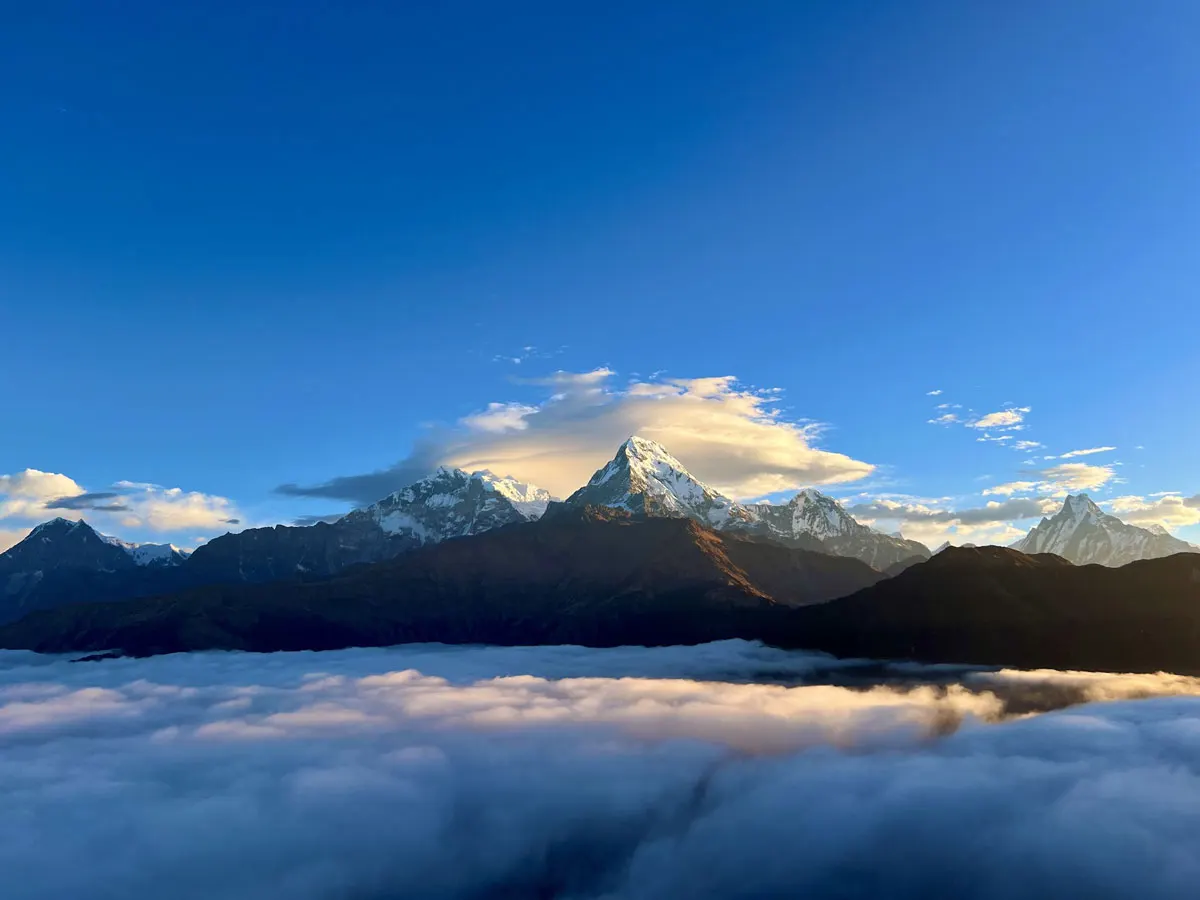
Ghorepani Poon Hill is a short, non technical trek in Nepal’s Annapurna region that ends at a 3,210 metre hilltop above the village of Ghorepani. Trekkers climb before dawn to watch the sun rise over Dhaulagiri, Annapurna I, Annapurna South and Machhapuchhre. Most people complete it in 4 to 6 days starting and ending near Pokhara, with no flights and no technical climbing skills required.
Of all the short treks radiating out from Pokhara, Ghorepani Poon Hill remains the one most trekkers ask about by name, and for good reason. In under a week, without a flight, an extreme level of fitness, or any real altitude risk, you stand on a ridge above the clouds and watch Dhaulagiri, Annapurna I, Annapurna South, Hiunchuli and Machhapuchhre catch the first light of the day, one peak at a time. Few viewpoints in the Himalaya deliver that much visual reward for that little physical investment.
This guide draws on route data, current permit rules, transport pricing and lodge conditions gathered directly for the 2026 season, so you can plan the trip with real numbers rather than guesswork. Whether you are a first time trekker, a family with children, a retiree looking for a gentler Himalayan experience, or a photographer chasing sunrise light, this page walks through everything from the Pokhara to Nayapul jeep fare to which teahouse rooms actually have hot showers.
The name Poon Hill comes from the Poon (Pun) clan of Magar people who have lived in this part of Myagdi and Kaski for generations, farming the terraced slopes below the ridge and herding livestock through the surrounding forest. The hill itself has no temple or religious monument at its summit, its significance is entirely about the view it commands over the Annapurna and Dhaulagiri massifs, and about the trail culture that has grown up around it since foreign trekkers first began visiting the Annapurna region in the 1970s.
The villages along the route, particularly Ghandruk, are strongholds of Gurung culture. The Gurung people are known across Nepal for their historic role in the British and Indian Gurkha regiments, and for a way of life built around transhumance farming, wool weaving and Buddhist influenced animism. Walking through Ghandruk’s stone paved lanes, past prayer flags and traditional slate roofed houses, gives visitors a genuine window into a living hill culture rather than a staged one.
Spring brings the Holi festival to the lower villages and, in higher Gurung communities, Lhosar celebrations mark the Tibetan influenced new year with music, dancing and home brewed millet drinks shared with guests. Trekking during these periods, with a bit of advance planning, lets you see the region’s cultural side rather than only its scenery.
| Stop | Altitude | What It’s Known For |
|---|---|---|
| Nayapul | 1,070 m | Main trailhead and permit checkpoint for the Annapurna Conservation Area |
| Tikhedhunga | approx. 1,540 m | Last village before the steep stone staircase to Ulleri |
| Ulleri | approx. 2,070 m | Perched above roughly 3,000 stone steps, with wide Annapurna South views |
| Ghorepani | 2,874 m | Overnight base village directly below Poon Hill |
| Poon Hill | 3,210 m | The sunrise viewpoint itself, with a watchtower and labelled peak signboards |
| Tadapani | approx. 2,630 m | Quiet forest village known for birdlife and rhododendron cover |
| Ghandruk | 1,940 m | Large Gurung village with a cultural museum and stone paved streets |
| Jhinu Danda | 1,780 m | Natural hot spring beside the Modi Khola, popular on extended routes |
Almost every Ghorepani Poon Hill trek begins in Pokhara, not Kathmandu. Travelers first reach Pokhara by a 25 to 30 minute domestic flight or a 6 to 7 hour tourist bus or private car ride from Kathmandu, then continue from Pokhara to the trailhead at Nayapul or Ghandruk by local bus, shared jeep, private taxi or private jeep.
There is no direct trekking route into Poon Hill from Kathmandu, so the first leg of any itinerary is getting to Pokhara. Domestic flights operated by carriers such as Buddha Air, Yeti Airlines and Shree Airlines cover the roughly 200 km hop in about 25 to 30 minutes and are the fastest option, especially useful if your overall trip schedule is tight. Tourist buses take 6 to 7 hours along the Prithvi Highway and are the most budget friendly choice, while a private car or jeep covers the same distance in around 6 hours with more flexibility on departure time and stops.
| Mode | Duration | Approx. Cost (per person) |
|---|---|---|
| Domestic flight | 25 to 30 minutes | USD 100 to 140 |
| Tourist bus | 6 to 7 hours | USD 10 to 25 |
| Private car or jeep | 5.5 to 6.5 hours | USD 90 to 140 (whole vehicle) |
Once in Pokhara, most trekkers head to Nayapul, the main gateway checkpoint into the Annapurna Conservation Area, or directly to Ghandruk if trekking the loop in reverse. There are four practical ways to cover this roughly 40 km stretch.
| Option | Where It Departs | Approx. Fare | Travel Time |
|---|---|---|---|
| Local bus | Baglung Bus Park, Pokhara | NPR 150 to 250 (about USD 1 to 2) | 1.5 to 2.5 hours |
| Private taxi | Lakeside hotels | NPR 1,800 to 2,500 (about USD 15 to 20) | 1.5 to 2 hours |
| Shared jeep | Near Bindhyabasini area or Lakeside | USD 15 to 20 per person | 1.5 to 2 hours |
| Private jeep | Booked through hotel or agency | USD 70 to 90 (whole jeep, 6 to 7 seats) | 1.5 to 2 hours |
The local bus from Pokhara’s Baglung Bus Park is the classic backpacker route and the cheapest way in, but expect a crowded ride with frequent stops. A private taxi from Lakeside is the simplest door to door option for solo travelers or couples who would rather not deal with bus schedules. Groups of four or more usually find a private jeep more comfortable and, once split between passengers, similarly priced to a taxi per head.
Pro Tip Book your taxi or jeep the evening before if you want an early departure. Vehicles waiting at Baglung Bus Park before 6 AM can be scarce in peak season (October to November), and hotels in Lakeside can usually arrange a car the night before for a small booking fee.
From Nayapul (1,070 m), the trail crosses the Modi Khola at Birethanti, then climbs gradually to Tikhedhunga before the famous stone staircase, often cited as roughly 3,000 to 3,300 steps, that leads up to Ulleri at about 2,070 m. This section covers around 10 to 11 km and typically takes 5 to 6 hours of walking on Day 1, making it the most physically demanding single stretch of the standard itinerary. Some operators now offer a jeep option that continues past Nayapul toward Ulleri or Banthanti during the dry months (roughly October to April), which can shave a full day off the schedule for travelers short on time, though the ride is rough and unavailable during the monsoon.
Hile is a small settlement on the stone step route between Tikhedhunga and Ulleri, and a handful of operators use it as an alternative drop off or pick up point when road conditions allow a vehicle to continue slightly beyond the standard Nayapul checkpoint. A private taxi from Lakeside covering this extended distance typically runs close to the Nayapul fare, around NPR 2,000 to 2,800 (roughly USD 16 to 22), with the exact price depending on road conditions that season and how far the driver is willing to continue on the rougher unpaved sections.
If you are short on time, flying is the most efficient way to link Kathmandu with the Poon Hill trailhead. The route is: domestic flight from Kathmandu to Pokhara (25 to 30 minutes), then road transport from Pokhara to Nayapul or Ghandruk (1.5 to 2 hours) as described above. This combination can get you from Kathmandu to the actual start of the trail in under half a day, compared to a full day if traveling overland both ways. It is the preferred option for travelers with a fixed international flight schedule or limited annual leave.
Newly built rural roads now allow 4WD jeeps to drive considerably further into the hills than in past years. A private jeep from Pokhara to Ghandruk (roughly 55 to 61 km, 3 to 4 hours) costs approximately USD 75 to 100 for the whole vehicle, or about USD 10 to 20 per person when shared among 6 to 7 passengers. During the drier months, some jeeps can continue toward Ghorepani itself, cutting out one or two trekking days for travelers who want the sunrise view without the full multi day walk in. This isn’t possible in the monsoon months of June through August, when landslip risk closes several of these tracks.
Important Note Driving all the way to Ghorepani removes most of the walking, and with it much of the reason people choose this trek in the first place, the villages, forests and gradual acclimatization. We generally recommend using jeep transport to skip only the least scenic lower sections (such as the Nayapul to Ulleri road walk in reverse) rather than the whole route, unless mobility or time genuinely requires it.
There is no single correct way to walk this trek. The table below compares the three most common structures used by trekking operators, including Nepal Tour Package’s own scheduling.
| Itinerary | Days | Route Summary | Best For |
|---|---|---|---|
| Classic 4 Day | 4 | Nayapul, Ulleri, Ghorepani, Poon Hill sunrise, Tadapani, Nayapul | Time limited trekkers wanting the core experience |
| Standard 5 Day | 5 | Nayapul, Tikhedhunga, Ghorepani, Poon Hill, Tadapani, Ghandruk, Nayapul | Most travelers, balances pace and cultural stops |
| Extended 6 to 7 Day | 6 to 7 | Adds Jhinu Danda hot spring or a Khopra Danda / Muldai Viewpoint side trip | Trekkers wanting hot springs, fewer crowds, or extra viewpoints |
The best time to visit Ghorepani Poon Hill is October to November and March to April, when skies are clearest for sunrise views. October and November bring crisp, stable post monsoon weather, while March and April add blooming rhododendron forests but slightly hazier mountain views by late afternoon.
| Season | Months | Conditions |
|---|---|---|
| Autumn (peak) | October, November | Clear skies, stable weather, busiest trails and lodges |
| Spring | March, April | Rhododendron blooms, warmer days, occasional afternoon haze |
| Winter | December to February | Cold mornings, occasional snow at Ghorepani, fewer crowds, clear skies |
| Monsoon | June to September | Heavy rain, leech activity, limited mountain visibility, muddy trail |
Ghorepani, at 2,874 m, sees night temperatures drop close to freezing in October and November and can fall below minus 5 degrees Celsius in winter, so warm layers matter even outside the coldest months. Poon Hill itself is windy and cold well before sunrise regardless of season, so a proper down jacket or several warm layers are essential year round for the summit hike.
Ghorepani has roughly 20 to 30 teahouse lodges, most offering simple twin rooms, shared or attached bathrooms depending on the property, and hot showers for a small extra fee. A standard double room costs about USD 3 to 10 a night in low season and is often discounted further if you eat dinner and breakfast at the same lodge, a long standing local arrangement across the Annapurna region.
Some of the newer and larger lodges in Ghorepani now offer rooms with attached bathrooms and, in a handful of properties, basic electric or gas heaters in the room for an extra charge. However, most standard teahouses along the route still use shared bathroom blocks with squat or western style toilets, and the main living space is heated by a central wood or gas stove in the dining hall rather than in individual rooms. If an ensuite, heated room matters to you, mention it when booking, since availability is limited and fills first in peak season.
| Room Type | Typical Nightly Cost | Notes |
|---|---|---|
| Standard double, shared bathroom | USD 3 to 6 | Often free or discounted if you dine at the lodge |
| Double with attached bathroom | USD 8 to 15 | Limited availability, book ahead in peak season |
| Luxury or premium lodge room | USD 40 to 90 | Found in a small number of upgraded properties near Ghorepani and Ghandruk |
Travelers wanting a more comfortable experience can now find a small number of upgraded lodges around Ghandruk and Ghorepani with private bathrooms, better bedding, solar hot water and dining rooms with more varied menus. These sit closer to a comfortable mountain lodge than a five star hotel, so it’s worth setting expectations accordingly, this is rustic luxury rather than resort style luxury. Nepal Tour Package can arrange upgraded lodge bookings as part of a private, customized itinerary for travelers who want extra comfort without giving up the trekking experience.
Menus are standardized across most teahouses in the region, and prices rise gradually with altitude since supplies are carried up by porters or mules. Dal bhat (rice, lentil soup, vegetable curry, usually with refills) remains the best value meal and the preferred choice of most guides for its energy content. Expect to pay more for imported items like pizza, pasta or chocolate bars than for local staples.
| Item | Typical Price |
|---|---|
| Dal bhat (rice, lentils, curry) | USD 4 to 7 |
| Fried noodles or fried rice | USD 3 to 5 |
| Hot lemon, ginger or masala tea | USD 1 to 2 |
| Boiled or bottled water (1 litre) | USD 0.50 to 1.50 |
| Snacks and chocolate bars | USD 2 to 4 |
Important Note Room rates rarely include hot showers, device charging or wifi. Budget separately for these, especially at higher altitude villages where solar and generator power is limited.
| Service | Typical Extra Charge |
|---|---|
| Hot shower (gas or solar) | USD 1.50 to 3.50 |
| Phone or camera battery charging | USD 1 to 3 per device |
| Wifi access | USD 2 to 4 per day, and often unreliable above Ghorepani |
All in, a mid range daily budget covering a room, three meals, hot showers, charging and the odd snack typically runs USD 25 to 40 per person per day on the Ghorepani Poon Hill route, before permits and transport. Backpackers eating only dal bhat and skipping hot showers can trim this closer to USD 15 to 20 a day, while travelers wanting upgraded lodges and full board comfort should budget USD 50 to 80 a day.
Two documents are required for this trek: the Annapurna Conservation Area Permit (ACAP), which costs NPR 3,000 (about USD 25) for foreign nationals, and the TIMS card, which costs NPR 2,000 (about USD 17) for independent trekkers or NPR 1,000 for those trekking with a registered agency group. Both are checked at trail checkpoints, and Nepali citizens are exempt from both fees.
| Permit | Foreign Nationals | SAARC Nationals | Where to Get It |
|---|---|---|---|
| ACAP | NPR 3,000 (about USD 25) | NPR 1,000 | NTB office in Pokhara or Kathmandu, or entry checkpoints |
| TIMS (group) | NPR 1,000 | NPR 1,000 | NTB or TAAN office, or via your trekking agency |
| TIMS (independent) | NPR 2,000 | NPR 1,000 | NTB or TAAN office in Pokhara or Kathmandu |
The ACAP and TIMS counter in Pokhara is run by the Nepal Tourism Board on Lakeside Road, generally open Sunday through Friday from around 10 AM to 5 PM, and closed on Saturdays. Bring your passport, two passport sized photos, and enough cash for both fees, since queues can lengthen considerably in the busiest weeks of October and November. Trekking agencies such as Nepal Tour Package can process both permits on your behalf, which is worth considering if you land in Pokhara on a Saturday or arrive close to your intended departure time.
Pro Tip Carry a few extra passport photos and photocopies of your passport’s photo page. Offices occasionally ask for spares, and it saves a return trip if you’re missing one.
Trekkers with extra days and a taste for quieter trails often extend from Ghorepani toward Khopra Danda (around 3,660 m) and Muldai Viewpoint (around 3,637 to 3,640 m). Both sit on the same general ridge system as Poon Hill but see a fraction of the foot traffic, and Muldai in particular offers a genuinely close up, almost eye level panorama of Dhaulagiri, Annapurna South and Machhapuchhre. The route also passes toward the sacred Khayer Lake at roughly 4,660 m, a Hindu pilgrimage site that draws visitors especially around the Janai Purnima festival. This extension typically adds 3 to 5 days to a standard itinerary and is best suited to trekkers who already have one Himalayan trek under their belt.
If your route continues toward Annapurna Base Camp, or simply loops back via Chhomrong, a stop at Jhinu Danda’s natural hot spring is a well earned reward. The pools sit beside the Modi Khola river, roughly a 20 to 30 minute walk down from the main village, and cost a small entry fee, generally a few hundred Nepali rupees. Soaking here after several days of walking is one of the more memorable, low key highlights the standard Poon Hill only itinerary misses entirely.
Many trekkers link the two treks into a single 10 to 12 day itinerary, walking from Ghorepani through Tadapani and Chhomrong up to Annapurna Base Camp at 4,130 m, then looping back via Jhinu Danda’s hot springs. This combination suits fitter travelers with a week and a half to spare who want both the classic Poon Hill sunrise and a true high altitude base camp experience in one trip.
Ghandruk is the largest and most visited Gurung settlement on the route, with stone paved lanes, traditional slate roofed houses, and a small community run museum documenting Gurung dress, farming tools, and the community’s long connection to the Gurkha regiments. A short guided walk through the village, paired with a home cooked meal and unobstructed views of Annapurna South and Machhapuchhre, is one of the most culturally rewarding stops on the whole route and pairs naturally with an overnight stay near the end of the trek.
The forest belt between Ulleri, Ghorepani and Tadapani holds some of the densest rhododendron cover in the Annapurna region, and from mid March through late April these hillsides turn shades of crimson, pink and white as Nepal’s national flower comes into full bloom. The stretch just below Ghorepani, along with the Deurali to Banthanti section, is particularly photogenic in this window, and several operators build entire spring itineraries specifically around this bloom.
Important Note There are no ATMs or currency exchange counters in Ghorepani or any other village along the trek route. Withdraw and exchange all the cash you’ll need in Pokhara before departing, and carry a mix of small denomination notes for teahouse bills, snacks and permit fees.
Every village along the route, from Tikhedhunga through Ghorepani to Ghandruk, has small shops and teahouses selling bottled and boiled water, biscuits, chocolate, instant noodles and basic trekking snacks. Prices climb gradually with altitude, since everything is carried up by porter or mule, so it’s worth stocking up on your favorite snacks in Pokhara where prices are lowest. Many trekkers now carry a reusable bottle and pay for boiled water or use a filter or purification tablets, which is both cheaper and better for reducing plastic waste on the trail.
Ghorepani has developed a small but genuine bakery culture, with several lodges baking their own bread, apple pie and cinnamon rolls fresh each morning, a welcome contrast after a cold pre dawn Poon Hill hike. Lodge dining halls double as cafes serving reasonable espresso style coffee, hot chocolate and milk tea, and most trekkers end up choosing their bakery by whichever lodge smells best that morning rather than by any fixed reputation.
Arrive at the viewpoint at least 20 to 30 minutes before official sunrise, since the best light often comes just before the sun clears the horizon. A wide angle lens captures the full panorama, while a mid range zoom is useful for isolating individual peaks like Dhaulagiri or Machhapuchhre as the light shifts across them. Temperatures at the summit before dawn regularly sit near or below freezing, so keep spare camera batteries in an inside jacket pocket, since cold drains them fast.
Ghorepani Poon Hill carries very little altitude sickness risk given its modest 3,210 m ceiling, but the stone staircases near Ulleri and Tikhedhunga are steep and can be slippery when wet, so sturdy footwear and trekking poles genuinely help. Travel insurance covering trekking up to at least 4,000 m is still worth carrying for any medical evacuation needs, and a hired local guide adds real value here, not for navigation risk but for language support, trail knowledge and quick help if plans need to change.
This is one of the busier trekking corridors in Nepal, so a few small habits make a real difference: carry a reusable bottle rather than buying single use plastic at every stop, stick to marked trails to avoid eroding the surrounding hillside, support family run teahouses and porters directly rather than only pre packaged tours, and ask permission before photographing villagers or their homes. Choosing lodges and guides based in the local Gurung and Magar communities keeps trekking income inside the villages the route passes through.
| Traveler Type | Why It Fits |
|---|---|
| First time trekkers | Well marked trail, established teahouses, low altitude risk |
| Families with older children | Manageable daily walking hours, comfortable lodges, cultural stops |
| Senior travelers | Moderate pace possible, no technical climbing, shorter daily distances can be arranged |
| Photographers | Reliable sunrise panorama, rhododendron season, village architecture |
| Solo travelers | Well trodden trail, easy to join guided group departures |
| Luxury travelers | Can be paired with upgraded lodges and private jeep transport |
Nepal Tour Package designs custom Poon Hill itineraries, from a fast paced 4 day sunrise trip to a full Khopra Danda and hot springs extension, complete with permits, transport and hand picked teahouses arranged for you.
Ghorepani Poon Hill remains one of the most accessible ways to stand face to face with the Annapurna and Dhaulagiri ranges without committing to a multi week expedition. With the route, permit, cost and seasonal details covered in this guide, you should have everything needed to plan a trip that matches your fitness level, timeline and comfort expectations, whether that’s a fast 4 day sunrise dash or a fuller two week loop through Khopra Danda and the Jhinu Danda hot springs. If you’d like a Kathmandu based team to handle the permits, transport and lodge bookings so you can simply focus on the walk, Nepal Tour Package is happy to build an itinerary around your dates.
📞 +977 9841620757 (Available on WhatsApp, Viber, WeChat, RedNote)
✉️ info@nepaltourpackage.com / nepaltourpackage@outlook.com
📍 Kathmandu, Nepal