Everything a traveler actually needs before heading up to Nagarkot: honest transport prices, real entry fee rules, sunrise timing, the downhill hike to Bhaktapur, and where to stay.
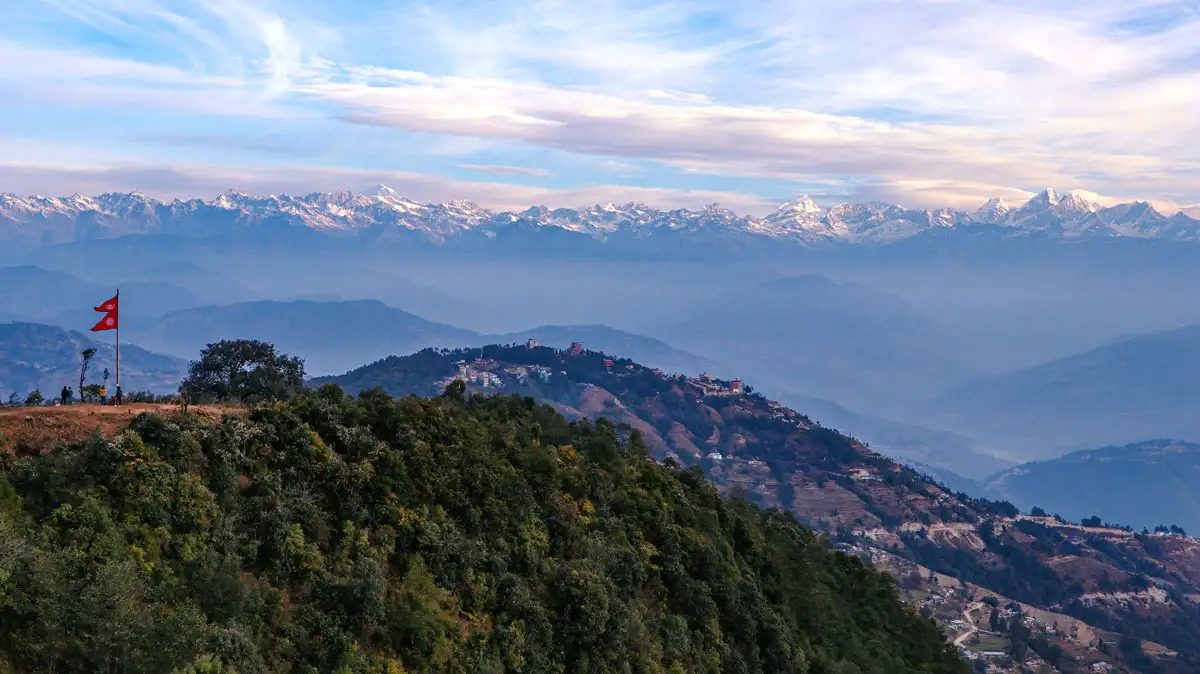
Nagarkot is the ridge every Kathmandu local eventually recommends when you ask, “Where can I see the Himalayas without a multi-day trek?” It sits on the eastern rim of the Kathmandu Valley, about an hour and a half from Thamel by road, and on a clear morning it delivers one of the widest Himalayan panoramas accessible without hiking boots or a permit. That said, Nagarkot has a reputation problem: cloud cover hides the mountains more often than glossy Instagram posts suggest, transport pricing is inconsistently quoted online, and the local entry fee situation has changed more than once in the past few years.
This guide sorts out what’s actually true in 2026: what a private car, taxi, Pathao ride, or local bus really costs, whether you’ll still be asked to pay an entrance fee, how long the hike down to Bhaktapur genuinely takes, and when you have the best odds of seeing Everest from the view tower. It’s written from years of running day tours and sunrise trips out of Kathmandu, so the advice reflects what travelers experience on the ground, not just what a brochure promises.
Nagarkot exists on nearly every Kathmandu Valley itinerary for one reason: it’s the easiest place near the capital to get a genuine, uninterrupted look at the Himalayan range, from Dhaulagiri in the west to Kanchenjunga in the east, without committing to a trek. Add in a UNESCO World Heritage temple (Changu Narayan) a few hours’ walk downhill and a second UNESCO city (Bhaktapur) at the bottom of that trail, and you get a compact one- or two-day trip that covers mountains, culture, and history together.
It also works for almost every type of traveler. Families like it because there’s no technical hiking required. Couples use it as a low-effort honeymoon add-on with boutique resorts built specifically around the view. Budget backpackers treat it as a cheap overnight escape from Kathmandu’s noise. Serious trekkers sometimes use it as a gentle warm-up walk before heading into the Annapurna or Langtang regions.
Nagarkot has no ancient temple complex of its own, unlike its Newari neighbors in the valley below. Its significance is more recent and practical: during the Rana period it functioned as a military outpost and later as a hill retreat, and its popularity as a sunrise-viewing destination grew through the 20th century as Kathmandu’s own skyline filled in and blocked mountain views from the city center. Today, Nagarkot falls administratively under Changunarayan Municipality in Bhaktapur District, which is worth knowing because local fee and regulation decisions (including the entrance fee discussed below) come from that municipal office, not a national tourism authority.
Short answer: The Nagarkot View Tower is a public viewing platform near the village center, roughly a 20 to 30 minute uphill walk from most hotels, and it’s the single most popular sunrise spot in the area.
The tower itself is a simple multi-story concrete structure with open viewing decks. It gets crowded on clear autumn mornings, with local families, school groups, and photographers all converging around 20 minutes before sunrise. Arrive early if you want unobstructed rail space for photos, and bring a headlamp or phone flashlight since the walk up is unlit before dawn.
Changu Narayan is one of Nepal’s oldest surviving temple complexes and a UNESCO World Heritage Site in its own right, separate from the seven monuments listed under “Kathmandu Valley.” Its pagoda-style architecture, stone inscriptions dating back over 1,500 years, and intricate wood carvings make it a worthwhile stop, especially since it sits directly on the popular downhill trail from Nagarkot. Most travelers combine the sunrise view with a hike down to this temple, then continue to Bhaktapur by vehicle or on foot.
Bhaktapur, at the base of the Nagarkot ridge, is one of the best-preserved medieval Newari cities in the Kathmandu Valley and a full UNESCO World Heritage Site. Its Durbar Square, 55-Window Palace, Nyatapola Temple (Nepal’s tallest pagoda), and pottery squares are commonly paired with a Nagarkot sunrise as a single day trip.
A network of ridge-top walking trails connects several viewpoints around Nagarkot, offering longer or shorter loop options depending on your fitness and time. These are the same trails used for the Nagarkot-to-Changu Narayan and Nagarkot-to-Bhaktapur hikes described below.
Short answer: Most travelers reach Nagarkot by private car (about 45–90 minutes from Kathmandu), local bus via Bhaktapur (2–3 hours, cheapest option), or ride-hailing app, with prices ranging from roughly NPR 100 for a bus seat to NPR 3,000+ for a private one-way car from Thamel.
| Transport Option | Route | Approx. Cost (2026) | Duration |
|---|---|---|---|
| Private car (one-way) | Thamel/Kathmandu → Nagarkot | NPR 2,500–3,500 per vehicle | 1–1.5 hrs |
| Private car (round-trip, sunrise) | Kathmandu → Nagarkot → Kathmandu (wait included) | NPR 4,500–6,500 per vehicle | 4–6 hrs total |
| Private car, combo route | Kathmandu → Nagarkot → Bhaktapur → Kathmandu | NPR 3,000–4,500 per vehicle | Half day |
| Pathao / InDrive (ride-hailing) | Thamel → Nagarkot | NPR 1,800–3,000 (surge pricing common pre-dawn) | 1–1.5 hrs |
| Taxi (metered/negotiated) | Thamel → Nagarkot View Tower | NPR 2,500–3,800 one-way (bargained) | 1–1.5 hrs |
| Taxi from Bhaktapur only | Bhaktapur → Nagarkot | NPR 700–900 one-way | 45–60 min |
| Local public bus | Ratna Park → Bhaktapur → Kamalbinayak → Nagarkot | NPR 100–180 total (two legs) | 2.5–3 hrs |
| Private driver, half-day hire | Kathmandu sunrise + Changu Narayan + Bhaktapur | NPR 5,000–8,000 per vehicle | 5–7 hrs |
Vehicle prices in the table are typically per car, not per person, and most sedans comfortably seat 3 passengers plus luggage. Splitting the fare across a small group brings the effective per-person cost down close to the bus fare while saving nearly two hours each way.
Short answer: Yes, Pathao and similar ride-hailing apps do operate in the pre-dawn hours in the Kathmandu Valley, but availability for a 40+ km out-of-city trip at 3:30–4:00 AM is inconsistent, and fares often carry a surge premium.
In practice, drivers are less willing to accept long, early, out-of-town rides through an app because return trips are unpaid dead mileage for them. Many travelers report needing to try several times, cancel, and re-request, or switching to a phone call booking with a known taxi or hotel-arranged driver instead. If your sunrise viewing is time-critical, booking a private car or hotel transfer the evening before removes this uncertainty entirely.
The public bus route runs in two legs. First, a Bhaktapur-bound bus from Ratna Park or Bagbazaar (roughly NPR 40–60) drops you near Bhaktapur’s main entrance. From there, a second local minibus from the Kamalbinayak terminal on Bhaktapur’s northeastern edge continues up to Nagarkot (roughly NPR 60–100). This is by far the cheapest way to reach Nagarkot, but it’s slow, involves a transfer, and doesn’t run on a fixed schedule, so it isn’t realistic if you need to arrive before sunrise.
Short answer: Nagarkot’s local “entrance fee” (roughly NPR 330–340) has been a recurring source of confusion; the Changunarayan Municipality publicly announced the fee was cancelled, but enforcement has been inconsistent for years, so some travelers still report being asked to pay at road checkpoints.
| Ticket / Fee | Who Pays | Approx. Price | Status (2026) |
|---|---|---|---|
| Nagarkot municipality entry fee | Foreign visitors | ~NPR 330–340 | Officially cancelled by the municipality, but inconsistently collected at checkpoints; carry small NPR cash just in case |
| Nagarkot View Tower | All visitors | Free / nominal local charge | The tower itself has no separate standalone ticket booth; it’s a public viewing platform |
| Changu Narayan Temple | SAARC nationals | ~NPR 100 | Payable at temple entrance |
| Changu Narayan Temple | Other foreign nationals | ~NPR 300 (roughly USD 2) | Payable at temple entrance |
| Bhaktapur Durbar Square | Foreign visitors | ~NPR 1,500 (approx. USD 15) | Covers all monuments within the square for the day |
| Bhaktapur Durbar Square | SAARC nationals | ~NPR 300–500 | Payable at square entrance |
There is no single “combined ticket” that bundles Nagarkot, Changu Narayan, and Bhaktapur into one payment. Each fee is collected separately at its own checkpoint. Budget for them individually rather than assuming a package rate, and keep in mind rupee amounts at local checkpoints can be rounded or adjusted without notice, since Nagarkot’s fee history has genuinely gone back and forth between “cancelled” and “reinstated.”
Where a fee is being collected, it’s typically at a roadside checkpoint on the main approach road into Nagarkot village, staffed by municipality-appointed collectors, not at the view tower itself. If you’re on an organized tour, your driver or guide will usually handle this directly. If you’re arriving independently by bus or on foot, keep some small NPR notes on hand.
The overnight version consistently gets better mountain visibility odds, since it gives you two chances (sunset and sunrise) instead of one, and it removes the pressure of a 3 AM departure from Kathmandu.
Short answer: The downhill hike from Nagarkot to Changu Narayan Temple is around 13–15 km and typically takes 3 to 4 hours at a relaxed pace; a shorter 2-hour route to Telkot lets you finish by vehicle from there, and some direct village paths to Bhaktapur can be covered in as little as 1.5 to 2.5 hours depending on the exact route and your pace.
It’s physically possible to walk the Nagarkot-Changu Narayan or Nagarkot-Bhaktapur trail independently; it’s a well-used local path through villages and terraced fields rather than remote wilderness, and no trekking permit is required for this specific route. That said, trail junctions are unmarked in several places, mobile signal is patchy in the forested sections, and a wrong turn can add an hour or more to your walk. Solo travelers unfamiliar with the area, or anyone hiking in low light around sunrise, benefit from a local guide, both for navigation and for the added cultural context as you pass through small Newari and Tamang villages along the way.
If you’d rather skip the full downhill walk but still want a taste of the trail, hike the first 2 hours to Telkot, then arrange a vehicle pickup from there to continue to Changu Narayan and Bhaktapur. This shortens the route without cutting out the scenic ridge sections.
Arriving at Changu Narayan mid-morning, after the hike down, tends to be quieter than visiting it as a standalone day-trip stop, since most standalone Changu Narayan visitors arrive later in the day by road. The stone courtyard, its carved pillars, and the small site museum are easy to cover in 45 minutes to an hour before continuing on to Bhaktapur.
Short answer: October to March offers the clearest skies and the best odds of unobstructed Himalayan views, with October–November and February–March generally considered the sweet spot, since December–January can bring cold fog in the mornings.
| Month | Sunrise Time (approx.) | Mountain Visibility | Weather Notes |
|---|---|---|---|
| October–November | 6:00–6:20 AM | Excellent | Post-monsoon clear skies, most reliable season |
| December–January | 6:40–7:00 AM | Good, but morning fog common | Cold mornings, occasional low cloud until mid-morning |
| February–March | 6:15–6:35 AM | Very good | Clear, cooler air; occasional spring haze late in the season |
| April–May | 5:15–5:40 AM | Moderate | Increasing pre-monsoon haze and dust |
| June–September | 5:00–5:20 AM | Poor | Monsoon cloud cover; mountains rarely visible |
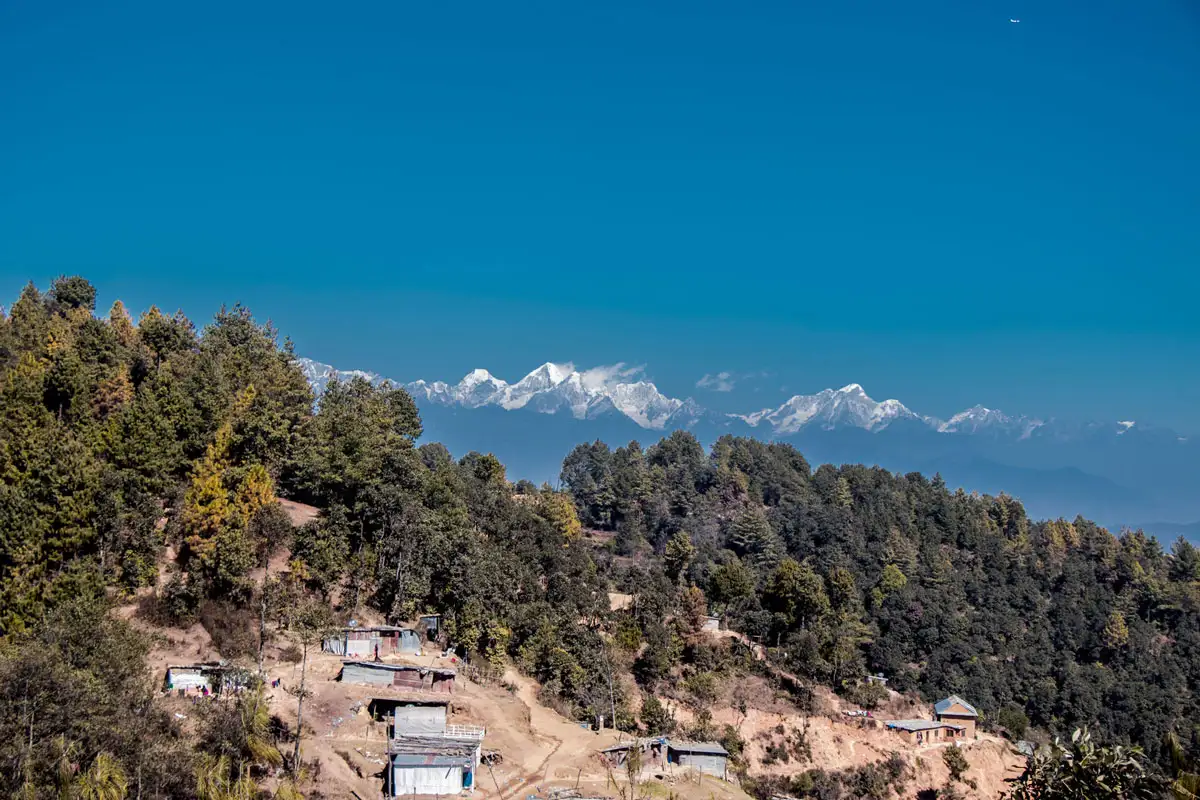
Short answer: Yes, on a genuinely clear day, Everest is visible from the Nagarkot View Tower as part of the wider Himalayan panorama, though it appears as a smaller, more distant peak among closer ranges like Langtang and Ganesh Himal rather than as a dramatic close-up.
Manage your expectations here: Everest from Nagarkot is a small notch on a long horizon of snow peaks, not the towering foreground view you’d get in the Everest region itself. Haze, even on an otherwise “sunny” day in Kathmandu, can hide it while nearer peaks remain visible, which is why October and November mornings, right after the monsoon clears the air, give the best odds.
Short answer: A standard guided Nagarkot sunrise and Changu Narayan hiking day tour from Kathmandu typically runs from around NPR 6,000–12,000 per person for a private option (less per person in a group), covering transport, a guide, and sometimes breakfast, over roughly 5 to 8 hours.
Group tours reduce the per-person cost meaningfully, while private tours offer flexibility on timing, which matters most for the pre-dawn departure.
| Category | Typical Price Range (per night) | Best For |
|---|---|---|
| Luxury boutique resort | USD 90–250+ | Honeymooners, couples, travelers wanting a private mountain-view room or infinity-edge deck |
| Mid-range hotel/lodge | USD 30–80 | Families, small groups, travelers wanting comfort without resort pricing |
| Budget guesthouse | USD 8–25 | Backpackers, solo travelers, short overnight stops |
Nagarkot’s overnight boutique resorts are genuinely one of its strongest selling points: several are built specifically with unobstructed mountain-facing rooms, rooftop decks, and in-room fireplaces for winter stays, which is difficult to replicate on a rushed day trip from Kathmandu.
Most hotels and resorts serve a mix of Nepali, Newari, Indian, and continental menus, with fresh vegetables sourced from Nagarkot’s own hillside farms; look out for locally grown greens, seasonal citrus, and honey sold along the roadside. In Bhaktapur, don’t skip juju dhau (“king curd”), the city’s famous thick yogurt served in clay bowls, or Newari snack sets like bara and choila if you’re stopping there after the hike.
Short answer: Dress in warm layers you can remove as the sun rises, since pre-dawn temperatures in Nagarkot during winter can drop close to freezing while daytime temperatures climb comfortably by mid-morning.
No trekking permit (such as a TIMS card) is required for the standard Nagarkot sunrise visit or the Nagarkot-Changu Narayan-Bhaktapur hiking route, since it falls outside national park or conservation area boundaries. If you extend into a longer route such as the Nagarkot-Chisapani-Sundarijal trek that touches Shivapuri Nagarjun National Park, a separate park entry permit is required; ask your operator to confirm this before you set off.
Nagarkot’s hillside ecosystem and small village communities benefit from visitors who stay on marked trails, carry out their own trash, and buy from local farms, teahouses, and guesthouses rather than exclusively from large resort chains. If you’re hiking through village land, understand that the paths often cross private terraced fields, so stick to the established trail and be mindful around livestock and working farmland.
Planning your Nagarkot sunrise trip? Nepal Tour Package designs private and small-group Nagarkot day trips, overnight escapes, and combined Kathmandu Valley itineraries built around your schedule and interests.
A round-trip private car for a Nagarkot sunrise viewing typically costs around NPR 4,500–6,500 per vehicle, including the pre-dawn departure and waiting time while you watch the sunrise, before driving back to Kathmandu.
It’s possible but not fully reliable. Pathao and similar apps do run at that hour, but driver acceptance for a long out-of-city trip pre-dawn is inconsistent, and surge pricing is common. Booking a private car or hotel transfer the night before is more dependable if your timing is fixed.
Expect to negotiate around NPR 2,500–3,800 for a one-way taxi from Thamel to Nagarkot, since most taxis for this route aren’t metered and pricing depends on bargaining, time of day, and fuel costs.
Budget roughly NPR 100–180 total across two bus legs: one from Ratna Park or Bagbazaar to Bhaktapur, and a second local minibus from Bhaktapur’s Kamalbinayak terminal up to Nagarkot.
A half-day private driver hire covering Nagarkot, Changu Narayan, and Bhaktapur typically runs NPR 5,000–8,000 per vehicle, depending on waiting time and exact stops requested.
The municipal entry fee has historically been around NPR 330–340 for foreign visitors. The Changunarayan Municipality announced it was cancelled, but enforcement has been inconsistent, so it’s worth carrying small NPR notes just in case a checkpoint is active during your visit.
No, the View Tower functions as a public viewing platform rather than a ticketed attraction with its own standalone entry fee separate from the general municipal entry charge described above.
There isn’t a single combined ticket. Bhaktapur Durbar Square entry (around NPR 1,500 for foreigners) and the Nagarkot municipal fee (where enforced, around NPR 330–340) are collected separately at their own checkpoints.
A private guided day tour combining the sunrise viewing, the downhill hike, and Changu Narayan Temple typically costs around NPR 6,000–12,000 per person, with lower per-person pricing in small groups.
Yes, it’s a well-used local trail with no permit requirement, but junctions are unmarked in places and mobile signal is patchy, so first-time visitors and solo hikers, especially in low pre-dawn light, generally benefit from a local guide.
Plan on roughly 3 to 4 hours for the full downhill route to Changu Narayan (about 13–15 km), or around 2 hours to the shorter Telkot point where a vehicle can meet you; some direct village paths can be covered in 1.5 to 2.5 hours at a brisk pace.
Yes, Everest is visible on a genuinely clear day as one peak within the wider Himalayan panorama, though it appears distant and relatively small compared to nearer ranges like Langtang, which tends to dominate the view.
During October and November, sunrise generally occurs between about 6:00 and 6:20 AM, and this period also offers the clearest post-monsoon skies of the year.
Dress in warm layers, including a fleece or down jacket, hat, and gloves for the pre-dawn cold, since winter mornings can approach freezing; you can shed layers as the sun rises and temperatures climb.
October through March offers the best odds overall, with October, November, February, and March generally considered the most reliable window, since December and January can bring morning fog despite otherwise clear conditions.
Nagarkot rewards travelers who plan around its real conditions rather than its marketing: budget realistically for transport and the still-unpredictable entry fee situation, pick an October-to-March window if the Himalayan view is your main goal, and consider the overnight option over a rushed 3 AM day trip if you can spare the extra night. Whether you’re chasing a sunrise photo, a gentle hillside hike down to Bhaktapur, or a quiet resort weekend away from Kathmandu, Nagarkot delivers a genuinely good return on a short amount of travel time.
If you’d like this planned for you, including verified pricing on the day, a driver who knows the current fee situation, and a guide for the downhill hike, Nepal Tour Package can put together a Nagarkot itinerary matched to your dates, budget, and interests.
📞 +977 9841620757 (Available on WhatsApp, Viber, WeChat, RedNote)
✉️ info@nepaltourpackage.com / nepaltourpackage@outlook.com
📍 Kathmandu, Nepal