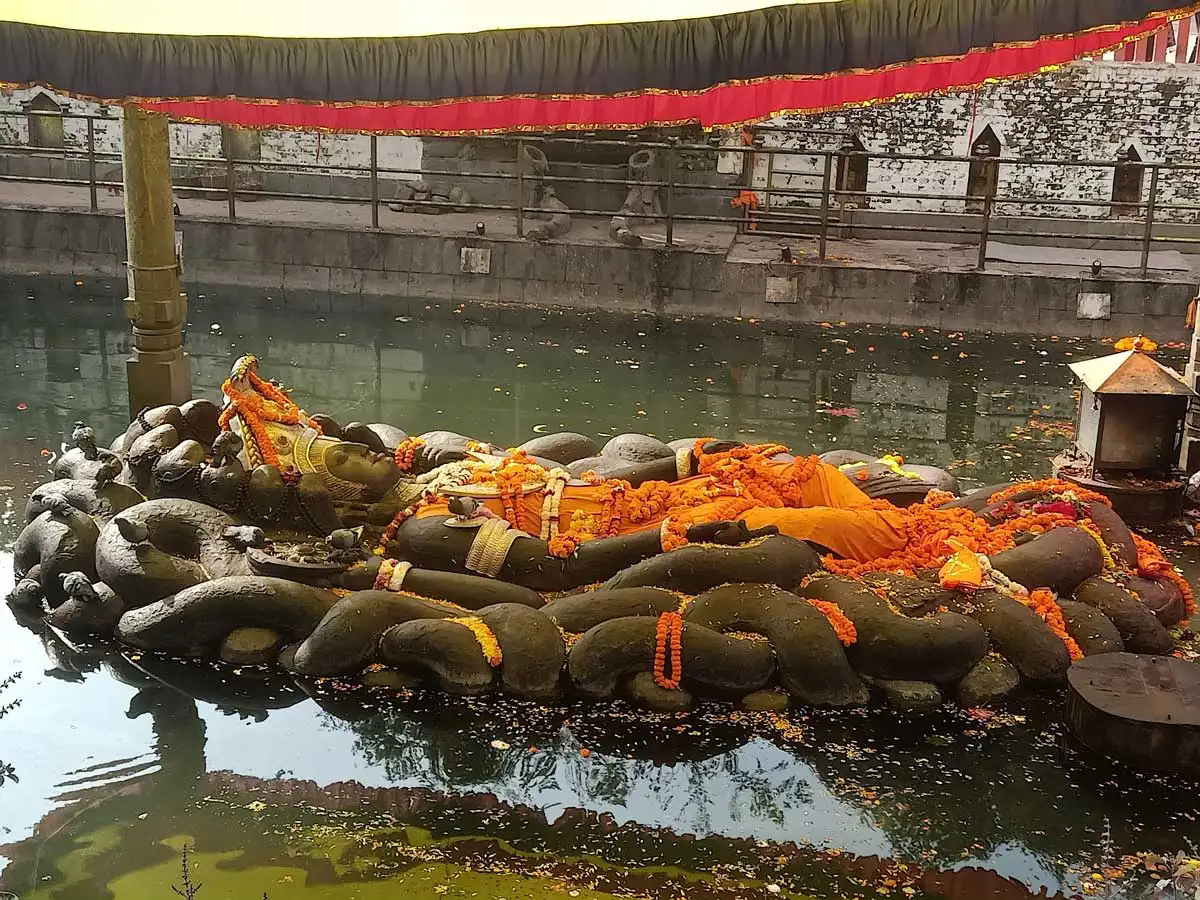
At the northern edge of the Kathmandu Valley, where the city gives way to the forested foothills of Shivapuri, lies one of Nepal’s most quietly powerful religious sites. Budhanilkantha Temple is home to a colossal stone statue of Lord Vishnu, carved from a single block of black basalt, reclining on a bed of coiled serpents in the middle of a stone-lined pond. There is no roof over him, no walls around him. He simply lies there, half submerged in water, as he has for roughly 1,500 years, watched over by pilgrims, monkeys, and the occasional curious traveler who stumbled onto this place almost by accident.
This guide is built for exactly that traveler, and for those who plan ahead too. Whether you are researching the history of the monolithic Sleeping Vishnu statue, wondering whether non-Hindus can enter the inner sanctum, or simply trying to figure out the cheapest way to get from Thamel to Budhanilkantha, everything you need is below, organized the way an experienced Kathmandu-based guide would actually explain it to you over a cup of tea.
Budhanilkantha Temple, located about 10 km north of central Kathmandu, houses a 5th or 7th century monolithic statue of Vishnu reclining on the coils of the cosmic serpent Shesha in an open-air pond. Entry is free for all visitors, the temple is open daily from early morning until evening, and the site can be combined with a Shivapuri National Park hike for a full day trip.
Most visitors to Kathmandu spend their time in Durbar Square, Swayambhunath, and Boudhanath, and rightly so. But Budhanilkantha offers something those crowded, ticketed sites cannot: a genuinely quiet, living shrine where local devotion happens in real time, largely undisturbed by mass tourism. You will likely share the space with far more Nepali pilgrims than foreign visitors, which for many travelers is exactly the point.
It also rewards the kind of traveler who likes context. The statue is not just an artwork; it is tied to a royal curse still observed by Nepal’s former monarchy, to a creation myth involving the god Vishnu resting between cycles of the universe, and to an annual festival, Haribodhini Ekadashi, that draws tens of thousands of pilgrims from across Nepal and India. Few sites in the valley pack this much mythology, history, and living ritual into one small courtyard.
The Budhanilkantha statue is generally dated to the Licchavi period, most likely the 7th century CE, though some scholars place its origin as early as the 5th century. It was carved from a single block of black basalt stone, quarried outside the valley and transported to the site, an engineering feat that remains impressive by any era’s standards.
The statue measures roughly 5 meters in length and depicts Vishnu reclining in yoga nidra, a state of divine cosmic sleep, floating on the coils of Shesha, the great serpent of eternity, within a pond meant to represent the cosmic ocean. This iconographic form, known as Jalasayana Narayana or Vishnu Anantasayana, appears in Hindu art across South Asia, but the Budhanilkantha version is exceptional for its scale and for the fact that it was never moved indoors. Unlike most temple deities enshrined in a garbhagriha (inner sanctum) with walls and a roof, this Vishnu has always rested in the open, under the sky, in water drawn from natural springs believed to originate from Gosaikunda, a sacred high-altitude lake in the Langtang region.
Local tradition holds that a farmer discovered the statue while ploughing his field, and that his plough accidentally struck the stone, drawing blood. This origin story is one of several reasons the site is treated with such reverence, and it partly explains why the statue was never relocated to a built temple like most other deities of comparable importance.
Pro Tip: If you are interested in Licchavi-era stone art, pair this visit with the National Museum in Chhauni or the stone sculptures scattered around Hanuman Dhoka Durbar Square, which show the same carving style from the same historical period.
The statue rests in water because it depicts a specific moment in Hindu cosmology: Vishnu asleep on the serpent Shesha, floating on the causal ocean between the destruction of one universe and the creation of the next. The pond is a physical representation of this cosmic ocean, and the water is fed by natural springs channeled from higher elevations in the Himalayas.
In Vaishnava theology, this state is not death or absence but active, generative rest. From Vishnu’s navel, tradition says, a lotus grows bearing Brahma, the creator god, who then begins the work of building the next cycle of existence. The pond setting is therefore not decorative. It is the entire theological point: Vishnu suspended between destruction and creation, water symbolizing the undifferentiated potential from which the universe re-emerges.
Practically speaking, the statue is genuinely surrounded by real water year-round, and visitors view it from a raised platform or the pond’s edge, not from inside a conventional temple hall.
The multi-headed serpent supporting Vishnu is Shesha (also called Ananta, meaning “endless”), the king of nagas and a symbol of infinite time. Depictions of Shesha commonly show multiple hoods, most often described locally as eleven, forming a protective canopy above and beneath the reclining god, representing eternity, protection, and the cyclical nature of time itself.
Nagas hold major spiritual significance across Nepali Hindu and Buddhist traditions, tied to water, fertility, and protection, and Shesha is considered the greatest of them. His coils form the platform on which Vishnu sleeps, and his raised hoods form a natural canopy, a detail carved with remarkable precision given the statue’s age and the single block of stone from which the entire scene was cut. Local priests and guides at the site are usually happy to point out the individual heads if you ask respectfully, though photography restrictions apply near the inner platform (see the photography section below).
According to long-standing tradition, the kings of Nepal from the Shah dynasty were forbidden from visiting Budhanilkantha Temple in person, based on a belief that a monarch who looked upon the statue’s face would die shortly afterward. This is often referred to locally as the “royal curse.”
The belief traces back to King Pratap Malla in the 17th century, who reportedly dreamed that he and the Vishnu statue were one and the same, and that seeing the statue directly would end his life. Whatever the historical accuracy, the tradition was taken seriously enough that Nepali kings sent representatives to perform rituals on their behalf rather than attending in person, a practice that continued for centuries. Some accounts extend this restriction to the royal family more broadly, though the details vary by source. Today, without an active monarchy, this tradition is now a matter of historical and cultural interest rather than an active taboo affecting most modern visitors, but it remains one of the most-asked questions guides field at the site and adds real depth to a visit that might otherwise be a five-minute photo stop.
Budhanilkantha’s main daily ritual is the morning worship (puja) and aarati, when priests offer flowers, vermilion, incense, and lamps to the statue, and the surrounding pond and platform are cleaned. This typically happens in the early morning hours and is open for visitors to observe respectfully from the designated viewing areas.
If you want to see the temple at its most alive, arriving in the early morning is the way to do it. This is when local devotees, often several dozen on an ordinary day and thousands during festival periods, come to offer prayers before starting their day. The atmosphere is calm rather than performative, closer to a neighborhood ritual than a tourist spectacle, which is part of its appeal.
Pro Tip: Arrive by 7:00 to 7:30 AM if you want to witness the morning rituals before the temple gets busy with the mid-morning crowd of local visitors.
Beyond the temple visit itself, Budhanilkantha works well as a base for a half-day or full-day of activity in the northern Kathmandu Valley.
Budhanilkantha sits right at the southern gate of Shivapuri Nagarjun National Park, making it one of the easiest entry points in the valley for a half-day or full-day hike. Popular routes from here include the climb to Shivapuri Peak (2,732 m) and the trail toward Nagi Gompa.
This is one of the most underused combinations in Kathmandu Valley travel planning. Most visitors treat Budhanilkantha as a standalone stop, but pairing it with even a short walk into Shivapuri National Park turns it into a proper half-day nature and culture excursion, with pine and oak forest, occasional wildlife sightings (langur monkeys, various pheasant species, and leopard signs at higher elevations, though leopards themselves are rarely seen), and sweeping views back over the Kathmandu Valley.
Nagi Gompa is a Buddhist nunnery located roughly a two to three hour uphill walk from Budhanilkantha inside Shivapuri National Park, known for its resident nuns, meditation retreats, and forest setting. Bishnudwar, a smaller spring-fed water source associated with Vishnu mythology, lies along some of the same trail network.
Nagi Gompa is a genuinely peaceful stop, popular with Kathmandu residents for weekend hikes and short retreats, and it is rarely crowded with international tourists. Combined with Bishnudwar’s spring, which locals connect mythologically to the same water source feeding the Budhanilkantha pond, this route gives a fuller picture of how the valley’s Hindu and Buddhist sacred geography overlap.
The ISKCON (International Society for Krishna Consciousness) temple in Budhanilkantha, sometimes called the Sri Sri Radha Madhav Sundar Mandir, is a large, active Krishna temple located a short distance from the Sleeping Vishnu site, offering another layer of Vaishnava devotional culture in the same neighborhood.
If you have an interest in Vaishnavism (the devotional tradition centered on Vishnu and his forms, including Krishna), visiting both sites on the same day makes sense geographically and thematically. The ISKCON temple tends to be more visitor-friendly for non-Hindus curious about temple architecture and philosophy, with staff generally happy to explain rituals and beliefs to international guests.
| Time | Activity |
|---|---|
| 7:00 AM | Arrive at Budhanilkantha Temple, observe morning aarati and cleaning ritual |
| 8:00 AM | Walk through Budhanilkantha Bazaar for tea and breakfast |
| 8:30 AM | Enter Shivapuri Nagarjun National Park through the Budhanilkantha gate |
| 9:00 AM to 1:00 PM | Hike toward Nagi Gompa or partway up Shivapuri Peak, depending on fitness and time |
| 1:00 PM | Return to Budhanilkantha, lunch at a local restaurant or hotel |
| 2:30 PM | Optional visit to the ISKCON temple |
| 3:30 PM | Return to Kathmandu city center or Thamel |
Budhanilkantha is located about 9 to 10 km north of central Kathmandu and Thamel, roughly a 30 to 45 minute drive depending on traffic. Visitors can reach it by local bus, taxi, ride-sharing apps, or private hired vehicle.
The temple sits at the base of the Shivapuri hills, at roughly 1,350 meters elevation, noticeably higher and cooler than central Kathmandu. From Thamel, the distance is approximately 9 to 10 kilometers, and from Kathmandu’s Ratna Park area, slightly less. Traffic through Maharajgunj and Chabahil can slow the journey during peak hours (roughly 8 to 10 AM and 4 to 6 PM), so factor that into your timing if you want to catch the early morning rituals.
| Transport Option | Approximate Cost (one way) | Approximate Duration | Notes |
|---|---|---|---|
| Local public bus | NPR 30 to 50 | 45 to 60 minutes | Requires a change at Ratna Park or Chabahil; slowest but cheapest option |
| Metered taxi | NPR 700 to 1,000 | 30 to 45 minutes | Negotiate or insist on the meter; fewer taxis use meters by default, so confirm before departure |
| Private hired car/driver | NPR 1,500 to 2,500 (return trip, half day) | 30 to 40 minutes each way | Best for combining with Shivapuri hike or a full day itinerary |
Ride-sharing apps such as Pathao and inDrive typically charge between NPR 400 and NPR 700 for a one-way trip from Thamel to Budhanilkantha, depending on traffic, time of day, and vehicle type (bike versus car).
Both apps are widely used in Kathmandu and generally cheaper and more transparent than street-hailed taxis, since the fare is fixed or negotiated within the app before the ride begins. Bike rides (single passenger, budget option) tend to run cheaper than car options. Mobile data or a local SIM card is recommended so you can use these apps reliably, since Wi-Fi coverage away from hotels is inconsistent.
There is a designated vehicle drop-off and small parking area near the temple entrance, adequate for private cars and vans but can get congested during festival days, particularly Haribodhini Ekadashi. Public buses stop slightly further from the temple gate on the main road, requiring a short walk through the bazaar.
Budhanilkantha can be visited year-round, but the most comfortable months are October to December and March to April, when skies are clear and temperatures are mild. Early morning visits are recommended year-round for the best atmosphere and lighting, regardless of season.
| Season | Months | Conditions | Best For |
|---|---|---|---|
| Autumn | October, November | Clear skies, mild days, cool mornings | Best overall visibility and hiking conditions in Shivapuri |
| Winter | December, January, February | Cold mornings, occasional fog, clear afternoons | Quieter visits, crisp mountain views |
| Spring | March, April | Warm days, rhododendrons blooming in Shivapuri | Good for hiking, colorful forest scenery |
| Monsoon | June, July, August, September | Heavy rain, leeches on forest trails, lush greenery | Fewer crowds, but hiking conditions are difficult |
Budhanilkantha Temple is generally open daily from around 4:30 or 5:00 AM until approximately 7:00 or 8:00 PM, though exact hours can shift seasonally and during festivals. There is no single midday closure for general viewing, though certain ritual times draw the largest crowds.
Because this is a living temple rather than a museum, hours can vary slightly, and it is worth checking locally or with your tour operator on the day of your visit, especially around major festivals when timings and access may be adjusted.
As of current practice, there is no separate paid entry ticket for foreign tourists or SAARC nationals to view the Budhanilkantha statue from the public viewing areas, unlike ticketed sites such as Durbar Square or Swayambhunath. Entry is generally free for all visitors, though donations to the temple are customary and appreciated.
Because policies at religious sites in Nepal can be updated by local authorities, it is sensible to confirm current entry arrangements with your guide or hotel on the day of travel, particularly if visiting independently.
Visitors should dress modestly, covering shoulders and knees, and must remove shoes before stepping onto stone platforms near the pond and shrine areas. Leather items are traditionally discouraged at many Hindu temple sites in Nepal, including this one, out of respect for the sanctity of the space.
Practical dress code notes for travelers:
Non-Hindus can view the Sleeping Vishnu statue from the surrounding public platform and pond area, but access to the innermost ritual space directly beside the statue, where priests perform daily worship, is generally restricted to Hindu devotees. This is consistent with practice at many, though not all, actively worshipped Hindu temples in Nepal.
This is one of the most common questions from international travelers, and it is worth setting expectations honestly. You will get an excellent, close, largely unobstructed view of the statue itself. What is restricted is the innermost ritual access reserved for priests and Hindu worshippers performing specific rites. This is not unique to Budhanilkantha and reflects general practice at many devotional Hindu sites across Nepal and India.
General photography of the temple grounds and the statue from the public viewing area is typically allowed, but visitors should avoid photographing priests during active rituals up close, avoid flash near the shrine, and always ask before photographing individual worshippers.
Practical photography etiquette:
Haribodhini Ekadashi, usually falling in October or November, marks the day Vishnu is believed to “awaken” from his cosmic sleep, and Budhanilkantha becomes the single most important pilgrimage site in Nepal for this festival, drawing tens of thousands of devotees over a 24-hour period.
This is genuinely one of the most dramatic single days to witness in the Kathmandu Valley if you are interested in living religious culture. Pilgrims arrive from across Nepal and northern India, queues can stretch for hours, and the usually calm courtyard transforms into a dense, devotional crowd. If you plan to attend, arrive very early, expect significant waiting, dress conservatively, and treat it as a pilgrimage experience rather than a casual sightseeing stop. Traffic and transport to the area is noticeably heavier on this day, so budget extra time.
Budhanilkantha and the neighboring Shivapuri foothill area have grown into a quieter, more upscale residential and hospitality zone compared to central Kathmandu, appealing to travelers who prefer nature, altitude, and calm over the density of Thamel.
| Accommodation Type | Typical Setting | Best For |
|---|---|---|
| Boutique hill resorts | Forested hillside near Shivapuri gate | Travelers wanting nature immersion with comfort |
| Mid-range hotels | Budhanilkantha Bazaar area | Convenient temple access, moderate budgets |
| Homestays and guesthouses | Residential neighborhoods nearby | Budget travelers, longer stays, cultural immersion |
| City hotels in Thamel/Lazimpat | Central Kathmandu | Travelers prioritizing nightlife, restaurants, easy onward transport |
Pro Tip: Staying one night near Budhanilkantha or the Shivapuri gate, rather than commuting from Thamel, makes an early morning aarati visit and a full day hike far less rushed.
Budhanilkantha Bazaar has a modest but genuine selection of local eateries, from tea and momo stalls to sit-down restaurants serving Nepali thali (a full plate meal of rice, lentils, vegetables, and pickles), Newari specialties, and simple continental options aimed at the growing resident and hiking crowd. This is a good place to eat an authentic, non-touristy Nepali meal at reasonable prices compared to central Kathmandu’s more internationally priced restaurants.
Yes, Budhanilkantha Bazaar has ATMs from major Nepali banks and several small cafes, though dedicated foreign currency exchange counters are limited compared to Thamel. It is advisable to withdraw or exchange money in central Kathmandu before heading out if you need a larger amount of cash.
Practical money tips:
| Expense Category | Approximate Cost (per person, one day) |
|---|---|
| Temple entry | Free (donations optional) |
| Round-trip transport (taxi or ride-share) | NPR 1,000 to 1,800 |
| Local snacks and lunch | NPR 300 to 800 |
| Optional guide (if hired independently, not through a tour package) | NPR 2,000 to 4,000 for a half day |
| Water, small purchases, incidentals | NPR 200 to 500 |
Costs are naturally lower when the visit is bundled into a broader Kathmandu Valley sightseeing tour, since transport and guiding costs are shared across multiple stops in the same day.
Because Budhanilkantha remains primarily a local devotional site rather than a mass tourism attraction, responsible behavior matters more here than at some larger monuments. Keep noise low, avoid crowding worshippers to get photographs, support the local bazaar economy by eating and shopping in the area, and consider a modest donation to the temple’s upkeep. If hiking into Shivapuri National Park afterward, carry out all trash, stay on marked trails, and respect the park’s conservation regulations, since this protected forest also serves as a key watershed for the Kathmandu Valley.
Travelers with very limited mobility should note that reaching the closest viewing platforms involves walking on stone surfaces and some uneven ground, so those with significant mobility restrictions should discuss arrangements with their tour operator in advance.
If you would rather not coordinate transport, timing, and ritual etiquette on your own, Nepal Tour Package Pvt. Ltd. offers guided Kathmandu Valley cultural day tours that include Budhanilkantha Temple alongside Pashupatinath, Boudhanath, and Shivapuri National Park, with a licensed local guide handling logistics, entry considerations, and cultural context in real time. This is often the most efficient way to combine Budhanilkantha with the valley’s other major heritage sites in a single, well-paced day, and it can also be tailored into a longer customized Nepal itinerary that includes trekking, wildlife safaris, or luxury Himalayan travel depending on your interests. If you are planning a Nepal trip that includes spiritual, cultural, or Himalayan foothill experiences, our team can build a customized itinerary around Budhanilkantha and the wider Kathmandu Valley based on your travel dates and interests.
Budhanilkantha Temple rewards travelers willing to step slightly outside Kathmandu’s most-photographed circuit. Behind the striking image of a giant stone Vishnu floating on serpents in an open-air pond sits a genuinely rich layer of history, royal tradition, cosmology, and living daily ritual, all still very much active rather than preserved behind museum glass. Whether you come for a quiet early morning visit, combine it with a hike into Shivapuri National Park, or plan your trip around the dramatic energy of Haribodhini Ekadashi, this Budhanilkantha temple travel guide should give you everything needed to plan the visit with confidence. If you would like this experience built into a wider Kathmandu Valley or Nepal itinerary, including trekking, cultural touring, or a customized Himalayan travel plan, Nepal Tour Package Pvt. Ltd. can help design that itinerary around your travel dates and interests.
📞 +977 9841620757 (Available on WhatsApp, Viber, WeChat, RedNote)
✉️ info@nepaltourpackage.com / nepaltourpackage@outlook.com
📍 Kathmandu, Nepal