Planning a journey to the Himalayas involves preparing your physical stamina, your gear checklist, and your financial logistics. Navigating financial transactions smoothly ensures your journey remains stress-free from the Kathmandu valley to high-altitude mountain trails. Therefore, this comprehensive Nepal money and currency guide provides essential, updated insights regarding cash management, payment methods, and local tipping customs.
Understanding local money dynamics helps you avoid unexpected transaction failures or high banking fees during your vacation. Many rural regions rely entirely on physical banknotes, which makes strategic cash management vital for every international visitor. Consequently, learning where to withdraw money and how to handle exchange rates will significantly improve your overall travel experience.
As you coordinate your itinerary with Nepal Tour Package, understanding financial logistics protects your holiday budget effectively. Let us dive deep into the specific mechanisms of handling currency smoothly while exploring the incredible landscapes of Nepal.
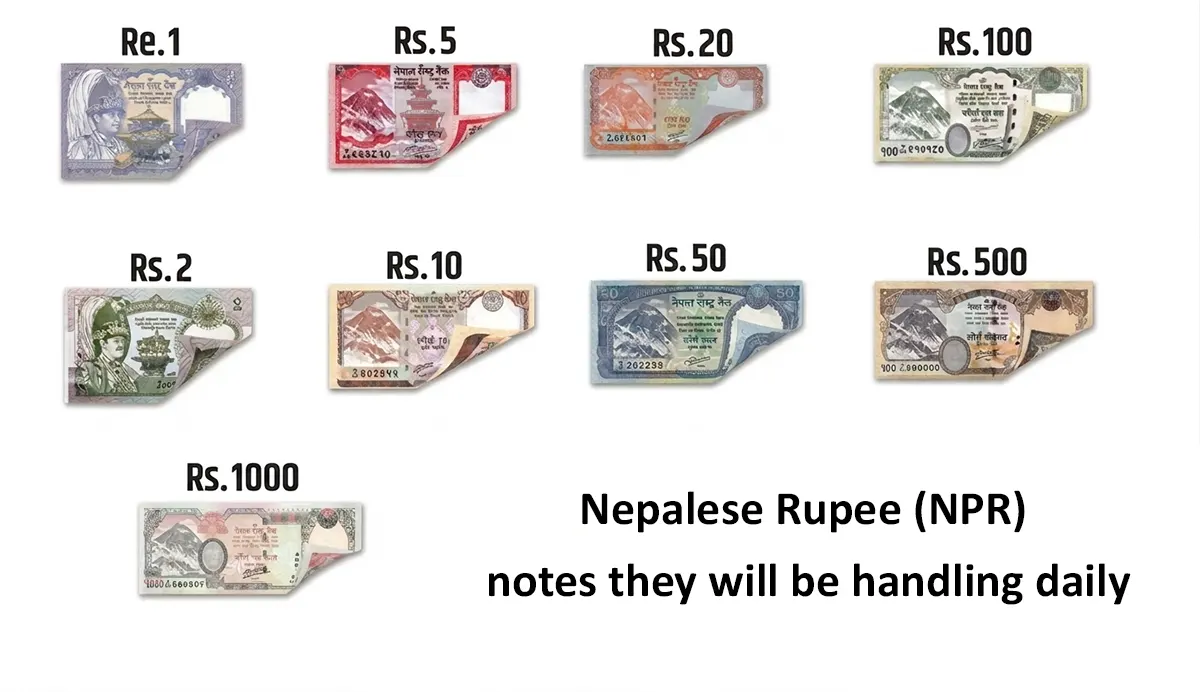
The official legal tender used across the country is the Nepalese Rupee, which uses the currency code NPR. This currency is locally symbolized by the characters “Rs” or the federal sign “रू” preceding the amount. Furthermore, the central banking authority, Nepal Rastra Bank, strictly regulates the issuance and circulation of all legal banknotes.
Currently, you will find banknotes circulating in denominations of 1, 2, 5, 10, 20, 50, 100, 500, and 1000 rupees. Although smaller coins exist, merchants rarely use them, so you will almost exclusively handle paper notes during your trip. Consequently, travelers should learn to identify the distinct colors and wildlife illustrations featured on each specific paper denomination.
As a vital note for this Nepal currency guide for tourists, remember that the local economy relies heavily on physical cash. While high-end establishments embrace digital transactions, the heart of the country runs on tangible banknotes. Therefore, keeping your wallet stocked with diverse denominations guarantees seamless daily interactions wherever you travel.
Importantly, the Nepali Rupee exchange rate maintains a strict peg to the Indian Rupee (INR) at a fixed 1.6:1 ratio. Because of this economic link, Indian currency is widely accepted in many Nepalese commercial centers, with some critical structural exceptions. Specifically, local authorities prohibit the use of Indian 1000 and 500 rupee banknotes within the country’s financial ecosystem.
For global currencies like the US Dollar, Euro, or British Pound, the exchange values fluctuate daily based on global market forces. The central bank sets a daily baseline, which commercial counters follow with minor retail margins. Therefore, checking the benchmark values online helps you verify whether a retail counter is offering an honest transaction rate.
Additionally, satisfy the foreign currency regulations enforced locally by bringing pristine, undamaged foreign banknotes for the conversion process. Local tellers routinely reject foreign bills that are torn, heavily creased, marked with ink, or printed before specific series years. Therefore, ask your home bank for crisp, newly minted banknotes before departing on your international flight.
When looking at where to exchange money in Kathmandu, you must utilize legally authorized money changers or licensed commercial banking branches. These official entities are heavily concentrated in urban centers, international airport arrival terminals, and popular tourist districts like Thamel. To protect your funds, always avoid unauthorized street dealers who promise unrealistic rates but operate illegally without government oversight.
Licensed money changers display their daily buying and selling rates on prominent electronic boards outside their shops. When you visit a counter, you must present your physical passport containing a valid Nepalese tourist visa. The teller will calculate the transaction using the daily official rate and provide a formal receipt for your records.
Crucially, retain these encashment certificates because you might need them at the airport to convert remaining rupees back to foreign currency. If you travel outside Kathmandu, note that exchange rates drop significantly in smaller mountain villages. Thus, converting the bulk of your foreign funds in the capital city remains the most financially sound strategy.
Finding the best ATMs in Kathmandu for foreigners is relatively simple because major urban areas feature modern banking infrastructure. Standard global networks, including Visa, Mastercard, and UnionPay, work seamlessly across automated teller machines operated by reputable commercial banks. Specifically, Nabil Bank, Himalayan Bank, and Standard Chartered Bank offer the most dependable connectivity for international debit cards.
However, most local ATMs impose a strict transactional withdrawal limit ranging between 10,000 and 35,000 rupees per transaction. Additionally, local banks levy a standard processing fee of roughly 400 to 500 rupees for each separate overseas transaction. Because these fees accumulate quickly, making fewer large withdrawals is far more economical than making multiple small cash extractions.
To ensure uninterrupted card access, notify your domestic banking provider about your specific travel dates before arriving in Asia. Otherwise, automated fraud prevention systems might flag your sudden Asian transactions and instantly freeze your primary financial accounts. Finally, always carry a backup debit card from a different network to guard against localized technical outages.
A common question for adventurers is, “are there ATMs on the Everest Base Camp trek?” While the Khumbu region has developed significantly, automated teller machines remain exceptionally rare and unreliable along high-altitude trails. You can find limited banking branches in Lukla and the vibrant trading hub of Namche Bazaar.
However, these remote mountain machines frequently run completely out of cash due to high demand from incoming trekkers. Furthermore, frequent alpine power outages and satellite connectivity drops can render these terminals completely useless for days at a time. Beyond Namche Bazaar, there are absolutely no cash machines available as you ascend toward base camp.
Therefore, you should never count on finding functional cash dispensers while hiking through remote mountain territories. Instead, treat Namche Bazaar as your absolute final safety net for emergency funds only. Withdraw your full estimated supply of physical Nepalese Rupees in Kathmandu before your scenic flight to Lukla begins.
While considering using international credit cards in Nepal, you will observe a distinct divide between urban centers and rural villages. Major establishments, including boutique hotels, upscale restaurants, and souvenir shops in cities, accept digital payments without any major issues. However, smaller family-owned retail shops, local transport providers, and street food vendors operate purely on physical cash transactions.
Additionally, most local businesses add a merchant processing surcharge of 3% to 4% onto your credit card total. This extra cost covers the processing fees charged by the regional banking networks handling the wireless transaction. Therefore, paying with cash is often the cheapest choice for smaller daily purchases like coffee or light snacks.
Regarding alternative options, utilizing premium travel cards can significantly minimize your international transaction costs. Platforms like Revolut or Wise allow you to convert money into major currencies while keeping conversion margins incredibly low. Nevertheless, always verify if your chosen digital card platform supports direct cash withdrawals at ATMs within South Asia.
Determining how much cash to bring to Nepal depends entirely on your travel style and your pre-paid arrangements. If you book comprehensive boutique packages through a local agency, your core expenses like hotels and flights are covered. Under these organized conditions, you only need personal spending money for extra drinks, souvenirs, and your crew’s tips.
As a general rule, bringing roughly $300 to $500 USD in physical foreign banknotes per person is highly advisable. This hard currency serves as an excellent emergency reserve if global banking networks experience temporary regional communication blackouts. You can easily keep this cash securely stored in your hotel safe or your deep money belt.
For independent travelers, your physical cash needs will be substantially higher to cover daily accommodation and trail permits. Calculate your total estimated expenses carefully based on your itinerary length, then add a 20% cash buffer. Having this financial cushion guarantees you can comfortably handle unexpected itinerary shifts or flight delays caused by mountain weather.
Calculating the Nepal average daily travel cost helps you structure your vacation budget efficiently without running out of funds. For independent city explorers, an average daily budget of 30 to 50 US dollars covers standard meals and transport. Budget backpackers can survive comfortably on 20 dollars per day by utilizing local public transport and homestay facilities.
Conversely, luxury travelers should naturally budget higher amounts to cover premium fine dining experiences, private helicopter charters, and upscale spa treatments. When you head into the mountains, daily costs shift because remote transportation increases the price of basic goods. A typical day on a trekking trail ranges from $25 to $40 USD for food and lodging.
| Travel Style | Estimated Daily Cost | Core Inclusions |
| Budget Backpacker | $20 – $25 USD per day | Homestays, public buses |
| Mid-Range Explorer | $30 – $50 USD per day | Guesthouses, taxis |
| Luxury Traveler | $150+ USD per day | 5-star hotels, flights |
| Mountain Trekker | $25 – $40 USD per day | Tea houses, trail meals |
Remember that amenities like high-speed Wi-Fi, hot showers, and electronic device charging cost extra fees along mountain routes. These small comforts add up quickly, so tracking your daily incidental spending is essential for staying on target. Planning ahead ensures your holiday budget remains perfectly balanced from your arrival to your departure.
Providing tips is a deeply ingrained custom within the South Asian tourism industry, reflecting appreciation for challenging physical labor. A professional tipping guide for trekking guides and porters Nepal helps you reward your mountain crew fairly based on regional realities. Although tipping is entirely voluntary, it serves as a crucial income supplement for guides, porters, and assistant cooks.
For a standard group trek, budgeting 15 to 20 US dollars per day for the lead guide is customary. Meanwhile, your dedicated porter should receive roughly 10 to 15 dollars per day for carrying your heavy gear. If you travel with an assistant guide, rewarding them with 10 to 12 dollars daily is highly recommended.
Always distribute these collective tips on the final evening of your trek at the regional trail completion point. Hand the money directly to each worker inside a sealed envelope to ensure your staff receives their compensation privately. Furthermore, try to tip using local currency notes so your crew doesn’t have to pay currency exchange fees.
Food lovers often wonder, “is tipping mandatory in Nepal restaurants?” Strictly speaking, tipping is not legally mandatory, but the cultural practice varies depending on the type of dining establishment you visit. In casual local eateries and street food stalls, tipping is rare, though leaving small change is appreciated.
However, mid-range and upscale tourist restaurants in Kathmandu and Pokhara automatically add a 10% Service Charge to your final bill. This mandated charge is legally designated to be distributed among the kitchen and waitstaff as part of their salary structure. When this fee is clearly printed on your receipt, adding an extra tip is completely unnecessary.
If a restaurant does not include a service fee, leaving a 5% to 10% cash tip is a wonderful gesture. This modest addition directly rewards the waitstaff for providing attentive service during your dining experience. Always look closely at your final bill before leaving cash on the table to avoid paying double gratuities.
Turn your dream Himalayan adventure into reality without any financial stress. Contact the local experts at Nepal Tour Package today to design an all-inclusive, professionally guided itinerary perfectly tailored to your budget!