If you only have room for one UNESCO site in your Nepal itinerary, most Kathmandu Valley locals will point you toward Bhaktapur Durbar Square before Kathmandu’s own. It isn’t just a monument zone you walk through with a camera and a ticket stub. Bhaktapur is a living, breathing Newar town where potters still spin clay wheels by hand, where curd is fermented in clay bowls the same way it was a century ago, and where the streets themselves are closed to traffic so you can actually stop and look up.
This guide covers everything a first-time visitor actually needs: the current entry fee and how the one-week ticket extension works, a breakdown of Bhaktapur’s four connected squares, the history behind the Nyatapola Temple and the 55-Window Palace, where to eat authentic juju dhau (king curd), how to get here from Thamel, and a realistic one-day itinerary that pairs Bhaktapur with Changu Narayan. Whether you’re a solo backpacker, a family with kids, a photographer chasing golden-hour light on pagoda roofs, or planning a custom Nepal tour with a local operator, this is the only page you’ll need to open before you go.
Quick Answer: Bhaktapur Durbar Square entry costs NPR 1,800 (about USD 18) for most foreign nationals, NPR 500 for SAARC nationals and Chinese citizens, and is free for Nepali citizens. The ticket covers the entire old city, including Taumadhi Square, Pottery Square, and Dattatraya Square, and can be extended to a full week free of charge if you show your passport at the ticket counter.
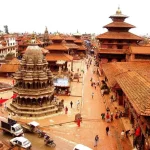
Bhaktapur (also called Bhadgaon, or Khwopa in the local Newari language) was one of three independent royal city-states in the Kathmandu Valley during the Malla period, alongside Kathmandu and Patan. Because Bhaktapur sat slightly apart from the valley’s main trade routes and modern sprawl, it retained more of its original medieval character than its two sister cities. Brick-paved lanes, wood-carved windows, and pagoda-style temples survive here in a density you won’t find anywhere else in Nepal.
The town earned the nickname “the city of devotees” for good reason: religious life is woven into daily routine, from morning rituals at neighborhood shrines to major chariot festivals that shut down entire squares for days. For travelers, that means Bhaktapur rewards more than a rushed hour of sightseeing. Give it a proper half or full day, and ideally, a sunset.
One of the most common questions from first-time visitors is what exactly their ticket covers, and why Bhaktapur “feels bigger” than a single square. That’s because Bhaktapur’s old town is organized around four connected public squares, each with its own character. Your single entry ticket covers all four.
| Square | What It’s Known For | Must-See Highlights |
|---|---|---|
| Durbar Square | The former royal palace complex and main heritage core | 55-Window Palace, Golden Gate, Vatsala Devi Temple, National Art Gallery |
| Taumadhi Square | Bhaktapur’s social and religious hub, a short walk from Durbar Square | Nyatapola Temple, Bhairavnath Temple, rooftop restaurants |
| Pottery Square (Kumale Tole) | Bhaktapur’s traditional clay-working community | Rows of pottery wheels, sun-drying clay pots, hands-on pottery classes |
| Dattatraya Square | Bhaktapur’s oldest residential quarter with wood-carving heritage | Dattatraya Temple, Pujari Math, Woodcarving Museum, Peacock Window |
Is the Bhaktapur Durbar Square ticket valid for Pottery Square and Dattatraya Square? Yes. A single entry ticket for the Bhaktapur Cultural Heritage City grants access to the entire old town, so you do not need separate tickets for Taumadhi, Pottery, or Dattatraya Squares. Ticket inspectors do random checks on the connecting lanes, so keep your ticket with you throughout your visit rather than leaving it at your hotel.
| Visitor Category | Entry Fee | Notes |
|---|---|---|
| Foreign Nationals (most countries) | NPR 1,800 (approx. USD 18) | Covers all four squares |
| SAARC Nationals (India, Bangladesh, Bhutan, Maldives, Pakistan, Sri Lanka) | NPR 500 | Passport or national ID required as proof |
| Chinese Citizens | NPR 500 | Passport required as proof |
| Nepali Citizens | Free | National ID required |
| Children under 10 | Free | All nationalities |
| Group Leaders (groups of 11 to 20 foreign tourists) | 1 free entry | Applies to the designated tour leader only |
Where do you buy the official entrance pass? Entry tickets are sold at the official ticket counters positioned at every main entrance into the old city, most notably near the main Durbar Square gate coming from the bus park side. Do not buy tickets from unofficial vendors or “guides” waiting outside the checkpoints; always use the marked government booths.
Can you pay with credit card or cash? Cash in Nepali Rupees is the most reliable payment method at the ticket counters. Some booths accept cards or mobile wallets, but connectivity issues are common, so carrying cash avoids delays, especially if you’re arriving early morning or in a group.
This is one of the most useful and least advertised details for travelers planning to stay in the Kathmandu Valley for several days. Bhaktapur’s municipal office allows foreign visitors to extend their single-entry ticket into a multi-day pass valid for up to seven days, at no extra cost.
Steps to extend your ticket:
This is genuinely useful if you’re staying overnight in Bhaktapur, doing a day trip and returning later in your Nepal itinerary, or splitting your visit across a busy Kathmandu Valley schedule. Without the extension, a fresh ticket must be purchased on any later visit.
Pro Tip: Ask for the extension on the same day you buy your ticket, not after you’ve already left the counter area. Staff are used to the request, but it’s far easier to process while you’re still standing at the booth.
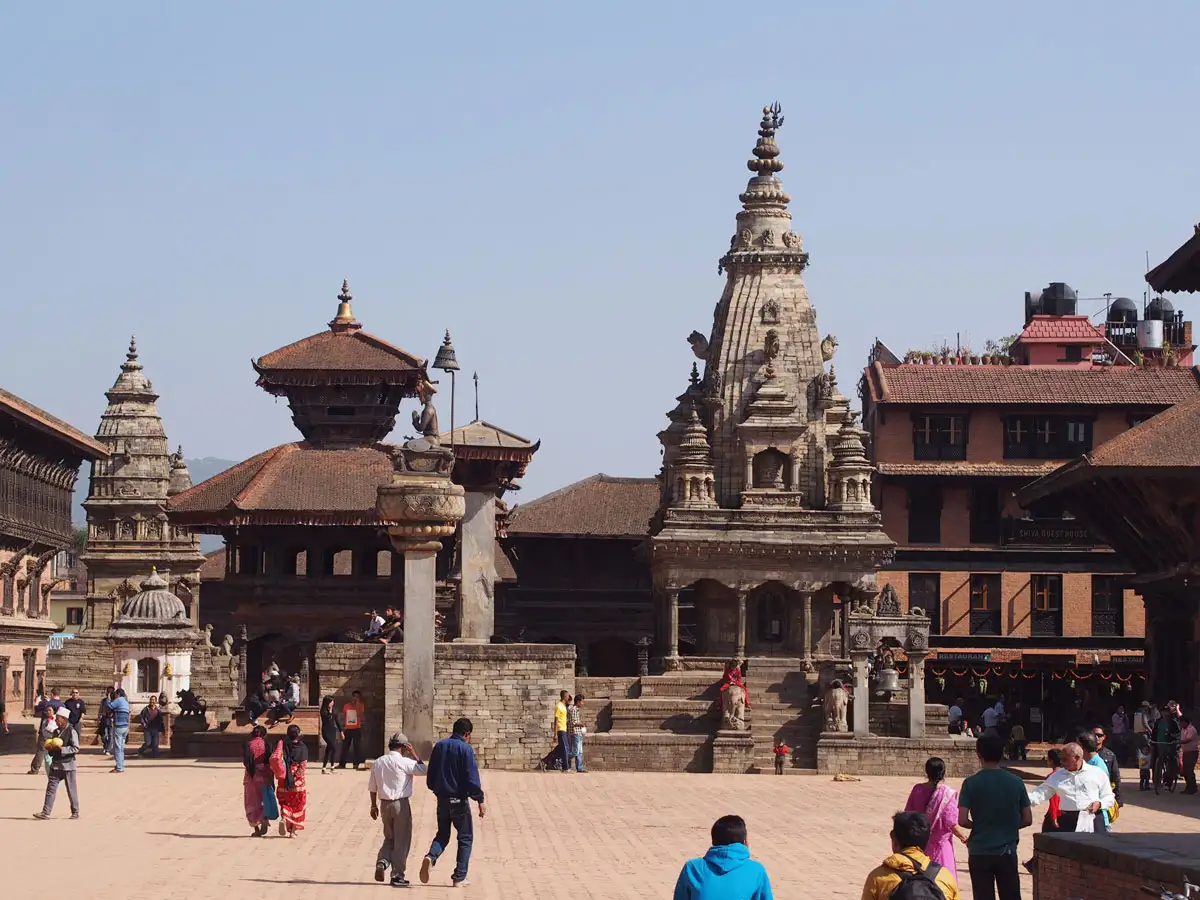
Bhaktapur rose to prominence under the Malla dynasty, and it was during the reign of King Bhupatindra Malla in the late 17th and early 18th centuries that the square gained much of the architecture still standing today. Unlike Kathmandu Durbar Square, which sits inside a dense modern city, or Patan Durbar Square, known for its Buddhist-Hindu artistic fusion, Bhaktapur’s palace complex retains a slower, more residential feel, with narrow lanes opening suddenly into wide brick courtyards.
The 55-Window Palace is the most photographed structure in Durbar Square, named for the row of intricately carved wooden windows lining its upper facade. Each window was carved by hand, and no two are identical. Attached to the palace is the Golden Gate (Sun Dhoka), an ornately gilded entrance often described as one of the finest surviving pieces of metal repoussé art in Nepal. It functions as the ceremonial entry to the palace’s inner courtyards, including the Taleju Temple complex, which remains closed to non-Hindus.
Standing near the palace is the stone Vatsala Devi Temple, built in a South Indian shikhara style rather than the pagoda form more common in the valley, giving it a distinct silhouette among its neighbors. Beside it hangs the Barking Bell, a large bronze bell cast in the 18th century. Local tradition holds that anyone who hears its full toll at night will experience nightmares, which is why it’s rung only during specific rituals and the daily curfew announcement of the old city guard, historically.
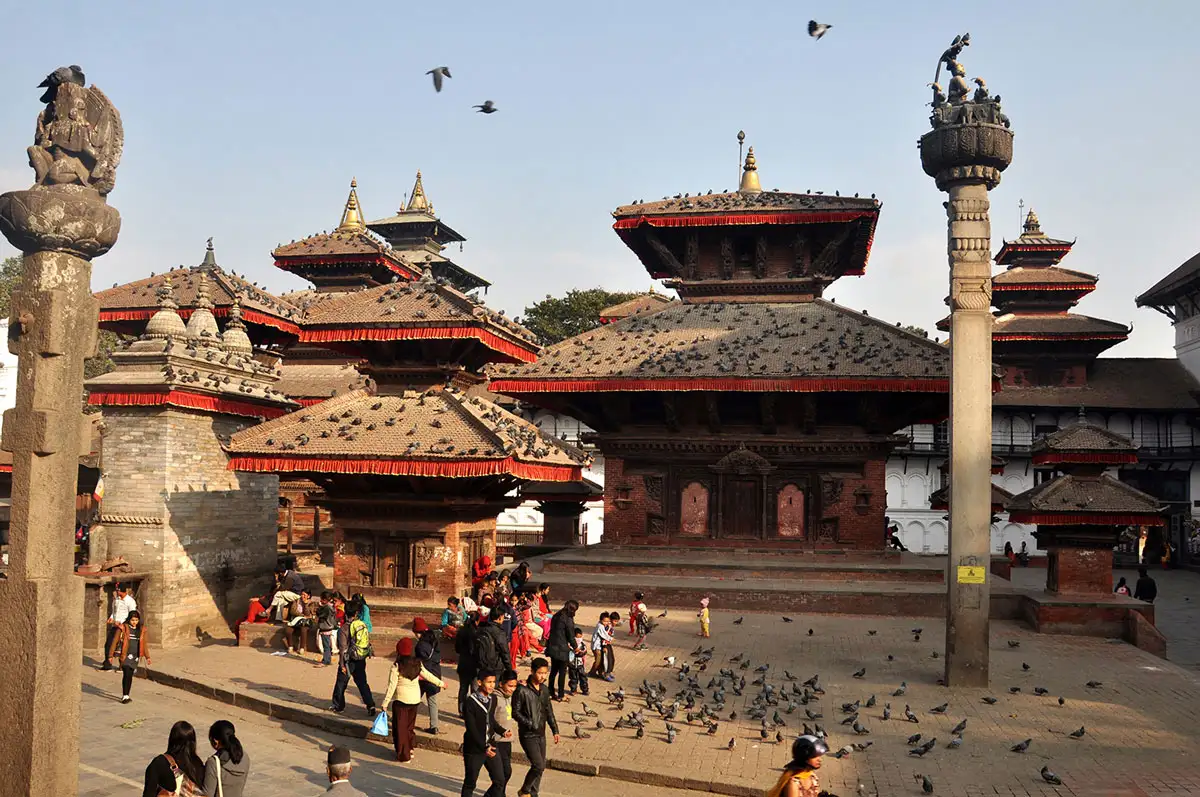
A short walk from Durbar Square, in Taumadhi Square, stands the five-story Nyatapola Temple, built in 1702 under King Bhupatindra Malla. At roughly 30 meters, it’s the tallest pagoda-style temple in Nepal, and it’s famous for having survived multiple major earthquakes, including 1934 and 2015, with only minor damage.
What does “Nyatapola” mean and why is it five stories? The name translates roughly to “five-roofed” in Newari. Each of its five terraces is guarded by a pair of stone figures, said to each be ten times stronger than the pair below: wrestlers, elephants, lions, griffins, and finally the goddess Siddhi Lakshmi at the top, to whom the temple is dedicated.
| Feature | Bhaktapur Durbar Square | Patan Durbar Square | Kathmandu Durbar Square |
|---|---|---|---|
| Dominant Influence | Newar Hindu, Malla-era royal architecture | Hindu-Buddhist artistic fusion | Mixed royal and religious, heavily urbanized |
| Signature Structure | 55-Window Palace, Nyatapola Temple | Krishna Mandir (stone shikhara temple) | Kasthamandap, Kumari Ghar |
| Setting | Traffic-free old town, residential feel | Surrounded by modern Lalitpur city | Embedded in busy central Kathmandu |
| Crowd Levels | Moderate, spread across four squares | Moderate to high | High, especially near main gates |
| Earthquake Recovery | Largely restored, minimal visible damage | Restored, some scaffolding may remain | Restored, ongoing conservation in places |
Two museums inside Durbar Square are frequently overlooked by visitors rushing between temples, yet they add real depth to understanding Newar craftsmanship.
A combined entry to these museums is typically included within the general heritage fee or requires a small additional charge at the museum door; confirm at the counter, as museum access policy is updated periodically.
A five-minute walk south of Durbar Square brings you to Bhaktapur’s Pottery Square, locally known as Kumale Tole. Here, generations of Newar potter families still work manual wheels in open courtyards, shaping everything from water jugs to decorative diyas, then laying them out in the sun to dry before firing.
What can you do at Pottery Square?
Taking a short class is genuinely one of the best “hidden” experiences in Bhaktapur. It costs relatively little, takes 30 to 60 minutes, and gives you a far better appreciation of the skill involved than simply watching from the sidelines.
Bhaktapur is considered the birthplace of juju dhau, literally “king curd,” a rich, slightly sweet set yogurt served in handmade clay bowls. The clay itself plays a role in the flavor and texture, absorbing excess whey and giving the curd its distinctive thickness.
Where to try authentic juju dhau: Small family-run curd shops around Durbar Square and along the lanes near Taumadhi Square serve it fresh daily, usually in disposable clay cups you can keep as a souvenir. Look for shops with a steady stream of local customers rather than the most tourist-facing storefronts, a reliable sign of freshness.
Several small restaurants and cafés around Taumadhi Square have rooftop or upper-floor seating with direct views of the Nyatapola Temple, making them popular spots for a relaxed lunch, a coffee break, or sunset drinks. Prices are moderate compared to Thamel, and the temple view alone is worth the stop, particularly in the late afternoon when the light softens against the temple’s terracotta brick.
Other local specialties to try in Bhaktapur:
Bhaktapur is one of the best places in the Kathmandu Valley to buy authentic Nepali handicrafts directly from producers rather than mass-market shops in Thamel.
What to look for:
Buying here supports artisans directly and typically costs less than equivalent souvenirs sold in more heavily touristed parts of Kathmandu.
Bhaktapur sits roughly 13 to 15 kilometers east of central Kathmandu, and several transport options are available depending on your budget and comfort preference.
| Method | Approx. Travel Time | Approx. Cost | Notes |
|---|---|---|---|
| Local public bus | 45 to 75 minutes | NPR 40 to 60 | Departs regularly from Ratna Park or Bagh Bazar; frequent stops, can be crowded |
| Private taxi | 30 to 50 minutes | NPR 1,000 to 1,500 one-way (negotiate before departure) | Fastest and most comfortable, traffic dependent |
| Ride-hailing app (Pathao, InDrive) | 30 to 50 minutes | Often cheaper than street taxis | Requires local SIM and app setup |
| Organized day tour | Half or full day | Varies by package | Includes guide, transport, and often Changu Narayan combined |
Is Bhaktapur Durbar Square completely vehicle and traffic free for tourists? Yes, the core old town, including all four squares, has been closed to general vehicle traffic since it was restored following brief exceptions made for earthquake relief efforts after 2015. This makes Bhaktapur one of the most pleasant places in the Kathmandu Valley to walk freely without dodging motorbikes, unlike much of central Kathmandu.
Short Answer: The best time to visit Bhaktapur Durbar Square is during Nepal’s dry seasons, October to December and March to April, when skies are clear, temperatures are comfortable for walking, and major festivals like Bisket Jatra (April) add cultural energy to your visit.
| Season | Months | Conditions | Good For |
|---|---|---|---|
| Autumn | October to November | Clear skies, mild days, cool evenings | Photography, general sightseeing, festivals |
| Winter | December to February | Cold mornings, sunny midday, dry | Fewer crowds, budget travel |
| Spring | March to April | Warm days, occasional haze, Bisket Jatra festival | Festival visits, cultural immersion |
| Monsoon | June to September | Frequent rain, humid, lush green surroundings | Fewer tourists, muddy lanes, carry rain gear |
Early morning visits, ideally before 9 a.m., offer the softest light for photography and the quietest streets before tour groups arrive.
Bisket Jatra is Bhaktapur’s most important annual festival, marking the Nepali New Year in mid-April. A massive wooden chariot carrying the deity Bhairav is pulled through the streets by two rival neighborhood groups in a tug-of-war style procession that can turn into a genuinely chaotic, thrilling scene, followed by the raising of a tall wooden pole (lingo) in an open field at the edge of town.
If your travel dates align with mid-April, witnessing even part of Bisket Jatra adds an entirely different dimension to a Bhaktapur visit, though expect significantly larger crowds and some street closures around the main procession route.
For travelers with a single day to dedicate to the eastern Kathmandu Valley, pairing Bhaktapur with Changu Narayan Temple, Nepal’s oldest Hindu temple and a separate UNESCO World Heritage Site, makes for an efficient and rewarding day.
This itinerary works well for solo travelers, couples, and families with older children. For families with young kids or travelers with limited mobility, consider splitting this into two half-day visits with a private vehicle on standby.
Staying overnight in Bhaktapur is genuinely worth considering, especially for photographers and travelers interested in daily Newar life. Most day-trippers leave by late afternoon, and the town changes character noticeably once tour groups depart: locals reclaim the courtyards, evening rituals begin at small neighborhood shrines, and the temples are beautifully lit after dark with far fewer people around.
Accommodation options range from simple guesthouses tucked into traditional courtyard buildings to a small number of boutique heritage hotels near the main squares. Rooms directly on Durbar Square are limited and book up quickly, particularly around Bisket Jatra, so reserve in advance if an overnight stay appeals to you.
Practical Travel Tips
What to Pack
Culture and Etiquette
Photography Tips
Responsible Tourism
Bhaktapur suits nearly every kind of traveler, but it particularly rewards:
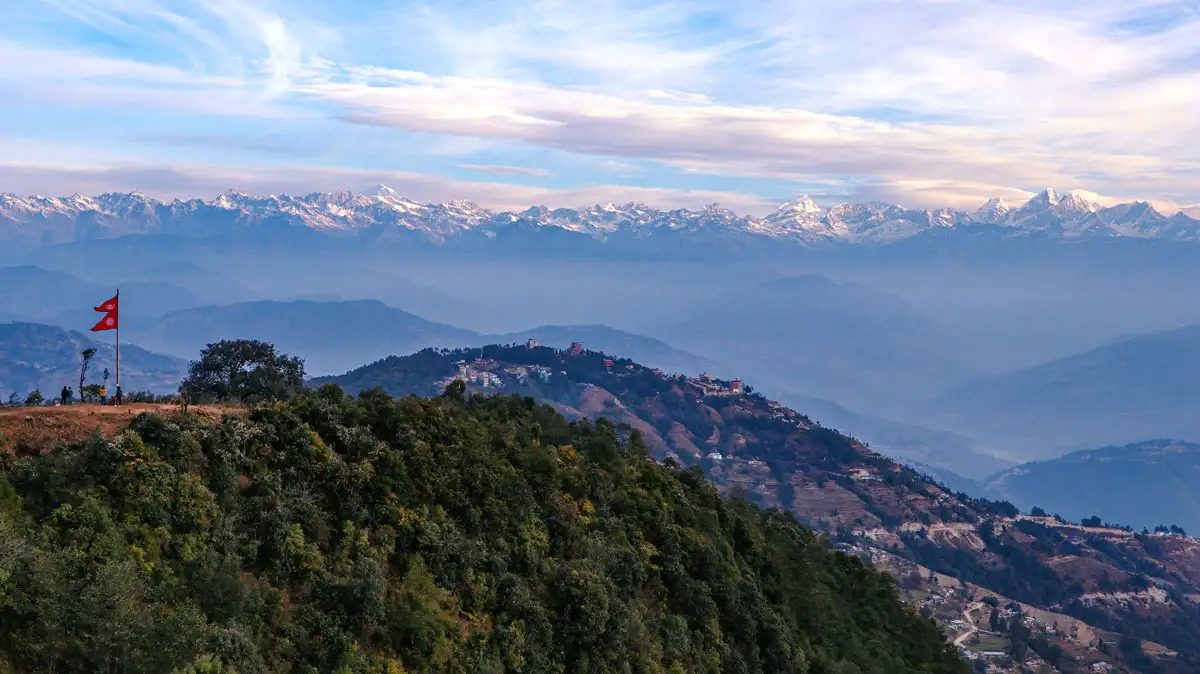
If you’d rather not coordinate transport, tickets, and timing yourself, Nepal Tour Package Pvt. Ltd. arranges private and small-group Kathmandu Valley heritage tours built around Bhaktapur Durbar Square, including combined itineraries with Changu Narayan, Nagarkot sunrise excursions, and full Kathmandu Valley UNESCO circuits covering Kathmandu, Patan, and Bhaktapur in a single trip. Our Kathmandu-based team can also build a fully customized itinerary around your travel dates, whether you’re planning a short layover day trip or a multi-day cultural immersion. Reach out to our local experts to plan the right combination for your schedule and interests.
Bhaktapur Durbar Square rewards visitors who slow down. Between the carved windows of the royal palace, the towering silhouette of Nyatapola Temple, the quiet rhythm of Pottery Square, and a bowl of fresh juju dhau eaten on a rooftop overlooking Taumadhi Square, this is one of the few places in the Kathmandu Valley where history isn’t behind glass, it’s still being lived. Whether you visit for an afternoon or extend your ticket for a full week, Bhaktapur deserves more than a passing stop on your Nepal itinerary.
📞 +977 9841620757 (Available on WhatsApp, Viber, WeChat, RedNote)
✉️ info@nepaltourpackage.com / nepaltourpackage@outlook.com
📍 Kathmandu, Nepal