Perched on a forested hillock in the western part of Kathmandu, Swayambhunath Stupa is one of the oldest and most photographed religious sites in Nepal. Locally nicknamed the “Monkey Temple” because of the troops of rhesus macaques that live on the hill, Swayambhunath is a working Buddhist pilgrimage site, a UNESCO World Heritage monument, and one of the best viewpoints over the Kathmandu Valley, all at once.
If you’re planning a visit, you probably have a mix of practical and curious questions: What does it cost to get in? Which staircase should you climb? Are the monkeys actually dangerous? Is sunrise or sunset better for photos? This guide answers all of that, drawing on firsthand travel planning experience from our team at Nepal Tour Package, a Kathmandu-based tour operator that sends travelers up this hill almost every day of the year.
We’ll walk through the entry fees, the routes up (including wheelchair-friendly options), the meaning behind the stupa’s iconic painted eyes, monkey safety, photography timing, nearby shrines most tourists miss, and a realistic sample itinerary you can use whether you have one hour or half a day.
| Detail | Information |
|---|---|
| Location | Western edge of Kathmandu, about 3 km from Thamel |
| UNESCO Status | Part of the Kathmandu Valley UNESCO World Heritage Site (inscribed 1979) |
| Foreign visitor entry fee | NPR 200 per person |
| SAARC national entry fee | NPR 50 per person |
| Nepali citizens & children under 10 | Free |
| Opening hours | Roughly 5:00 AM to 8:00 PM daily |
| Main staircase steps | 365 steps on the eastern side |
| Best time to visit | Early morning (6:00–8:00 AM) or late afternoon before sunset |
| Time needed | 1 to 2.5 hours depending on depth of exploration |
| Wheelchair/senior access | Yes, via the western road entrance |
Swayambhunath is worth visiting because it combines a 1,500-year-old pilgrimage site, the valley’s best panoramic viewpoint, and a rare, living example of Hindu-Buddhist religious harmony, all within a 20-minute ride from central Kathmandu.
For many travelers arriving in Nepal, Swayambhunath is the first proper introduction to the country’s spiritual layer. Unlike a museum piece, the stupa is still very much in use. Monks chant in the surrounding monasteries, elderly Newar and Tibetan devotees spin the prayer wheels each morning, and butter lamps are lit daily at the base of the main chaitya. Combine that with a genuinely impressive view over the Kathmandu Valley, and it earns its reputation as one of Nepal’s essential half-day trips.
According to the founding legend recorded in the Swayambhu Purana, the Kathmandu Valley was once a vast lake. A radiant, self-existent (swayambhu) lotus flower bloomed from its waters, glowing with a divine light. The Bodhisattva Manjushri is said to have arrived from the east and, seeing the lotus, cut a gorge at Chobhar with his sword to drain the lake and make the light accessible to pilgrims. Where the lotus settled became the hill on which Swayambhunath now stands, and the flower is believed to have transformed into the stupa itself.
Archaeological evidence, including a stone inscription from the 5th century AD, confirms the site was already an established Buddhist pilgrimage destination during the Licchavi period, and it likely predates that as an animist or pre-Buddhist sacred hill. Over the centuries, Swayambhunath grew from a modest chaitya into the layered complex of monasteries, shrines, and stupas seen today, shaped by Licchavi, Malla, and later Shah-era patronage. Because both Hindus and Buddhists consider it sacred, it’s often cited as Nepal’s clearest architectural expression of religious coexistence.
The painted eyes on the stupa’s spire are the “Wisdom Eyes” of the Adi-Buddha, representing all-seeing compassion and awareness. The curl between them is not a nose but the Nepali numeral “1” (एक), symbolizing the unity of all existence and the single path to enlightenment.
Each of the four sides of the main golden spire, or harmika, carries a painted pair of eyes gazing out toward the cardinal directions. There is no visible mouth, which local guides often explain as a reminder that wisdom is better expressed through compassion and silence than through speech. Above the eyes, a third eye is painted on the forehead, representing higher spiritual perception, the ability to see beyond ordinary reality.
Below the spire sits the gilded Vajra (thunderbolt), a symbol of indestructible spiritual power central to Vajrayana Buddhism, resting on a stone mandala platform at the top of the main staircase. This is one of the most photographed single objects at the site, and it’s worth pausing here rather than walking straight past it toward the stupa dome.
The whitewashed dome with its gilded spire is the visual centerpiece, ringed by a series of prayer wheels that devotees spin clockwise while circling the base.
Just north of the main stupa stands the pagoda-style Harati Devi Temple, dedicated to the Hindu goddess associated with protecting children and curing smallpox in local tradition. Its presence right beside a Buddhist stupa is a good illustration of the syncretic worship you’ll see throughout the complex.
A quieter, less-visited shrine tucked behind the main stupa, associated with a legendary tantric master said to still be in meditation inside a sealed chamber, believed by some locals to control rainfall over the valley. It rarely draws large crowds, making it a good stop if you want a few minutes away from the main plaza.
At the top of the eastern staircase, before you even reach the main dome, you’ll pass the large gilded Vajra resting on its stone mandala base, flanked by two carved stone lions.
A modest on-site museum near the southwestern side displays historical artifacts and photographs relating to the stupa’s restoration. Several working monasteries and a nunnery sit around the back paths, generally quieter and less touristed than the main plaza.
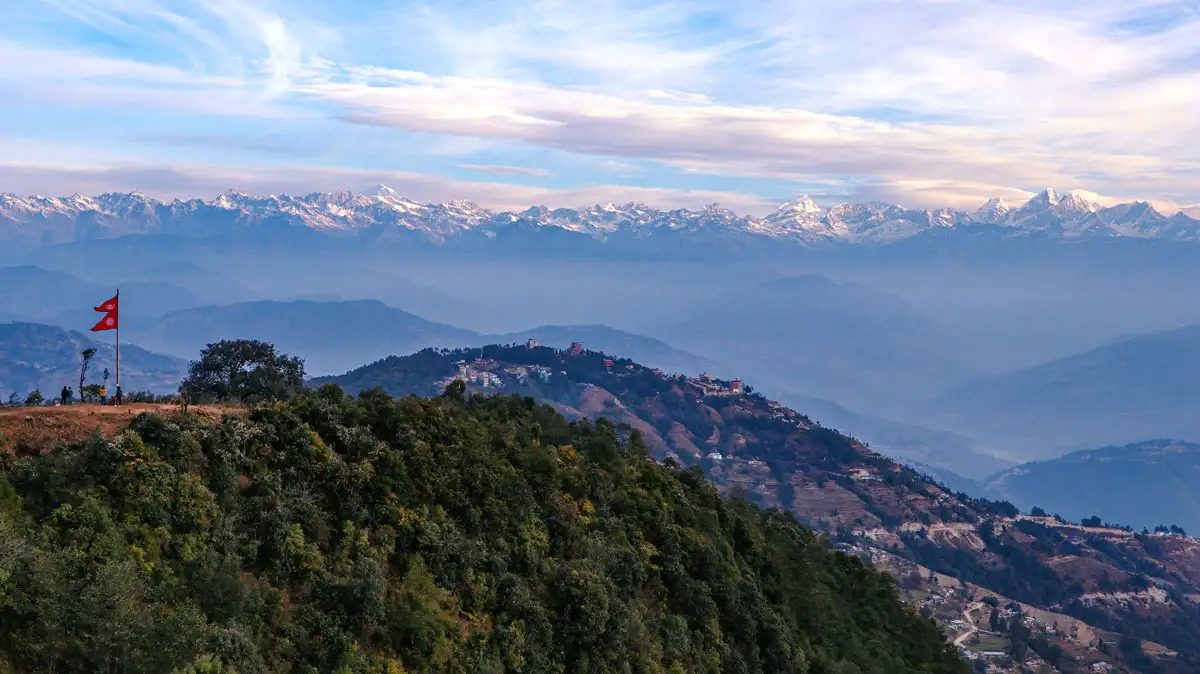
From the hilltop platform, you get a genuine 360-degree sweep of the Kathmandu Valley. On a clear winter morning, the view extends to distant Himalayan ridgelines on the horizon; on a hazier day (common from March to May and in monsoon), the mountains disappear but the sprawling cityscape below is still worth the climb.
Swayambhunath is about 2 to 3 km from Thamel. Walking takes 30 to 45 minutes, a taxi takes 10 to 15 minutes and costs roughly NPR 400–600, and ride-hailing apps like Pathao or InDrive are usually the cheapest door-to-door option.
It’s a flat, doable walk of roughly 30–45 minutes through the Bhagwan Bahal and Chhauni areas, ending at the base of the eastern staircase. It’s a reasonable option if you enjoy street-level Kathmandu and don’t mind traffic and uneven pavement, but it isn’t especially scenic and isn’t recommended in the middle of the day during the hot pre-monsoon months.
A metered or negotiated taxi from Thamel typically costs NPR 400 to 600 one-way and takes 10 to 15 minutes depending on traffic. Always agree on the fare before getting in, or insist the driver uses the meter.
These apps are generally the most transparent and cost-effective option for independent travelers, often 30–50% cheaper than a street-hailed taxi, and they let you choose between the eastern staircase entrance or the western road-side entrance.
Local microbuses run from central Kathmandu toward Swayambhu for around NPR 20–50, but routes aren’t always clearly marked for visitors and this option suits travelers comfortable navigating without English signage.
If you’re arriving by private car, taxi, or tour vehicle, the western gate offers a paved road that climbs almost to the top of the hill, ending at a parking area a short, mostly flat walk from the main stupa plaza. This is the entrance most tour operators use for guests who are older, traveling with young children, or simply short on time, since it avoids the 365-step climb entirely. Parking here is informal curbside space rather than a large managed lot, so arriving outside peak midday hours makes finding a spot easier.
The main eastern staircase to Swayambhunath has 365 steps, one for each day of the year, according to local tradition, climbing roughly 77 meters from the base to the hilltop plaza.
The climb is steep in sections and shaded by trees for much of the way, with resting points, small shrines, and (frequently) resident monkeys along the route. Most reasonably fit travelers manage the climb in 15 to 25 minutes at an easy pace. If you’re visiting with young children, elderly relatives, or anyone with mobility concerns, the western road entrance is the far more practical choice.
Swayambhunath is not a fully wheelchair-accessible site in the way a modern purpose-built attraction would be, but the western back gate makes it realistically accessible for many visitors with mobility limitations. Vehicles can drop passengers close to the hilltop plaza, avoiding the steps entirely, though the plaza and inner walkways themselves have some uneven paving, cobblestones, and minor gradients that a companion or wheelchair-assist may be needed to navigate. If accessibility is a firm requirement for your group, it’s worth telling your tour operator in advance so vehicle drop-off and timing can be planned around quieter hours.
Yes. Swayambhunath is open from roughly 5:00 AM to 8:00 PM, which comfortably covers both sunrise and sunset. Sunrise offers soft light, cooler temperatures, and fewer crowds, while sunset brings warmer tones over the valley but noticeably more visitors and tour groups.
Morning light (arrive by 6:00–6:30 AM) tends to be the better choice for photography and atmosphere: you’ll catch devotees performing their morning kora (circumambulation), the butter lamps still lit from dawn rituals, and cooler air for the climb. Sunset is also rewarding for the valley views and golden light on the stupa’s gilded spire, but expect more foot traffic, tour buses, and vendor activity in the last hour before closing.
| Factor | Best Choice | Why |
|---|---|---|
| Time of day | 6:00–8:00 AM or 4:30–6:00 PM | Softer light, fewer crowds, cooler temperatures |
| Best season for visibility | October to February (post-monsoon, dry winter) | Clearest air, occasional distant Himalayan views |
| Season to avoid for views | March to May, June to September | Pre-monsoon haze and monsoon cloud cover reduce valley visibility |
| Weather note | Check air quality apps in dry season | Kathmandu’s air quality dips in winter dry spells, affecting how far you can see |
Even on a hazy day, the stupa complex itself remains fully worth visiting for its cultural and religious depth, the view is a bonus, not the only reason to go.
According to legend, the monkeys descended from head lice that fell from Manjushri’s hair as he grew his own, transforming into the sacred rhesus macaques that have inhabited the hill ever since. Practically, the forested hillside and constant offerings of food make it an ideal, self-sustaining habitat.
The temple’s popular English nickname, the “Monkey Temple,” comes directly from this resident population, which numbers in the hundreds and is considered sacred rather than a nuisance by most local devotees, even when they’re raiding a snack stall.
Generally no, but they are wild animals accustomed to humans and will act aggressively if they sense food, especially if you’re holding a bag, wrapper, or visible snack. Bites and scratches, while uncommon, do happen most often when tourists try to feed or photograph them at close range.
Rhesus macaques here are habituated to crowds and largely uninterested in people who aren’t carrying anything edible. Problems tend to arise from a specific set of avoidable behaviors: waving food around, letting children approach too closely, or reaching out to touch a monkey for a photo.
A telephoto or zoom lens (even a phone’s zoom function) lets you photograph the monkeys comfortably without approaching them, which produces better, more natural shots anyway since habituated animals tend to pose awkwardly for close-up phone photography. For the stupa and valley views, early morning side-lighting brings out the texture of the whitewashed dome and gilded spire far better than the flat light of midday. If you want people-free architectural shots, arrive right at opening time before tour groups build up around 9:00–10:00 AM.
Walk clockwise around the stupa, keeping it on your right shoulder, in line with Buddhist tradition. Spin the prayer wheels lining the path with your right hand as you pass, in the same clockwise direction, without stopping to reverse or spin them backward.
This clockwise movement (kora) mirrors the perceived motion of the sun and is considered a devotional act in its own right, not just a scenic walking loop. Visitors of any faith are welcome to walk the kora respectfully; you don’t need to be Buddhist to circle the stupa, but going clockwise and spinning wheels in the correct direction is a simple, meaningful courtesy.
Most visitors spend all their time at the main plaza and skip the surrounding shrines entirely, which is understandable given time pressure but means missing some of the site’s most interesting corners. Harati Devi Temple, just steps from the main stupa, draws steady local devotion from parents seeking protection for their children’s health. Shantipur, tucked behind the main complex, is quieter still and tied to one of the valley’s more unusual legends about a meditating tantric sage. Neither requires extra time beyond what’s needed to walk a few minutes off the main path, and both offer a break from the crowds around the central dome.
Stalls lining the staircase and surrounding the plaza sell prayer flags, thangka paintings, mala beads, and singing bowls. Genuinely handmade, hand-hammered singing bowls have a slightly irregular shape and a complex, layered resonance when played; machine-made tourist versions tend to look more uniformly polished and produce a thinner, single-note tone. If a bowl’s authenticity and craftsmanship matter to you, ask the vendor to demonstrate it, compare a few, and expect to negotiate; asking prices are rarely fixed at tourist-facing stalls.
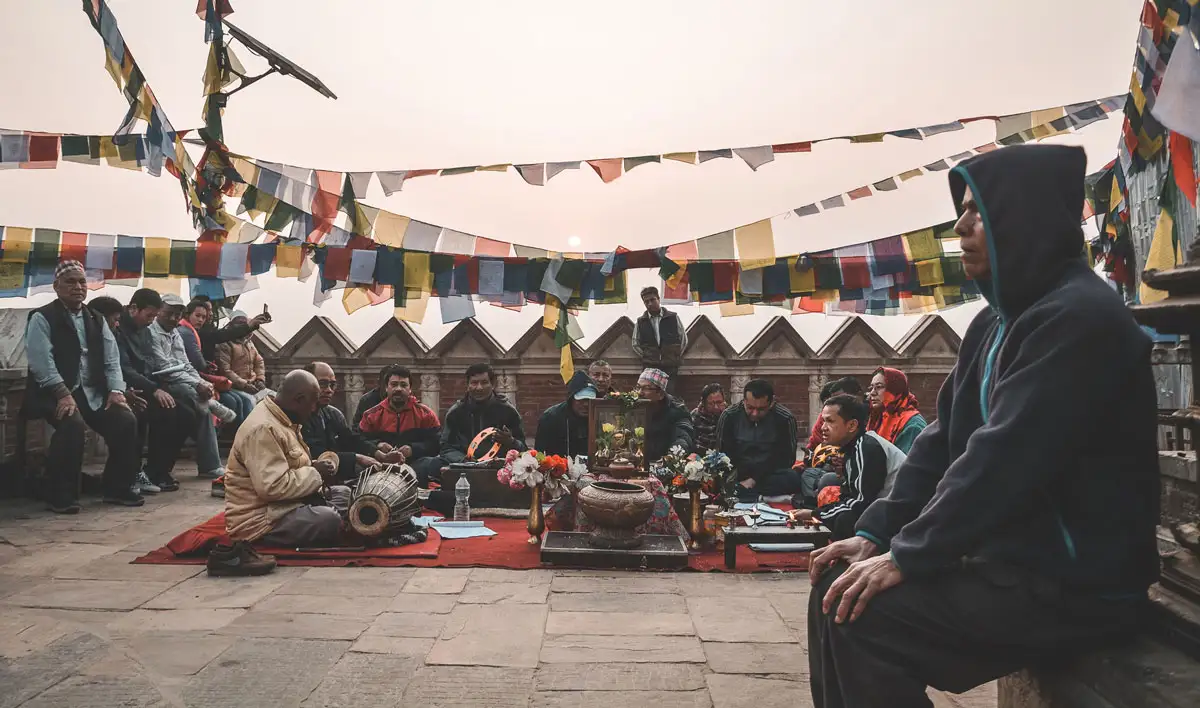
Arriving before 7:00 AM gives you a genuine chance to witness the site’s active devotional life: monks chanting in the monasteries around the hill, devotees lighting butter lamps at small shrines, and elderly worshippers making their kora before the day’s tourist traffic builds. This is a quieter, more contemplative side of Swayambhunath that the midday crowds rarely see, and it costs nothing extra beyond the entry fee.
| Time | Activity |
|---|---|
| 6:00 AM | Depart Thamel by taxi or ride-share |
| 6:15 AM | Arrive at eastern staircase base, buy ticket |
| 6:15–6:40 AM | Climb the 365 steps, pausing at shrines along the way |
| 6:40–7:15 AM | Explore main stupa plaza, Vajra platform, valley viewpoint |
| 7:15–7:40 AM | Visit Harati Devi Temple and Shantipur Temple |
| 7:40–8:00 AM | Walk the back paths, small museum, monastery courtyards |
| 8:00–8:15 AM | Browse souvenir stalls near the descent |
| 8:15 AM | Descend via western road side or return down the staircase |
This itinerary can be shortened to under an hour if you enter via the western gate and skip the back paths, or extended into a full valley heritage day combined with Boudhanath, Pashupatinath, and Kathmandu Durbar Square, an itinerary our team regularly builds for first-time visitors to the valley.
| Season | Months | Conditions |
|---|---|---|
| Winter (dry) | October–February | Clear skies, best mountain visibility, cool mornings, ideal overall |
| Pre-monsoon | March–May | Warmer, increasing haze, occasional dust |
| Monsoon | June–September | Frequent rain, greener hillside, fewer crowds, reduced valley visibility |
October through February is the most reliable window for both comfortable climbing weather and clear valley views, while monsoon months trade visibility for noticeably thinner crowds if you don’t mind carrying a light rain jacket.
Swayambhunath suits a genuinely broad range of travelers. Families appreciate the accessible western entrance and the fact that kids under 10 enter free. Solo backpackers treat it as an easy, low-cost half-day outing from Thamel. Photographers and early risers get real value from the sunrise light and valley views. Spiritual and pilgrimage-focused travelers will find it one of the most historically significant Buddhist sites in the valley. The main groups who should plan carefully are those with serious mobility limitations (use the western gate) and anyone with a strong aversion to monkeys at close range, since they are genuinely everywhere on the staircase route.
Entry fees directly support the ongoing conservation and restoration of the stupa complex, so paying the correct ticket price (rather than accepting an off-book “shortcut” from an informal tout) matters more than it might seem. Buying handmade crafts directly from stallholders on the hill supports local artisan income more directly than mass-produced souvenirs bought elsewhere in the city. And simple monkey-safety habits, not feeding them, not carrying loose snacks, protect both visitors and the animals from the kind of negative encounters that can lead to monkeys being treated as pests rather than the sacred residents local tradition considers them to be.
If you’d rather not coordinate transport, timing, and ticketing yourself, Nepal Tour Package offers guided Kathmandu Valley heritage tours that combine Swayambhunath with Boudhanath, Pashupatinath, and the Durbar Squares in a single well-paced day, along with fully customized itineraries for families, photographers, and pilgrimage-focused travelers who want extra time at specific shrines. Our guides are based in Kathmandu year-round and know the quiet hours, the back paths, and the local etiquette that turns a quick photo stop into a real understanding of the site. Reach out to us to build an itinerary around your travel dates, group size, and interests.
Swayambhunath Stupa rewards a little planning: knowing the correct entry fee, choosing the staircase or the western gate based on your fitness and time, timing your visit for morning or late-afternoon light, and taking a few sensible precautions around the resident monkeys. Beyond the logistics, it remains one of the most genuinely living religious sites in the Kathmandu Valley, still shaped daily by the same chanting, lamp-lighting, and clockwise devotion that has continued here for well over a thousand years. Whether you climb the 365 steps at sunrise or arrive by road for an easier visit, it’s a half-day well spent early in any Nepal itinerary.
If you’d like help building a full Kathmandu Valley heritage day, or a longer customized Nepal itinerary around Swayambhunath, Nepal Tour Package’s Kathmandu-based team can put together a plan suited to your dates, pace, and interests.
📞 +977 9841620757 (Available on WhatsApp, Viber, WeChat, RedNote)
✉️ info@nepaltourpackage.com / nepaltourpackage@outlook.com
📍 Kathmandu, Nepal