Landing in Kathmandu after a long flight, the last thing you want is to spend your first hour in Nepal hunting for a working phone signal. The good news is that getting a tourist SIM card at Kathmandu Airport is genuinely one of the easiest parts of arriving in Nepal — if you know exactly where to go and what to bring.
I’ve walked this route more times than I can count, watched first-time trekkers fumble through the wrong queue, and seen families waste 40 minutes because nobody told them a passport photo wasn’t strictly necessary. This guide strips out the guesswork. You’ll know exactly which counter to walk to, what it costs in 2026, which network suits your specific trip, and how to be online before your driver even finds a parking spot outside.
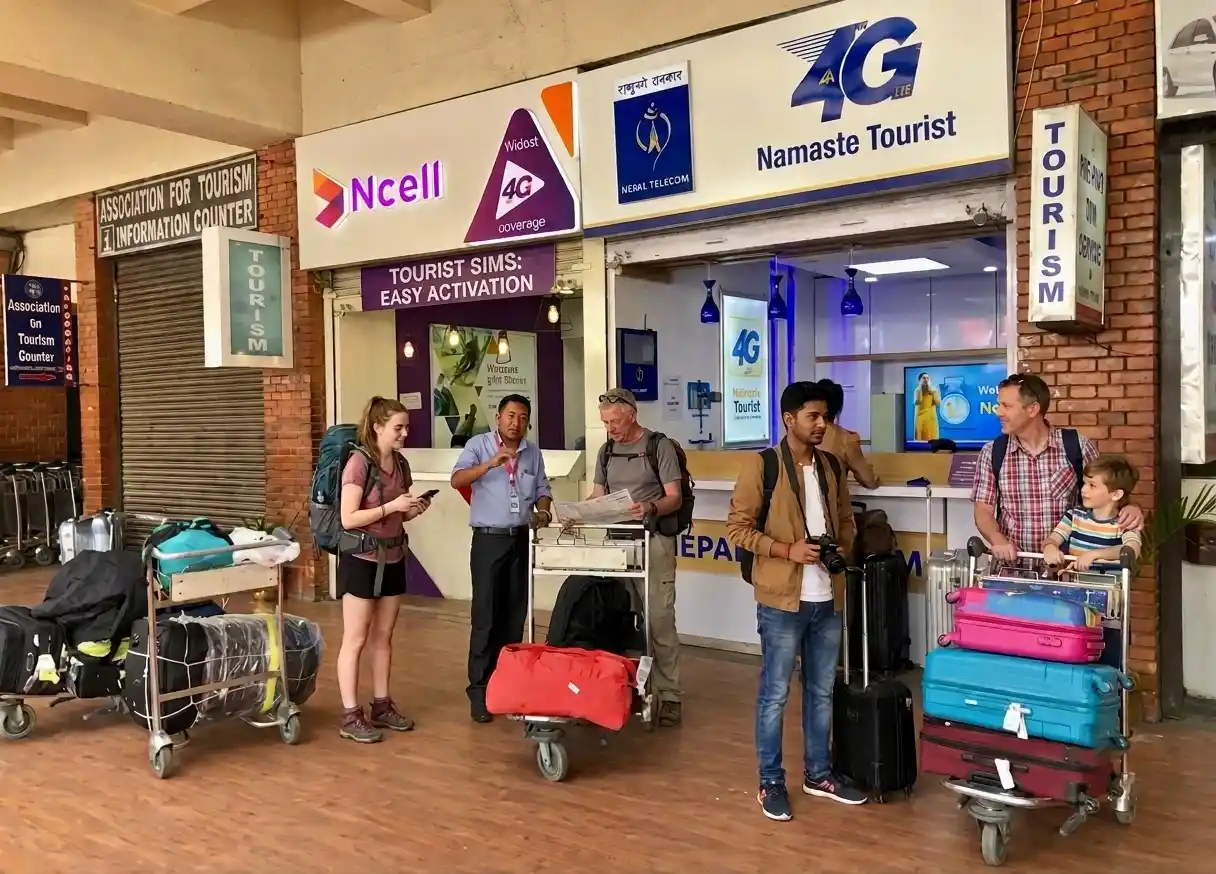
You can buy a tourist SIM card at Tribhuvan International Airport (TIA) in the arrivals hall, right after immigration and baggage claim. Ncell and Nepal Telecom (NTC) both operate counters there. Bring your original passport (photocopies aren’t accepted); a passport photo helps but most counters can take one on the spot. Expect to pay roughly NPR 100–1,200 (about $0.75–$9) depending on the data package, and to be online in 5–15 minutes. Counters serve nearly every international arrival, including late-night flights.
Nepal’s SIM registration laws are strict — this isn’t a “grab a SIM off a shelf” country. Every card must be registered against your passport, which means the process, while fast, isn’t instant. Travelers who don’t prepare tend to lose time in three places: not knowing which counter to walk toward, not having the right payment method ready, or picking a data plan that doesn’t suit their actual itinerary (a city-only trip versus a three-week trek toward Everest Base Camp). This guide solves all three before you land.
Nepal’s mobile market for travelers effectively comes down to two operators, and both have a physical presence at the airport:
There is no single “best” choice — it depends entirely on where your trip takes you, which is exactly what this guide helps you figure out.
Tribhuvan International Airport has a single international arrivals hall, and the SIM counters sit inside it, positioned so you pass them naturally on your way to the exit.
Location: After you clear immigration and collect your luggage from the baggage belt, walk toward the arrivals hall exit. The SIM counters are positioned along this walkway, before you reach the taxi and pickup area — you do not need to step outside the terminal to reach them.
What you’ll see:
Staff at both counters generally speak functional English and deal with tourists all day, every day, so the process is well-rehearsed on their end even if it’s new to you.
If your priority is speed, the Ncell counter typically moves fastest because it has more staff and higher throughput. If your priority is coverage for a Himalayan trek, walk the extra few steps to the NTC counter instead — a slightly longer queue is worth it if you’re heading to Everest or Annapurna.
Here’s the exact sequence, step by step:
Pro Tip: Activate your SIM at the counter, not later at your hotel. If there’s a registration error, it’s far easier to fix while the agent who registered you is still standing in front of you.
Queues build up right after multiple wide-body flights land within the same 30-minute window — common in the late morning and early evening. To skip the worst of it:
This is one of the most common worries for travelers on long-haul flights that land after midnight: will anyone even be there?
The SIM counters at TIA are staffed to match international flight schedules, not fixed office hours. In practice, that means they stay open for nearly every international arrival, including late-night and early-morning flights, because that’s when a large share of long-haul traffic from the Gulf, Europe, and East Asia lands. This is different from Ncell and NTC’s regular city service centers, which run standard business hours (roughly 9:00 AM–5:30 PM on weekdays).
If you land very late and find a counter unexpectedly closed: your hotel Wi-Fi will get you through the night, and Thamel’s mobile shops open again from around 9–10 AM.
| Requirement | Details |
|---|---|
| Original passport | Mandatory. Photocopies are not accepted for initial registration. |
| Passport-sized photo | Not always mandatory — most counters can take one on the spot, sometimes for a small fee (~NPR 50). |
| Local address | Your hotel or guesthouse name and address; write it down in advance to save time. |
| Visa/entry stamp | Not always requested, but useful to have visible. |
| Payment | Nepali rupees preferred; card and USD acceptance varies by counter (see below). |
Note that Nepal’s telecom regulations do not accept Aadhaar cards or other non-passport foreign ID for tourist SIM registration — your passport is the only reliable document to bring.
Short answer: not necessarily. While a printed passport photo can speed things up, nearly every counter at TIA has a small camera setup and can take your photo on the spot, usually within a minute and often for a nominal fee. Don’t delay your trip trying to source a passport photo beforehand — it’s one less thing to worry about.
This is one of the most-asked practical questions, and the honest answer is: it depends on the counter and the day. Nepali rupees is the currency these counters are built around, and it’s the safest assumption. Some counters will accept US dollars or major currency notes for convenience, but typically at a less favorable exchange rate than you’d get from an ATM or currency exchange counter. International Visa and Mastercard are increasingly accepted, especially at the larger Ncell counter.
Practical recommendation: Withdraw a small amount of Nepali rupees from the ATMs inside the arrivals hall (there are several) before heading to the SIM counter. It removes any uncertainty and often gets you a better package price than paying in foreign currency.
Prices below are the most current publicly available figures as of mid-2026. Telecom pricing changes periodically, so treat these as a close estimate rather than an exact quote.
| Package | Data | Validity | Approx. Price (NPR) | Approx. Price (USD) |
|---|---|---|---|---|
| SIM card only | — | — | ~100–110 | ~$0.75–$0.80 |
| Short-stay data pack | 10 GB | 7 days | ~500 | ~$3.60 |
| TouristPro 30-day pack | 5–10 GB | 30 days | ~500–1,000 | ~$4–$8 |
| Package | Data | Validity | Approx. Price (NPR) | Approx. Price (USD) |
|---|---|---|---|---|
| Basic SIM (registration only) | — | — | Often free or ~90 | ~$0.65 |
| Short-stay pack | 1 GB/day | 7 days | ~500 | ~$3.60 |
| Mid-stay pack | 4.5 GB total | 28 days | ~700 | ~$5.10 |
| Long-stay pack | 1 GB/day | 28 days | ~1,200 | ~$8.70 |
| Trekking-length pack | 12 GB | 42 days | ~1,200 | ~$8.70 |
Featured Snippet Answer — How much does a 30-day tourist SIM card cost in Nepal? A 30-day tourist SIM package in Nepal typically costs between NPR 500 and NPR 1,200 (roughly $4–$9), depending on data allowance and network. NTC’s 28-day plans run cheaper for heavy data users, while Ncell’s TouristPro packs offer a good balance of data and call minutes for shorter, city-based stays.
If budget is the priority and you’re mostly staying in Kathmandu or Pokhara, NTC’s data-capped plans (1 GB/day for 7 days at roughly NPR 500) are usually the cheapest way to get a working connection without paying for data you won’t use. If you want more flexibility with no daily cap, Ncell’s short-stay packs offer 10 GB over 7 days at a similar price point.
Yes. Both Ncell and NTC now issue eSIMs directly at their airport counters if your phone supports the feature (most phones from the last five years do). Ask specifically for the eSIM queue — it’s frequently faster than the physical SIM line since there’s no card to physically hand over.
Alternatively, international eSIM providers (Airalo, Holafly, and similar services) let you activate a Nepal data plan before you even board your flight, so you land already connected. The trade-off: these plans are usually data-only — no local phone number, meaning you can’t receive calls from a trekking guide or hotel, and per-gigabyte pricing tends to run higher than a local physical SIM bought at TIA.
Featured Snippet Answer — Is a local SIM or international eSIM better for Nepal? A local physical SIM from Ncell or NTC is generally cheaper per gigabyte and gives you a working Nepali phone number for calls with guides, drivers, or hotels. An international eSIM is more convenient if you want data working the moment you land, but it costs more and won’t provide a local number.
In most cases, from the moment you reach the counter to having a fully working SIM, expect 5 to 15 minutes. During peak arrival windows with several flights landing close together, this can stretch to 20 minutes. Activation itself — the network registering your number — usually completes within a few minutes of the agent submitting your details; the rest of the time is registration paperwork and payment.
Both work well, and the right choice depends on your priorities.
| Factor | Kathmandu Airport | Thamel (Kathmandu) |
|---|---|---|
| Convenience | Highest — get connected before you even leave the terminal | Requires a taxi ride first, so you’re offline until you arrive |
| Price | Slightly higher on some packages | Often marginally cheaper, more plan variety |
| Speed of process | 5–15 minutes | 5–20 minutes, but shop quality varies |
| Staff English proficiency | Consistently good, tourist-focused | Good in licensed shops, mixed in unlicensed ones |
| Risk of unlicensed vendors | None — only official counters operate at TIA | Some risk; stick to clearly branded, authorized shops |
Our recommendation: Buy at the airport if you value your first hours in Nepal being stress-free — especially if you need to coordinate with a driver, guide, or hotel immediately. If you have time to spare and want to compare more package options, Thamel is a reasonable second stop, but there’s no need to specifically wait for it.
This is arguably the most important question for adventure travelers, and it deserves a direct answer.
NTC (Nepal Telecom) generally has the strongest network in high-altitude and remote regions, including sections of the Everest and Annapurna trekking routes, because it’s the state-backed operator with the widest physical infrastructure reach. Ncell tends to be faster in cities — Kathmandu, Pokhara, Bhaktapur, Chitwan — but its signal becomes less consistent above roughly 3,000–3,500 meters on major trekking routes.
On the Annapurna Circuit, both networks generally perform well in lower and mid-elevation villages (Besisahar through Manang). Above Manang and around the Thorong La pass area, NTC tends to hold a signal more consistently than Ncell. Around Annapurna Base Camp and the Machhapuchhre Base Camp area, NTC is the more dependable choice.
Below Namche Bazaar, both Ncell and NTC typically work reliably. Above Namche, NTC is generally considered more consistent through the higher villages (Dingboche, Lobuche), while both networks have been reported to work — though inconsistently — closer to Everest Base Camp itself. Many trekkers on the EBC route rely on a mix of an NTC SIM for basic connectivity and paid WiFi services (such as Everest Link) at teahouses for faster browsing.
Featured Snippet Answer — Which SIM card is best for trekking in Nepal? NTC (Nepal Telecom) is generally the best SIM card for trekking in Nepal, thanks to its wider network infrastructure in remote, high-altitude regions like the Everest and Annapurna routes. Ncell remains the stronger choice for city-based travel with faster urban data speeds.
If your trip includes any multi-day trek, buy an NTC SIM specifically for that purpose, even if you also carry an Ncell SIM for city days. Many experienced trekkers and guides carry two SIMs for exactly this reason — Ncell for Kathmandu and Pokhara, NTC as a backup once they’re on the trail. It costs an extra dollar or two and can be the difference between staying reachable in an emergency and being completely offline for a week.
If you didn’t buy a SIM at the airport, Thamel and Pokhara’s Lakeside district both have authorized Ncell and NTC shops. The process mirrors the airport: passport, photo (if needed), registration form, payment, activation — usually within 5–20 minutes. Before heading into the mountains, top up with enough data or a package that comfortably covers your trek length; recharging mid-trek is possible in larger trail towns (like Namche Bazaar or Manang) but not guaranteed in smaller villages.
For treks longer than two weeks — Everest Base Camp, Annapurna Circuit, Manaslu, or similar — NTC’s 42-day, 12 GB package (roughly NPR 1,200 / $8.70) tends to offer the best balance of validity length and usable data without needing a mid-trek recharge. Shorter treks under 10 days are well served by the 28-day, 4.5 GB plan.
To put this in context, here’s a realistic timeline for a typical international arrival at TIA:
There’s no seasonal element to buying a SIM card itself — counters operate year-round — but the timing matters more during Nepal’s peak trekking seasons (March–May and September–November), when TIA sees a higher volume of international arrivals. During these windows, build a little extra buffer into your airport transfer schedule, since both immigration and SIM counters see longer queues.
Buy only from clearly branded Ncell or NTC counters and shops. Unregistered or informally resold SIM cards can cause connectivity problems later and, in rare cases, legal complications, since Nepal’s telecom registration is tied directly to your passport details. Sticking to official counters at the airport, or licensed shops in Thamel and Pokhara, keeps the process simple and compliant.
Once you’re connected, the arrivals hall at TIA also has currency exchange counters, ATMs, and a tourist information desk — worth using in the same walk-through before you head out to meet your driver or taxi. If you’re heading into Kathmandu proper, Thamel (for onward shopping or gear), Boudhanath Stupa, and Pashupatinath Temple are among the most visited first-day stops for travelers basing themselves in the capital before a trek or cultural tour.
Getting connected is just the first small logistics step of a Nepal trip. If you’re heading toward Everest Base Camp, the Annapurna Circuit, a cultural tour of the Kathmandu Valley, or a Himalayan wildlife safari in Chitwan, it’s worth locking in your permits, guide, and itinerary before you land — connectivity is easy to sort out at the airport, but trekking permits (TIMS, national park entry) and reliable local guides are not something to leave to chance. A local Nepal-based operator can typically confirm these details for you well before your flight lands.
Getting a tourist SIM card at Kathmandu Airport really can take under 10 minutes once you know where to walk and what to bring. Head to the arrivals hall counters with your original passport, pick a network based on your itinerary — Ncell for city speed, NTC for high-altitude reliability — and you’ll be online before you’ve even left the terminal. Whether you’re heading straight into Kathmandu’s temples and alleyways or catching an early jeep toward the mountains, this is one piece of trip logistics you can genuinely resolve in the time it takes to walk from baggage claim to the exit doors. If you’d like help lining up the rest of your itinerary — permits, guides, or a custom Himalayan trip plan — a local Nepal-based travel team can take that off your plate before you even land.