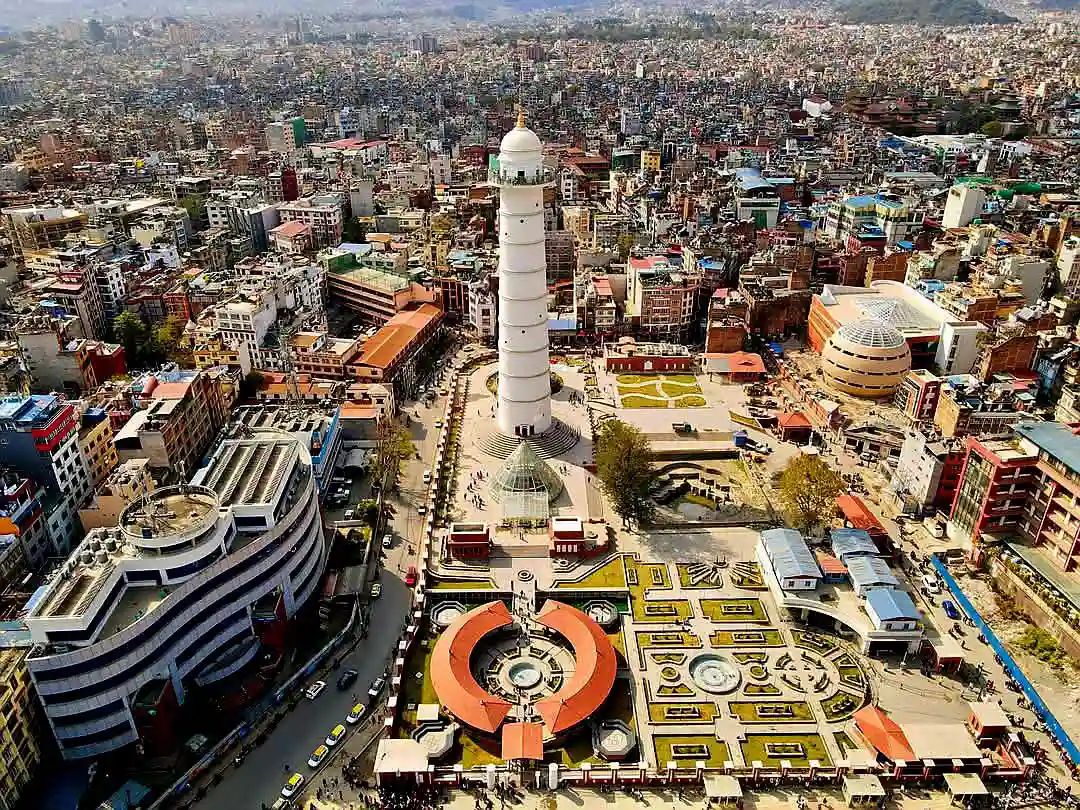
Standing 72 meters above the rooftops of Sundhara, Dharahara Tower Kathmandu is one of the few landmarks in Nepal’s capital that tells you, at a glance, exactly where you are. Locals still call it by its older name, Bhimsen Tower, and for good reason — it has collapsed and been rebuilt more than once in its nearly two-century history, most recently after the devastating April 2015 earthquake. The tower reopened fully to the public in September 2024 as a 22-storey structure with elevators, a viewing deck, a museum, and the preserved ruins of its predecessor standing quietly beside it as a memorial.
If you’re planning a trip to Kathmandu, chances are you’ve already got Dharahara on your shortlist — either because you want the panoramic view over the valley, or because the story of a tower that keeps falling down and rising again simply refuses to leave you alone. This guide covers everything a real visitor needs: current ticket prices, how to book online, opening hours, whether there’s an elevator, what the best time of day actually is for photography, and what’s changed since the tower’s dramatic rebuild.
Dharahara Tower is a 72-metre, 22-storey rebuilt landmark in Sundhara, central Kathmandu, open daily from 8:00 AM to 8:00 PM. Entry costs NPR 200 for Nepali citizens, NPR 500 for SAARC nationals, and NPR 1,000 for other foreign visitors. Tickets can be booked online at dharahara.gov.np or bought at the counter, and two elevators carry visitors to the 20th-floor viewing deck for 360-degree views of the Kathmandu Valley.
| Quick Fact | Details |
|---|---|
| Height | 72 metres (236 ft), same as the original |
| Floors | 22 storeys (including 2 basement levels) |
| Location | Sundhara, central Kathmandu |
| Opening hours | 8:00 AM – 8:00 PM daily, including public holidays |
| Elevator | Yes, 2 lifts, ~10 people each; 213-step spiral stairs also available |
| Viewing deck | 20th floor, 2.5-metre-wide open-air deck |
| Entry fee (foreign, non-SAARC) | NPR 1,000 |
| Entry fee (SAARC) | NPR 500 |
| Entry fee (Nepali citizens) | NPR 200 (50% discount for students, seniors, PWD) |
| Premises-only entry | NPR 50 |
| Online booking | dharahara.gov.np/book, paid via Khalti or IME Pay |
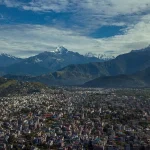
Dharahara isn’t just a viewpoint — it’s arguably the most tangible symbol of how Kathmandu responds to disaster. You’ll see the crumbled base of the original 2015 tower preserved right next to the new structure, a deliberate choice by planners to keep the memory of that earthquake visible rather than erasing it. Climbing to the top gives you a genuinely different perspective on the city: the tightly packed rooftops of the old town, the wide sweep of Tundikhel parade ground to the north, and on a clear winter morning, a hazy but unmistakable line of Himalayan peaks on the horizon.
For photographers, history buffs, and anyone who wants to understand Kathmandu’s relationship with earthquakes without visiting a museum exhibit, Dharahara delivers something most other city viewpoints in Kathmandu can’t: a direct, physical sense of resilience.
Dharahara’s story begins in 1832, when Bhimsen Thapa, then Nepal’s Mukhtiyar (roughly equivalent to Prime Minister), had it built under commission from Queen Lalit Tripurasundari. Standing around 61 metres tall with 11 storeys, it was — for its time — one of the tallest structures in the Kathmandu Valley, built primarily as a military watchtower. Soldiers were summoned to the nearby Tundikhel parade ground by bugles blown from its top floor.
The tower has been unlucky with earthquakes. An 1834 quake damaged it and it was repaired; a much larger 1934 earthquake destroyed it almost entirely, leaving only two of the original storeys standing, and it was rebuilt as a shorter, nine-storey structure by then-Prime Minister Juddha Shumsher Rana. That version stood for 79 years, becoming a fixture of postcards and school textbooks, before the catastrophic 7.8-magnitude earthquake of April 25, 2015 brought it down again — an event in which roughly 180 people lost their lives, since the tower was open to visitors at the moment it collapsed.
Reconstruction began in October 2018, with the foundation stone laid by then-Prime Minister K.P. Sharma Oli. The rebuilt tower was ceremonially inaugurated on April 24, 2021, though construction and finishing work continued for several more years. It finally opened fully to the public on September 19, 2024 — Nepal’s Constitution Day — initially for free, with paid entry introduced from November 24, 2024. Today, the new Dharahara stands at the same 72-metre height as its immediate predecessor, but with a completely different structural philosophy: reinforced concrete and steel engineered specifically to withstand future earthquakes, wrapped in a white facade that echoes the tower’s historic Mughal-influenced design.
Pro Tip: The ruins of the pre-2015 tower have deliberately been left in place beside the new structure. Don’t skip walking around this section — it’s a quiet, sobering counterpoint to the polished new building and adds real context to what you’re seeing.
Dharahara sits in Sundhara, right in the heart of old Kathmandu, close to Kathmandu Durbar Square, Ratna Park, and the New Road shopping district. It’s genuinely central — most travelers staying in Thamel can walk there in around 20 minutes, and taxis from anywhere in the city core rarely take more than 10–15 minutes barring traffic.
The tower’s footprint covers roughly 42.2 ropanis of land (about 2.1 hectares), and the surrounding complex includes a landscaped garden, a fountain, a food court, a small museum, an exhibition hall, and multi-level basement parking. Because it sits at low elevation in the valley floor rather than on a hilltop, Dharahara’s views are entirely a function of its own height rather than elevation gain — which is exactly why the viewing deck matters so much.
By taxi: The easiest option for most travelers. From Thamel, expect a fare of roughly NPR 300–500 depending on traffic; ask specifically for “Sundhara” or “Dharahara” as your destination.
On foot: From Thamel, it’s approximately a 20-minute walk south toward the Bagmati River area, following signs toward Sundhara Road. From Kathmandu Durbar Square, it’s closer to a 10-minute walk.
By local bus: Buses heading toward Ratna Park pass through the area; get off near Ratna Park and walk roughly 500 metres down Sundhara Road. Fares typically run NPR 20–50, though this option requires more patience and isn’t ideal if you’re short on time or unfamiliar with local routes.
By private car: If you’re driving from central Kathmandu, head south toward the Bagmati River, then turn onto Sundhara Road; the tower is visible from a distance once you’re in the area. Basement parking is available on-site (see the Parking section below).
Nearest landmark for orientation: Ratna Park and the General Post Office are both a short walk away, making Sundhara easy to find even without GPS.
As of the current fee structure (in effect since November 2024), here’s exactly what you’ll pay:
| Visitor Category | Entry Fee (NPR) |
|---|---|
| Nepali citizens | NPR 200 |
| Nepali students, senior citizens, persons with disabilities | 50% discount |
| SAARC nationals (India, Bangladesh, Bhutan, etc.) | NPR 500 |
| Foreign tourists (non-SAARC, including most Western travelers) | NPR 1,000 |
| Premises-only entry (no tower climb) | NPR 50 |
For commercial photography or videography inside the complex, separate fees apply (historically around NPR 1,000/hour for photography and NPR 5,000/hour for videography), so casual visitors snapping photos on their own phones needn’t worry — those charges are aimed at professional shoots and commercial productions.
Note on pricing changes: Entry fees at Dharahara have been adjusted more than once since the tower reopened, and management of the site was, as of early 2026, in the process of transitioning to Kathmandu Metropolitan City. Because of this, it’s worth double-checking current prices on the official booking site before your visit, especially if you’re traveling later in 2026 or beyond.
Booking ahead is genuinely useful here, since it lets you lock in a specific time slot and skip some of the counter queue.
If online booking feels like a hassle, or if you don’t have a Nepali payment method set up, you can simply buy tickets directly from the counter outside the tower — though during peak tourist season or weekends, expect a longer wait.
Dharahara currently operates 12 hours a day, from 8:00 AM to 8:00 PM, a schedule extended in mid-2025 from the original 10:00 AM–4:00 PM window in response to public demand. Importantly, the tower now stays open even on public holidays, which wasn’t always the case in its earlier operating phase (it was previously closed on Wednesdays). If you’re visiting during a major Nepali festival, it’s still worth confirming hours in advance, as management transitions and special events can occasionally affect the schedule.
Featured Snippet Answer: Dharahara Tower is open daily from 8:00 AM to 8:00 PM, including public holidays. Hours were extended from a previous 10 AM–4 PM schedule in July 2025 to accommodate growing visitor demand. Always confirm current hours on dharahara.gov.np before visiting, since site management has changed hands more than once.
Yes. As of the most recent confirmed updates, Dharahara Tower is fully open to the public with paid entry, functioning elevators, and an accessible viewing deck. The site has moved past its earlier “trial” phase (when entry was free and capped at 500 visitors per day) into full operational status, having welcomed well over 230,000 visitors since paid entry began. That said, because oversight of the tower is currently shifting from the federal Ministry of Urban Development to Kathmandu Metropolitan City, it’s sensible to check for any short-term closures tied to that transition before you finalize your itinerary.
Yes — this is one of the most searched practical questions about the tower, and the answer matters for families, seniors, and anyone who isn’t up for climbing over 200 steps. Dharahara has two elevators, each with a capacity of roughly 10 people, running to the upper floors near the viewing deck. A 213-step spiral staircase also winds through the tower for visitors who want the workout or simply prefer stairs — some travelers treat it as informal trekking-fitness practice.
Can you climb the New Dharahara Tower in Kathmandu? Yes, both by elevator and by stairs. Most visitors take the elevator up and, if they’re curious, walk down via the staircase to see the tower’s interior structure and informational displays along the way.
The rebuilt Dharahara has 22 storeys, including two basement levels used mainly for parking, a ground floor housing the museum and food court area, and upper floors leading to the 20th-floor viewing deck, a 2.5-metre-wide open platform that wraps around the tower for 360-degree views. This is a significant increase from the pre-2015 tower’s nine floors, and part of why the new structure — while the same overall height — feels noticeably more spacious inside.
This is the single most practical question for photographers and view-seekers, so here’s a direct answer.
Early morning (shortly after 8:00 AM opening) generally offers the clearest air, the fewest crowds, and the best odds of spotting distant Himalayan peaks on the horizon — visibility is almost always better before Kathmandu’s daytime haze and traffic pollution build up. If seeing the mountains matters to you, mornings during the drier months (October to February) are your best bet.
Late afternoon, roughly 90 minutes before closing (around 6:00–6:30 PM), is the better choice for photography lovers who want golden-hour light on the city’s rooftops and temple spires, plus the option to watch the sunset from the viewing deck. The trade-off is that afternoon haze can sometimes soften the mountain views, even if the city-level photography looks stunning.
Featured Snippet Answer: The best time to visit Dharahara Tower for city views is early morning, right after the 8 AM opening, when air clarity is highest and crowds are thinnest — ideal for spotting the Himalayas. For golden-hour photography of the Kathmandu skyline itself, visit in the last two hours before the 8 PM closing instead.
Weekdays vs. weekends: Weekdays are consistently less crowded than weekends, when the tower draws large numbers of domestic visitors and families. If your schedule allows it, a weekday morning is close to the ideal combination of good light, clear air, and minimal queueing.
The 20th-floor viewing deck at Dharahara is one of the most central and accessible panoramic viewpoints in Kathmandu proper, but it’s worth knowing how it compares to alternatives:
| Viewpoint | Type | Best For |
|---|---|---|
| Dharahara Tower (20th floor) | Man-made tower, city center | Convenient 360° city views without leaving central Kathmandu |
| Swayambhunath (Monkey Temple) | Hilltop temple | Elevated valley views combined with a major cultural/spiritual site |
| Nagarkot | Hill station, ~32 km from Kathmandu | Best sunrise Himalayan panoramas, requires a day trip |
| Chandragiri Hills (cable car) | Mountain viewpoint | Wider Himalayan range views, half-day excursion |
If your time in Kathmandu is limited to a day or two, Dharahara gives you a genuinely good valley view without the logistics of a hill excursion. If mountain views are your priority and you have an extra day, pairing a Dharahara visit with a sunrise trip to Nagarkot or Chandragiri rounds out the experience well.
Honestly, yes, and for reasons that go beyond the view. Several international visitors have noted in reviews that Dharahara isn’t yet a major fixture on the typical Western tourist circuit — it tends to draw far more domestic visitors than the likes of Durbar Square or Swayambhunath — which means you often get a less touristy, more locally textured experience. The mix of a modern engineering achievement, a genuinely moving earthquake memorial, and a central-city panoramic view makes it a strong half-day addition to a Kathmandu itinerary, particularly if paired with nearby historic sites.
One honest caveat worth mentioning: a small number of visitors have noted that the glass at the viewing area isn’t always spotlessly clean, which can slightly affect photo quality — a minor issue, but one that sets realistic expectations rather than overselling the experience.
The reconstruction project, awarded to Raman Construction Company Limited for approximately NPR 3.48 billion, took a notably long road: foundation laid in December 2018, ceremonial inauguration in April 2021, and full public opening only in September 2024 — meaning the “finishing” phase alone stretched over three years. Key engineering and design features include:
If you’re arriving by private vehicle or taxi with waiting time, parking is available on-site:
Beyond parking, the complex includes a small museum documenting the tower’s history and the 2015 earthquake, a food court for a quick meal or snack break, a landscaped garden and fountain area good for resting between the tower climb and further sightseeing, and clean, well-maintained public facilities. As mentioned earlier, oversight of the parking facility specifically is expected to shift toward Kathmandu Metropolitan City management, which has floated plans to eventually offer it as a free parking option for the busy New Road commercial district — worth watching if you’re visiting later in 2026.
“Bhimsen Tower” and “Dharahara” refer to the same landmark — Bhimsen Tower is simply the older, more historically rooted name, referencing Bhimsen Thapa, the tower’s original builder. If you hear locals or older guidebooks use “Bhimsen Stambha” or “Bhimsen Tower,” they’re pointing you to exactly the same location in Sundhara. Both names remain in everyday use, so don’t be thrown off if a taxi driver responds better to one than the other.
Visually, the new Dharahara retains the tall, cylindrical minaret profile of its predecessors, finished in a clean white facade with subtle carved detailing that nods to its historic Mughal-inspired design. It’s noticeably more modern in feel than the pre-2015 tower, with visible engineering upgrades like reinforced structural elements and a glass-fronted viewing deck near the top. Structurally it tapers slightly toward the summit, culminating in the bronze mast. Around its base, the contrast is striking: a pristine new structure standing beside the rubble and lower floors of the original tower, deliberately left as they were found after the 2015 earthquake.
| Feature | Pre-2015 Dharahara | New Dharahara (2024–present) |
|---|---|---|
| Height | 61 metres | 72 metres |
| Floors | 9 storeys | 22 storeys |
| Primary material | Brick, lime mortar (Vajra-Surki, Chuna) | Reinforced concrete and steel |
| Access | Stairs only | Two elevators plus a 213-step staircase |
| Earthquake resistance | Minimal by modern standards | Purpose-engineered seismic resistance |
| Additional facilities | Basic, limited public amenities | Museum, food court, garden, extensive parking |
| Viewing access | Balcony near top | Dedicated 20th-floor open viewing deck |
Dharahara’s original purpose was explicitly military. Built as a watchtower under Bhimsen Thapa — Nepal’s de facto military and political leader during a period of tension with the British East India Company — it allowed authorities to survey the valley and, more importantly, to summon soldiers quickly. Bugles sounded from the tower’s top floor were the signal for troops to assemble at Tundikhel, the parade ground just to the northeast. One historic signboard at the site even notes that the tower’s practice of summoning citizens for announcements was framed as demonstrating religious harmony across Hindu, Muslim, and Christian communities in the valley. Its height, at the time among the tallest structures in Nepal, also functioned as a visible symbol of Bhimsen Thapa’s authority and Nepal’s sovereignty during a period of geopolitical pressure.
Perhaps the most emotionally resonant part of a Dharahara visit isn’t the new tower at all — it’s what remains of the old one. After the April 25, 2015 earthquake struck at 11:56 AM local time, the tower collapsed within seconds, killing roughly 180 people who were on-site or nearby at the time, many of them tourists and locals who had climbed up just before the quake hit. Authorities made a deliberate decision not to fully clear the rubble but to preserve the tower’s remaining base as a memorial, standing directly beside the new structure. Walking this section is a quiet, sobering experience, and it’s worth setting aside a few extra minutes rather than rushing straight to the elevator queue.
Beyond time of day, the season you visit in matters too:
Dharahara holds genuine religious significance for many Nepali Hindus — the original tower housed a shrine dedicated to Shiva, and even today it’s common to see sacred threads tied to fences around the site during festivals like Dashain and Tihar. Visitors are welcome to observe respectfully; there’s no strict dress code for entering the tower itself, but modest clothing is appreciated, particularly if you plan to visit nearby temple sites like Kathmandu Durbar Square afterward.
Dharahara works well for almost every type of traveler passing through Kathmandu:
It’s less essential for travelers with very limited time who must prioritize UNESCO World Heritage sites like Swayambhunath, Pashupatinath, or Bhaktapur Durbar Square, though even then, Dharahara pairs naturally with a Kathmandu Durbar Square visit given the short walking distance between them.
8:00 AM – Arrive at Dharahara for opening; take the elevator up to the 20th-floor viewing deck for morning light and Himalayan visibility 9:00 AM – Walk the memorial ruins site and visit the small on-site museum 9:45 AM – Browse the food court or grab tea at a nearby café 10:15 AM – Walk to Kathmandu Durbar Square for temple and palace sightseeing 12:00 PM – Explore New Road or Ason Bazaar for shopping and local street food 1:00 PM – Return to Thamel for lunch and afternoon rest
| Item | Approx. Cost (NPR) |
|---|---|
| Dharahara entry ticket | 1,000 |
| Taxi from Thamel (one-way) | 300–500 |
| Snack at on-site food court | 200–400 |
| Optional parking (if driving) | 20/hour |
| Approximate total for a solo half-day visit | 1,500–2,000 |
Dharahara’s reconstruction has not been without controversy — some critics have questioned the cost of rebuilding a modern tower using significant public funds while thousands of 2015 earthquake survivors continued living in temporary shelters for years afterward. As a visitor, it’s worth engaging with the site thoughtfully rather than treating it purely as a photo backdrop: read the museum displays, spend time at the memorial ruins, and consider that your entry fee now contributes directly to the site’s ongoing maintenance and management.
1. What is Dharahara Tower and where is it located? Dharahara is a 72-metre, 22-storey rebuilt tower in Sundhara, central Kathmandu, originally constructed in 1832 and reconstructed after the 2015 earthquake.
2. How much does it cost for foreign tourists to enter Dharahara Tower? Foreign tourists from non-SAARC countries pay NPR 1,000 per person; SAARC nationals pay NPR 500.
3. Can I book Dharahara tickets online before arriving in Kathmandu? Yes, tickets can be booked at dharahara.gov.np/book using Khalti or IME Pay, up to 4 tickets per booking.
4. Is there an elevator to the top of Dharahara Tower? Yes, two elevators (each carrying about 10 people) run to the upper floors, alongside a 213-step spiral staircase for those who prefer to climb.
5. What are the current opening hours of Dharahara Tower? Dharahara is open daily from 8:00 AM to 8:00 PM, including public holidays.
6. What is the best time of day to visit for the clearest views? Early morning, shortly after opening, offers the clearest air and best Himalayan visibility; late afternoon offers better golden-hour photography light for the city itself.
7. How many floors does the new Dharahara Tower have? The rebuilt tower has 22 storeys, including two basement levels, with the main viewing deck on the 20th floor.
8. Is Dharahara Tower worth visiting for international tourists? Yes — it offers a central, uncrowded panoramic viewpoint plus genuine historical depth through its preserved earthquake ruins, though it’s still less touristy than sites like Durbar Square or Swayambhunath.
9. Can children visit Dharahara Tower? Yes, though children generally cannot be issued a ticket without an accompanying adult.
10. Is Dharahara Tower wheelchair or mobility-friendly? The elevator access makes the tower considerably more accessible than in the past, though visitors with significant mobility limitations should contact site management in advance to confirm current accessibility provisions.
11. What is the difference between Dharahara Tower and Bhimsen Tower? They’re the same landmark — Bhimsen Tower is the older historical name, referencing original builder Bhimsen Thapa, while Dharahara is the more commonly used contemporary name.
12. Are there discounts for students or senior citizens at Dharahara? Yes, Nepali students, senior citizens, and persons with disabilities receive a 50% discount on the standard local entry fee.
13. What happened to the original Dharahara Tower? It collapsed during the April 25, 2015 earthquake, killing approximately 180 people; its ruined base has been preserved as a memorial beside the new structure.
14. Can you see the Himalayas from Dharahara Tower? On clear days, particularly in the early morning during the October–February dry season, distant Himalayan peaks are visible from the viewing deck, though haze can obscure them at other times.
15. What else is there to do near Dharahara Tower? Kathmandu Durbar Square, New Road shopping street, Ranipokhari, Ason Bazaar, and Freak Street are all within easy walking distance.
Dharahara Tower Kathmandu earns its place on a Nepal itinerary not just for the view from its 20th-floor deck, but for what the whole site represents: a city that keeps rebuilding, quite literally, in the same spot it keeps falling down. Whether you’re booking your Dharahara tower ticket online via Khalti for a specific time slot, or simply walking up from Kathmandu Durbar Square on a whim, a couple of hours here gives you panoramic valley views, a working sense of Kathmandu’s history, and — if you time it for early morning on a clear winter day — a genuine glimpse of the Himalayas on the horizon.
If you’re planning a broader Nepal itinerary and want Dharahara built into a well-paced Kathmandu Valley sightseeing day alongside Durbar Square, Swayambhunath, or a half-day Nagarkot excursion, a local Nepal travel operator can help structure the logistics so you’re not wasting time in transit between sites.