KATHMANDU — In an event hailed by the mountaineering community as “nothing short of a miracle,” a 52-year-old Nepalese mountain guide has been rescued alive after going missing for seven days in the extreme high-altitude regions of Mount Everest.
Dawa Sherpa, a veteran guide from Okhaldhunga attached to the expedition company Himalayan Traverse, had been out of contact since May 29. He was discovered on Thursday morning, June 4, 2026, crawling through the snow near the Khumbu Icefall, just a 40-minute distance above Everest Base Camp.
Sherpa went missing during his descent from the summit phase while guiding a Polish climber. He was last seen at the “Yellow Band,” a prominent rock feature located above Camp 3 at an elevation of approximately 7,200 meters (23,622 feet). As the climbing season drew to a close and teams began dismantling routes, Sherpa became separated from his group.
The area spanning Camp 3, Camp 4, and the summit is widely designated as the “Death Zone” due to acutely low oxygen levels and freezing temperatures where human survival is typically limited to a few hours. Yet, Sherpa managed to survive an entire week without supplementary food, water, or severe weather shelter.
According to officials, Sherpa fought for survival by slowly descending the treacherous terrain on his own. He managed to seek temporary shelter in an icy crevice overnight and eventually scavenged minor food remnants at Camp 3 before continuing his descent toward safety.
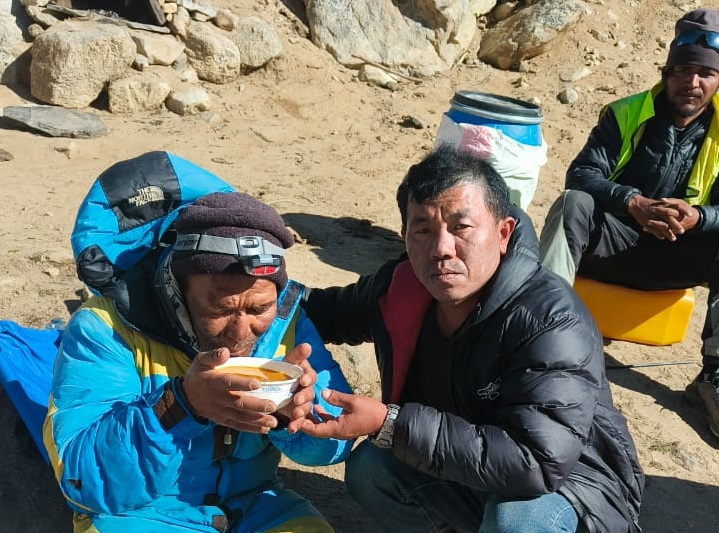
A specialized waste management and route-clearing crew from the Sagarmatha Pollution Control Committee (SPCC)—often referred to as “Icefall Doctors”—spotted Sherpa on Thursday morning. The team found him in critical condition, physically exhausted and crawling on his hands and knees. The clothes on his back were completely torn, indicating he had dragged himself a significant distance across the jagged ice.
The SPCC crew immediately provided emergency first aid, food, and water before taking turns carrying him down to Gorakshep. The rescue occurred less than 24 hours after an aerial search by a recovery helicopter on Wednesday failed to spot him.
From Gorakshep, a rescue helicopter airlifted Sherpa to Kathmandu, where he was admitted to HAMS Hospital for emergency treatment.
The news of Sherpa’s survival brought immense relief to his family, who had already given up hope of finding him alive. At the time of his rescue, his family had entered the second day of traditional funeral rites.
“We first heard that he was still alive on the local news,” his wife, Damu Sherpa, told reporters at the hospital. “We couldn’t believe it at first and had to ask for photos to be sent to confirm it was indeed him.”
Medical personnel at HAMS Hospital confirmed that while Sherpa is physically weak and suffering from severe frostbite on his extremities, his vital signs are stable, and he is able to speak slowly.
While the mountaineering community celebrates Sherpa’s survival, the incident has sparked scrutiny regarding safety regulations and rescue response times.
The Department of Tourism (DoT) announced plans to launch an official investigation into the disappearance and subsequent delay in reporting. Family members and community leaders have alleged that the expedition agency delayed organizing a formal search and rescue operation for over three days after Sherpa initially went missing.
“To survive for seven days at that altitude without support is a historical rarity,” said Nisha Thapa Raut, Director of the Department of Tourism. “While we celebrate this miraculous outcome, we will firmly investigate the operational timelines and safety management protocols of the expedition organizers involved.”